<?xml version="1.0" encoding="UTF-8"?>
<feed xmlns="http://www.w3.org/2005/Atom">
  <title type="text">Spokane Historical</title>
  <updated>2026-02-12T21:42:41+00:00</updated>
  <generator uri="http://framework.zend.com" version="1.12.20">Zend_Feed_Writer</generator>
  <link rel="alternate" type="text/html" href="https://spokanehistorical.org/"/>
  <link rel="self" type="application/atom+xml" href="https://spokanehistorical.org/items/browse?output=rss2"/>
  <id>https://spokanehistorical.org/</id>
  <author>
    <name>Spokane Historical</name>
    <uri>https://spokanehistorical.org</uri>
  </author>
  <link rel="hub" href="https://pubsubhubbub.appspot.com/"/>
  <entry>
    <title type="html"><![CDATA[ Duncan Gardens: Manito Park Tour]]></title>
    <summary type="html"><![CDATA[<img src="https://spokanehistorical.org/files/fullsize/479452d5968213ed985b3d80ea60cd92.jpg" alt="The Duncan Gardens" /><br/><p>John W. Duncan was the second park superintendent from 1910 to 1942.  The garden is now named for him.  It was his vision that created the gardens we see today.</p><p>Duncan came to Spokane from the Boston Park system and according to Aubrey L. White, former park board president, "he has been so successful that our parks are now nationally known."</p><p>If you look at the photos, you will see that the garden has had a variety of planting schemes, but the essential architecture has remained the same.The garden was designed in a classical European Renaissance style with bilateral symmetry, a central water feature, and geometrical planting beds.</p><p>"I do not suppose there is a single thing in our city that has been taken in as many snap shots as the sunken gardens," wrote Aubrey L. White in 1928.  This has not changed.  Every year volunteers help the Friends of Manito plant the Duncan Garden that attracts several visitors each year. </p><p><em><strong><a href="https://spokanehistorical.org/items/show/25">For more (including 6 images, 1 audio file,&#32;&amp;&#32;1 video) view the original article</a></strong></em></p>]]></summary>
    <published>2011-05-23T00:48:15+00:00</published>
    <updated>2026-02-12T21:42:31+00:00</updated>
    <link rel="alternate" type="text/html" href="https://spokanehistorical.org/items/show/25"/>
    <id>https://spokanehistorical.org/items/show/25</id>
    <author>
      <name>Tracy L. Rebstock</name>
    </author>
  </entry>
  <entry>
    <title type="html"><![CDATA[ Ice Skating in the Little Spokane River Valley<br />
]]></title>
    <summary type="html"><![CDATA[<p><strong><em>In a time when distractions were less a part of our daily lives, outdoor recreation was a top priority for most folks in the Spokane area.  Ice skating was one of the most popular activities outdoors, and the Little Spokane River valley was the destination of choice.</p></strong></p><img src="https://spokanehistorical.org/files/fullsize/0f679ee6c552a67b140cd240c9ab53e7.jpg" alt="Skating at Wandermere" /><br/><p> Before Wandermere Golf Course was even in existence, the lake on the property was known for its winter pastime of ice skating.  As far back as the late 1800s when Francis H. Cook owned the property and continuing through the ownership of Benjamin Laberee, the ice at Wandermere was a destination for wintertime recreation.  Eventually, with the facility's purchase by Robert C. Ross and A. L. Doran, the soon-to-be Wandermere Golf Course, continued the traditions of the past.  Ice skating was the business's first revenue generator as the clubhouse construction was ongoing for the newly planned multi-sport activity center north of Spokane. </p><p>In the fall of 1930, ice skating was all the rage in the Spokane area, as well as nationwide.  It was a different era, before other distractions, such as the television, and easy access to the automobile and other forms of recreation.  People ventured outside year-round and what better way to spend an afternoon or an evening than to ice skate in the great outdoors?  Recreational skating was not hard to come by during this era.  Most all major lakes and ponds in the Spokane vicinity froze over, and before long the ice was filled with people of all ages. Liberty Lake, Cannon Park, Manito Park, and Newman Lake were all popular destinations.  As far back as the late 1800s, Spokane residents enjoyed ice skating activities.  Liberty Park was one of the first city-run ice rinks that boasted an eight-acre pond to be used for winter recreation and according to the Spokesman-Review in 1889, “Properly cared for by the city, it will be a better skating pond than the young people of Spokane were ever able to get in this vicinity before. A pretty little rustic house will be erected near the lake and provided with a large fireplace. Here a caretaker will be in charge next winter, and the skaters come to do their skates or rest from their exertions.”</p><p>Around the area of the Little Spokane River, ice skating was not uncommon.  At one point in the early 1930s, there were three outdoor rinks within a two-mile radius.  Wandermere competed with Greenleaf Park (present Pine River Park) and Silas Cook’s outdoor rink just to the north of the golf course property.  All three of these facilities needed to stay ahead of the others in amenities and condition of the ice.  Skating was a very competitive business to gain customers that hopefully returned for seasons to come.  Night skating, music, the size of the rink, and concessions were big draws, and all three venues did their best to accommodate their clientele. </p><p>In September of 1930, with the purchase of the property on the Little Spokane River, the first order of business at Wandermere was to construct the clubhouse.  To generate revenue during this time, Ross and Doran continued to operate the skating facility on the man-made lake.  During the first winter of operation, skating was the main business.  Advertisements in the local paper boasted Wandermere as the “finest rink in the Northwest.”  On New Year’s Day of 1931 skaters could enjoy sandwiches, a heated clubhouse, and music as they twirled around the ice for an admission price of twenty-five cents, day or night.  The Rose Bowl was even broadcast over the P.A. system so that people could listen to the Washington State Cougars play in their first Rose Bowl game against the Alabama Crimson Tide.</p><p>On Christmas day of 1931, Wandermere hosted a winter carnival that brought multiple events to the ice. Skaters were able to use the clubhouse to change shoes and grab a light lunch before heading out to the activities slated for this winter sports extravaganza.  The list of events included races from a quarter mile for kids up to twelve and a mile race for kids fourteen to eighteen years old. Adults could participate in the open mile race for men and the open half-mile for women.  “Fancy” skating exhibitions and a barrel jumping contest rounded out the day’s activities. Judges for all the races were W. J. Kommers, chairman of the Spokane Figure Skating Club, John T. Little, owner of a prominent sporting goods store in town, and businessman, Claude LaLone. After the day’s events, spectators and participants were encouraged to gather at the clubhouse to enjoy the fireplace while listening to music on the radio. </p><p>The Christmas day carnival was such a success that the crew at Wandermere repeated the activities on New Year’s Day.  This time high school team relay races were added to the program, with a silver trophy cup donated by Bill Hatch Sporting Goods as the grand prize for the winners.  Listed on the carnival program were prizes including skating socks, candy, cigars, New Year’s dinner tickets, and other awards. </p><p>Winter recreation on Wandermere Lake continued into the 1970s when the activity seemed to fade away from interest.  Occasional snowmobile races and hockey practices by the Spokane Comets, Spokane Jets and other winter activities dotted the calendar over the years, but the frozen pond at Wandermere had seen its heyday. Coupled with the increased liability and the competition with other activities, the business of skating ceased.  Although ice skating is still a popular attraction in Spokane, the lakes and ponds around the area gradually prohibited public skating, and the interest turned to indoor rinks and modern refrigerated facilities.</p><p><em><strong><a href="https://spokanehistorical.org/items/show/936">For more (including 12 images&#32;&amp;&#32;1 audio file) view the original article</a></strong></em></p>]]></summary>
    <published>2022-12-21T21:38:45+00:00</published>
    <updated>2026-02-12T21:42:40+00:00</updated>
    <link rel="alternate" type="text/html" href="https://spokanehistorical.org/items/show/936"/>
    <id>https://spokanehistorical.org/items/show/936</id>
    <author>
      <name>Ty A. Brown</name>
    </author>
  </entry>
  <entry>
    <title type="html"><![CDATA[ The Bing Crosby Theater]]></title>
    <summary type="html"><![CDATA[<img src="https://spokanehistorical.org/files/fullsize/8c6454358e18b9f37c2d95c34cc060c9.jpg" alt="[Untitled]" /><br/><p>The Clemmer Theatre, now known as the Bing Crosby Theater, was built in 1915 by Edwin W. Houghton.  The building was first used as an 800-seat movie theater.  The theater was very luxurious with painted murals, 1600 lights, and a grand Kimball organ.  In 1929, the building was sold to Universal and renamed Audian.  A few years later the theater was once again resold, and it became the State Theater.  </p><p>The Metropolitan Mortgage Company bought and refurbished the building in 1988, and The Metropolitan Theater of Performing Arts, or The Met, became the new name. When the Metropolitan Mortgage Company went out of business in 2004, Mitch Silver purchased and renamed the property the Bing Crosby Theater.  This was in response to a local historian who realized the city needed a landmark to commemorate their most famous entertainer, Bing Crosby.  The theater is also recognized on the National Register of Historic Places.</p><p>Bing Crosby played some of his earliest musical engagements here. In the summer of 1925, Bing Crosby and Al Rinker were the only two remaining members of their previous band, called the Musicaladers.  They were hired at the Clemmer Theatre, as part of a group of entertainers responsible for the intermission and between movies show.  The group wrote their own scripts, built their own stage sets, and chose what songs would be appropriate.  The idea was to build their mini production around the theme of the movie that would be playing.</p><p>For five months, Bing Crosby was free to spread his wings and explore his acting and singing skills.  One of the songs Al and Bing sang was "California Here We Come."  Two months later, the two men went on a journey that would lead them straight to Hollywood.</p><p><em><strong><a href="https://spokanehistorical.org/items/show/73">For more (including 7 images) view the original article</a></strong></em></p>]]></summary>
    <published>2011-06-07T01:17:42+00:00</published>
    <updated>2026-02-12T21:42:31+00:00</updated>
    <link rel="alternate" type="text/html" href="https://spokanehistorical.org/items/show/73"/>
    <id>https://spokanehistorical.org/items/show/73</id>
    <author>
      <name>Billie Slick</name>
    </author>
  </entry>
  <entry>
    <title type="html"><![CDATA[&quot;Dutch&quot; Jake Goetz, Harry Baer and the Coeur d&#039;Alene Hotel]]></title>
    <summary type="html"><![CDATA[<img src="https://spokanehistorical.org/files/fullsize/bdb96f0c4a4c712b87df983af02e1dfa.jpg" alt="Dutch Jake Getz original saloon, the Frankfurt Project on right." /><br/><p>"Dutch" Jake Goetz and his partner Harry Baer embodied the gold rush and pioneer attitude.  After receiving two hundred thousand dollars in 1888 for their role in discovering the Bunker Hill mine, Dutch and Baer moved to Spokane Falls.  There the partners constructed a hotel saloon called the Frankfurt Project, named after Goetz's German birthplace.  The Saloon was completed in 1888 and burnt down in the great Spokane fire of 1889.  After the fire, the Frankfurt Block was included in a list published in the New York Times among the more important buildings lost in the Spokane fire.</p><p>Dutch and Baer were not deterred by the fire, in fact after their establishment had burned, they erected a large tent to serve as their temporary housing while they maintained operations and raised money.  In 1894 the Coeur d'Alene hotel was built.  </p><p>The Coeur d'Alene Hotel was described as the greatest variety, greatest extravagance, and greatest overall place in Spokane by Jim Wardner.  Jim Wardner had a part in the Bunker Hill mine, was the namesake of Wardner, ID and traveled extensively between Arizona, California, Utah, Wisconnsin and Washington following the mining booms.  Wardner marveled at the use of an electronic Keno game, that kept the game square, and other gambling activities such as Roulette and Stud Poker.  Aside from gambling the Coeur d'Alene Saloon had multiple bars, lunch counters and lodging for its guests.  The Hotel also was home to a theatre, a dance hall, Turkish bath and the finest whiskey.  Jim Wardner explained:</p><p>"A person can get anything he wants in this place of business - drink, bath, meal, bed, shave, go to the theater, dance hall or gambling room."</p><p>The building was heated by steam and lit by gas and electricity.  Although Dutch is admittedly running a casino, his moral standards are praised by Jim Wardner, who explains that Jake encourages moderation by his guests in all of his many amenities.  Goetz is also described as a philanthropist as it was said at the Coeur d'Alene Hotel that even the homeless could come in for a meal, rest and a bath at no charge.  Goetz was described as a fair employer as well, paying his employees an average of four dollars per day while spending $576 per day on his combined staff salary.  It is no doubt that the Coeur d'Alene Hotel was a busy and exciting place near the turn of the century.</p><p><em><strong><a href="https://spokanehistorical.org/items/show/165">For more (including 5 images&#32;&amp;&#32;1 video) view the original article</a></strong></em></p>]]></summary>
    <published>2012-05-31T22:55:05+00:00</published>
    <updated>2026-02-12T21:42:32+00:00</updated>
    <link rel="alternate" type="text/html" href="https://spokanehistorical.org/items/show/165"/>
    <id>https://spokanehistorical.org/items/show/165</id>
    <author>
      <name>Zachary Wnek</name>
    </author>
  </entry>
  <entry>
    <title type="html"><![CDATA[&quot;From This Earth&quot; Northwest Mining Association Statue]]></title>
    <summary type="html"><![CDATA[<img src="https://spokanehistorical.org/files/fullsize/b36293c3d5897888019329a92420dd73.jpg" alt="Statue." /><br/><p>Spokane artist Glenn Emmons was the artist chosen by the Northwest Mining Association to sculpt what Spokesman Review writer Lorie Hutson dubbed, the "larger-than-life bronze statue" that they donated to Spokane.  According to Hutson, "he carefully researched the details for each of his sculptures.  He went to the Hecla Mining Co's mines in Silver Valley to study miners at work and their equipment for the bronze."  The statue depicts a hard-rock miner holding a jackleg drill against rock face, checking the quality of the ore that he's extracting.  This is Emmons' most prominent sculpture in Spokane.  </p><p>This statue was commissioned by the Northwest Mining Association, in celebration of their centennial anniversary in 1995.  The NWMA was founded in 1895 in Spokane, Washington as a non-profit, non-partisan trade association.  The association soon grew to support the mining industry in Alaska, Idaho, Oregon, Montana, Washington, Alberta, and British Columbia.  Their main purpose is to support and represent the mining and smelting interests in the U.S. and Canada and consider themselves "the national voice for exploration and access to public lands."  Today they monitor and interpret local, state, and national legislation that impacts the mining industry.  They also consider creating and dispersing mining education materials to federal and state agencies, the public, and international business communities as part of their purpose.  Committee activities, referrals, and their annual convention are the platforms they use to accomplish their purposes.  </p><p><em><strong><a href="https://spokanehistorical.org/items/show/207">For more (including 8 images&#32;&amp;&#32;1 audio file) view the original article</a></strong></em></p>]]></summary>
    <published>2012-06-13T07:06:02+00:00</published>
    <updated>2026-02-12T21:42:32+00:00</updated>
    <link rel="alternate" type="text/html" href="https://spokanehistorical.org/items/show/207"/>
    <id>https://spokanehistorical.org/items/show/207</id>
    <author>
      <name>Allie Todd</name>
    </author>
  </entry>
  <entry>
    <title type="html"><![CDATA[&quot;Hole-in-the-Ground:  Remote, Secluded - Intriguing!&quot;]]></title>
    <summary type="html"><![CDATA[<img src="https://spokanehistorical.org/files/fullsize/b9380d616319a64e424fdffe92fc4649.jpg" alt="Gazing over 1,000 acres of pasture land, circa 1900." /><br/><p>Welcome to Hole-in-the-Ground, where you will notice one of the most peculiar geological formations in the region.   As part of the channeled scablands, Hole-in-the-Ground was created by the powerful flood waters of glacial Lake Missoula some 15,000 years ago.  The torrents carved coulees, valleys and gorges through the basalt rock of the region, leaving behind the immense walls surrounding enormous trenches.  But these geological formation of the region can also be explained in another way. </p><p>According to Palus tribal legend, Hole-in-the-Ground was the home of Beaver during the "time of the Animal People."  Armed with spears, the five Wolf Brothers ambushed Beaver as he resided peacefully at his lodge.  An epic battle ensued, which consequently formed the curious geography of Southeast Washington.  During the fight, Beaver ripped and "chewed-out" nearby Rock Lake and as he clawed his way towards the Snake River Valley, his beating tail created the various small waterfalls along the Palouse River.  Beaver was eventually killed by the Wolf Brothers and, in the throes of death, he carved-out the sheer cliffs of Palouse Falls.  Beaver's heart turned to stone as the giant creature collapsed at the confluence of the Snake and Palouse rivers.  His remains were transformed into the region's various tribes, but the Palus were said to have "sprung from his heart."  For the Palus, Hole-in-the-Ground is not just an interesting sight to behold, it is at the forefront of creation.</p><p>The natural barriers provided by the massive stone walls, along with the fertile, 1,000 acre valley below, makes for a great livestock and horse corral, especially for the region's cattle rustlers.  In the 1870s and 1880s, the Masterson Gang, a notorious group of rustlers and thieves led by "Big Bill" Masterson, used Hole-in-the-Ground as their main rendezvous point and corral.  The gang raided ranches as far as Montana and Oregon, bringing back as much as 500 horses in a single trip.  The herds were rested here, grazing in the lush grassland valley for a few days before they were driven again to be sold - and always at a profit.  Sometimes, the herds were sold back to the same ranchers the gang stole them from.  The gang was eventually foiled by Hole-in-the-Ground homesteaders Henry Jones and Luke Rawls.  Rawls, who was deputized, successfully infiltrated the gang and with the aid of Jones, was able to arrest Masterson in the Spokane Valley after returning from a trip to "fetch some horses" in Montana. </p><p><em><strong><a href="https://spokanehistorical.org/items/show/424">For more (including 5 images) view the original article</a></strong></em></p>]]></summary>
    <published>2014-05-01T07:21:14+00:00</published>
    <updated>2026-02-12T21:42:35+00:00</updated>
    <link rel="alternate" type="text/html" href="https://spokanehistorical.org/items/show/424"/>
    <id>https://spokanehistorical.org/items/show/424</id>
    <author>
      <name>Robert M. Lambeth</name>
    </author>
  </entry>
  <entry>
    <title type="html"><![CDATA[&quot;The Big Blowup:&quot; The 1910 Fires and their Aftermath]]></title>
    <summary type="html"><![CDATA[<p>The summer of 1910 was hot and dry in the northwestern United States. And on August 20-21 the nation would feel the fury and reach of nature's wrath.</p><p>Fires on the scale of 1910's were not unheard of at this time. In 1825, upwards of 3.5 million acres in the settled Northeast succumbed to fires, while in 1871, Northeastern Wisconsin witnessed the obliteration of 1.5 million acres, 1,000 deaths, and 16 towns. However, what made the fires in Idaho, Montana, and Washington unique was the fact that they originated far away from civilization, thus making containment tactics much more arduous.</p><p>During the summer of 1910, multiple fires broke out, including: Bean Creek Fire, Big Creek Fire, Clearwater Fires, Forty Nine Meadows Fire, Iron Mountain Fire, Lakeview Fire, Loop Creek Fire, Lower Clark Fork Fires, Mineral County Fires, Placer Creek Fires, St. Maries Fire, St. Joe Fire, Setzer Fire, and Trout Creek Fire. The worst fires surrounded Wallace, ID. On August 20, gale force winds reaching 70 mph pushed the fires across the parched earth into one another, forming the "Big Blowup," also known as the "Big Burn."  </p><p>This being a period of high immigration, many immigrants were recruited to combat the blazes. Men were pulled off the streets and out of saloons, and were even accused of setting fires in order to stay employed. The fire season was so severe many of the Northwest units of  the U.S. Army were mobilized to help, along with mining and logging workers who were accustomed to fighting fires.</p><p>After the fire died out, official reports estimated 1,736 total fires burned more than 3 million acres of private and federal land. In comparison, wildfires throughout the nation consumed roughly 5 million acres in 1910 altogether. The 1910 flames scorched an estimated 7.5 billion board feet of timber and at least 85 people were killed. Several small towns were completely decimated, and one-third of Wallace was destroyed. Smoke from the fires reached New England and San Francisco, and soot traveled all the way to Greenland.</p><p>The Big Blowup occurred only five years after the establishment of the U.S. Fire Service (U.S.F.S.). Many of the men who were involved in the 1910 fires would earn high positions in the U.S.F.S. in subsequent years. This was the catalyst for U.S.F.S. wildland fire suppression policies, which still influence fire prevention and management around the world today.   </p><p><em><strong><a href="https://spokanehistorical.org/items/show/458">For more view the original article</a></strong></em></p>]]></summary>
    <published>2014-07-01T19:22:36+00:00</published>
    <updated>2026-02-12T21:42:35+00:00</updated>
    <link rel="alternate" type="text/html" href="https://spokanehistorical.org/items/show/458"/>
    <id>https://spokanehistorical.org/items/show/458</id>
    <author>
      <name>Caitlin M. Shain </name>
    </author>
  </entry>
  <entry>
    <title type="html"><![CDATA[&quot;The World&#039;s Largest Stage&quot;<br />
: Spokane&#039;s Golden Age Auditorium Theater]]></title>
    <summary type="html"><![CDATA[<p><strong><em>It was the "crown jewel" of a small town that had burned to the ground just one year before...</em></strong></p><img src="https://spokanehistorical.org/files/fullsize/d2df269d32c5aafe4be2c3767512ed3e.jpg" alt="The Auditorium Theater" /><br/><p>In 1878 just fifty-four citizens called Spokane home, including two young entrepreneurs who would leave a mark on the city.  John Browne and Anthony Cannon made great fortunes in real estate and business and became Spokane's first millionaires. In 1889 they began construction on the magnificent Auditorium Theater, which would become the center of Spokane's civic and cultural life. </p><p>Located on the corner of Main and Post, where present day Riverpark Square now stands, the Auditorium Theater was still under construction when the Fire of 1889 left Spokane's central business district in ruins.  When construction was complete in 1890, the immaculate five story red brick building became one of the finest theaters west of the Mississippi.  Before construction began, Cannon and Browne visited Chicago to see what was then the largest theater in the country,  the Chicago Auditorium.  To rival Chicago, builders were instructed to go "one foot wider and one foot deeper" on the Spokane Auditorium.  From 1890 until the construction of the Hippodrome Theater in New York in 1914, the Auditorium in Spokane was the largest theater in America.  </p><p>No expense was spared in the construction.  Granite was taken from the base of Mt. Spokane to complete the foundation.  Inside, were 17 dressing rooms and a "box office vestibule (lit) by stained glass windows."  Atop the building stood a large gold-plated statue of Thalia,  Goddess of Music.  The Auditorium drew acts from all over the world. Sarah Bernhardt, Alma Gluck, Anna Held and Al Jolson, performed on the stage. Jolson appeared in 1917 while a young Bing Crosby watched from his seat.</p><p>Several factors contributed to the demise of the Auditorium Theater.  Browne and Cannon went bankrupt, World War I and the Great Depression happened, and the rise of motion pictures overshadowed the glory days of the live theater. In 1934, the building was sold and the new owners promptly had it razed.  In its place stands a Payless Drug Store.  </p><p>The "world's largest stage" remained a fond memory for many Spokanites who were alive to experience it during its time.  Old Bill Wallace, who once managed the theater came by to see the "old stage ripped apart" on that fateful day in 1934.  Unable to watch any longer, Old Bill simply "walked away" and "let her go."</p><p><em><strong><a href="https://spokanehistorical.org/items/show/625">For more (including 2 images) view the original article</a></strong></em></p>]]></summary>
    <published>2016-03-19T05:04:00+00:00</published>
    <updated>2026-02-12T21:42:37+00:00</updated>
    <link rel="alternate" type="text/html" href="https://spokanehistorical.org/items/show/625"/>
    <id>https://spokanehistorical.org/items/show/625</id>
    <author>
      <name>Tara Justine</name>
    </author>
  </entry>
  <entry>
    <title type="html"><![CDATA[“She Said She Had Always Wanted to Be a Whore”: The Unusual Divorce of W.P. and Kate Horton]]></title>
    <summary type="html"><![CDATA[<p><strong><em>This couple endured what could possibly be the shortest marriage in frontier Washington history—all because one person chased their lifelong dream. </em></strong></p><img src="https://spokanehistorical.org/files/fullsize/16b4727cd9ef9504796646cddd407cb2.jpg" alt="[Untitled]" /><br/><p>Kate, a young, blushing bride, married W.P. Horton on September 21, 1861 in Walla Walla County in Washington Territory. W.P. promised “to be to her a good, kind, faithful, and affectionate husband,” and Kate “to make him a kind, faithful, and affectionate wife.” This is not how things turned out. </p><p>According to court testimony, the very day after the wedding, Kate Horton began “disregarding her duties and obligations as the wife,” and initiated a series of quarrels featuring abusive and insulting language towards her new husband.</p><p>According to Mr. Horton, his new wife only married him to get away from her mother. What she really wanted was to “go away and reside in a house of ill-fame." He tried to talk her out of this rash course of action, but Kate replied that "she had always wanted to be a whore and that she would be one.” </p><p>A few days later, Kate left for a dance hall and warned W.P. that he should not follow, presumably because she would be fulfilling her desire to become a prostitute. </p><p>On September 30th, nine days after the wedding, W.P. Horton made his way to the courthouse. Mrs. Horton was issued a summons, but court records show that she was not present at the time the case was heard. The divorce was granted that same day, which was very uncommon for cases of abandonment which normally required a year waiting period. </p><p>This was perhaps because of W.P. Horton's standing in the community. The next year, he was elected County Recorder and soon he was a Justice of the Peace himself, granting a divorce for Ned and Mary Clough in 1862. A few conclusions can be made about Mr. and Mrs. Horton’s divorce— it could have been granted quickly due to his influence and connections in Walla Walla County, the very short duration of their marriage, or additional knowledge that the presiding judge may have had.   </p><p>This is not the last we heard of Mr. Horton. He remarried about a year after his divorce, had children, and continued on with his life, eventually ending up in Whitman County. Mrs. Horton is not mentioned again in either newspaper articles, marriage records, or court records, and she vanishes without a trace.</p><p><em><strong><a href="https://spokanehistorical.org/items/show/742">For more (including 2 images) view the original article</a></strong></em></p>]]></summary>
    <published>2017-12-10T03:23:41+00:00</published>
    <updated>2026-02-12T21:42:39+00:00</updated>
    <link rel="alternate" type="text/html" href="https://spokanehistorical.org/items/show/742"/>
    <id>https://spokanehistorical.org/items/show/742</id>
    <author>
      <name>Jen Hughes</name>
    </author>
  </entry>
  <entry>
    <title type="html"><![CDATA[“Uncle Dan” Drumheller, Spokane’s beloved Murderer?: How a Spokane icon got away with murder--perhaps?]]></title>
    <summary type="html"><![CDATA[<p><strong><em>Charged with the Murder of an Indian man in 1883, Dan Drumheller was never found guilty—but there's more to the story than meets the eye. </em></strong></p><img src="https://spokanehistorical.org/files/fullsize/21e35eafaf3854f73e6653e9cd312b81.jpg" alt="&quot;Riverside Avenue in Stagecoach Days&quot;" /><br/><p>Daniel Drumheller, A pioneer of the Northwest and early Mayor of Spokane was perhaps one of Washington’s most iconic pioneers. Traveling across the plains from St. Joseph, Missouri, all the way to Sacramento, California, at age 14 in 1854, “Uncle Dan” Drumheller had already seen more of the new world than most kids would ever imagine seeing.</p><p>Drumheller was an adventurous young man, and luck was often on his side. After arriving in Sacramento, young Dan quickly became a full-time cowboy in northern California and eventually eastern Washington. He fought in the Pyramid Lake Indian War and allegedly served in the Pony Express covering a section known as the Carson Sink in Nevada, a notoriously dangerous stretch of “road.”</p><p>In 1860, at the ripe old age of 20, Dan decided it was time to move his roots to Walla Walla country. There he began to run sheep and cattle, and provided meat to a rapidly growing white population. In 1880 he made his way north to the pioneer village of Spokane Falls, becoming one of its earliest and most prosperous citizens.</p><p>Sometime shortly after the construction of the first bridge across the Spokane river in 1883, an apparently inebriated Indian man thought it would be funny to spook Drumheller and his sheep while Drumheller was crossing the bridge.  An enraged Drumheller struck the Native man with a stick, and the Indian left and returned with a gun. At that point, a police officer intervened and arrested the Indian, whose name is not given in any of the surviving accounts.</p><p>The Indian was placed in the town's makeshift jail, a rude timber structure with wide gaps between the logs. Like most prisoners in the unsecured and unguarded jail, he was chained to a large rock to prevent escape and left for the night. </p><p>The next morning it was discovered that the man had been shot. "Atrocious! A Dastardly Deed!" cried The Spokane Falls Review. It was reported that the killer had place a stub of candle on one of the logs and shot the Indian with a shotgun. </p><p>A week later, the Review reported that the wounded man was in pain and dying. “There is no one in this community who excuses the crime,” the paper said. An update at the end of the article read, “P.S. We understand that the Indian died Friday evening.” </p><p>Suspicion immediately fell on Drumheller as the possible murderer.  Even before the victim died, it was reported that "Friday evening Mr. Dan Drumheller was arrested on a warrant sworn out by an Indian named Lewis, and released on his own recognizance. Of course, no one believes that Drumheller was implicated in the shooting, but as he struck the man on the bridge the Indians have an idea that he must have desired the death of the prisoner."</p><p>Drumheller was quickly acquitted of the murder; a report on the proceeding claimed that: “A number of witnesses were examined but nothing new was elicited.”</p><p>Did Dan Drumheller murder the Indian man? We cannot say for sure. This brief run-in with the law in no way slowed the rise of Daniel Drumheller.  He build a slaughterhouse on the northern edge of the growing city at a site that today is known as Drumheller Springs.  One of the largest cattle ranchers in Eastern Washington, he had a herd of as many as 14,000 cattle. He organized the Traders National Bank in 1885, which eventually became a part of Seattle-First National Bank. Drumheller was elected  Mayor of Spokane in 1891. </p><p>In the early 20th century, an elderly Dan Drumheller was a beloved reminder of Spokane's frontier past. He was often a participant in parades and ceremonies, and in the 1910s he told his life story to a newspaperman, whose columns about Drumheller were combined into a popular book, Uncle Dan Drumheller Tells Thrills Of Western Trails In 1854.  </p><p>When he died in 1925, Daniel Drumheller left an estate of $118,000 to his seven children. In the newspapers, he was lauded as "one of the real pioneers of the Inland Empire." But no one ever mentioned that time in 1883, when he was charged with murdering an Indian man.</p><p><em><strong><a href="https://spokanehistorical.org/items/show/878">For more (including 2 images) view the original article</a></strong></em></p>]]></summary>
    <published>2020-12-11T00:02:58+00:00</published>
    <updated>2026-02-12T21:42:40+00:00</updated>
    <link rel="alternate" type="text/html" href="https://spokanehistorical.org/items/show/878"/>
    <id>https://spokanehistorical.org/items/show/878</id>
    <author>
      <name>Jackson Gospodarek</name>
    </author>
  </entry>
  <entry>
    <title type="html"><![CDATA[“We’re not invisible”: Community Center Supports Urban Indians]]></title>
    <summary type="html"><![CDATA[<p><strong><em>Frustrated by rising unemployment and the lack of Indigenous recognition, Spokane’s Urban Indian population constructed their own place of cultural and community involvement.</em></strong></p><img src="https://spokanehistorical.org/files/fullsize/c2db16a9a989273838841836dd640c18.jpg" alt="[Untitled]" /><br/><p>Founded by members of the American Indian Movement (AIM) on June 12, 1967, Spokane’s American Indian Community Center was formed in response to the social and economic turbulence experienced by Indigenous peoples. As more Natives left the reservations in search of employment, the community center— originally located on 1007 N Columbus St—helped new arrivals find stability in a city where urban Indians were a distinct minority. </p><p>“We [needed] to show that not all Indians [were] riding around on horseback with feathers in their hair,” said Bert L. Peters, director of the Center in 1969; to do this, they worked to involve “the Spokane community in several projects…to help the Indian reach his rightful place in society.”</p><p>Hoping to foster pan-Indian relations, the center aided multiple native nations throughout the eastern Washington region and beyond—including, among others, the Spokane, Coeur d’Alene, Northern Cheyenne, Blackfeet and the Confederated Tribes of the Colville Reservation. While they were considered a small population, estimated at 2,400 in 1967, Spokane’s urban Indian community experienced rapid-growth during the 1960s.                                                       </p><p>“Many people…wonder why the Indians leave the reservations for the cities,” said Peters, “they are forced to because conditions on the reservations are far worse than they are in the city.” But with these swelling numbers came the realization that many Native Americans from reservations had little preparation prior to relocation.</p><p>In response to the growing needs of urban Natives, the center sponsored events and programs including job fairs to help adults find employment opportunities in Spokane. They also advocated for self-determination by promoting vocational schooling and cultural events.</p><p>This dedication to supporting Indigenous peoples continues to this day; the community center—now found at 801 E 2nd Ave—still plays a vital role as a socializing-hub for urban Indians in the Spokane area. “There’s a lot of Natives here that are smart—that are educated; they know their people [and] they know what it takes to serve [their] people,” said Lux Devereaux, Executive Director of the center. “We’re in this whole thing together—don’t leave us out. We’re not invisible.”</p><p><em><strong><a href="https://spokanehistorical.org/items/show/804">For more (including 2 images) view the original article</a></strong></em></p>]]></summary>
    <published>2019-03-07T11:15:01+00:00</published>
    <updated>2026-02-12T21:42:39+00:00</updated>
    <link rel="alternate" type="text/html" href="https://spokanehistorical.org/items/show/804"/>
    <id>https://spokanehistorical.org/items/show/804</id>
    <author>
      <name>Madelyn R. Brown </name>
    </author>
  </entry>
  <entry>
    <title type="html"><![CDATA[“Will Be Run Out of the City” : Racial profiling in Spokane at the Turn of the 20th Century]]></title>
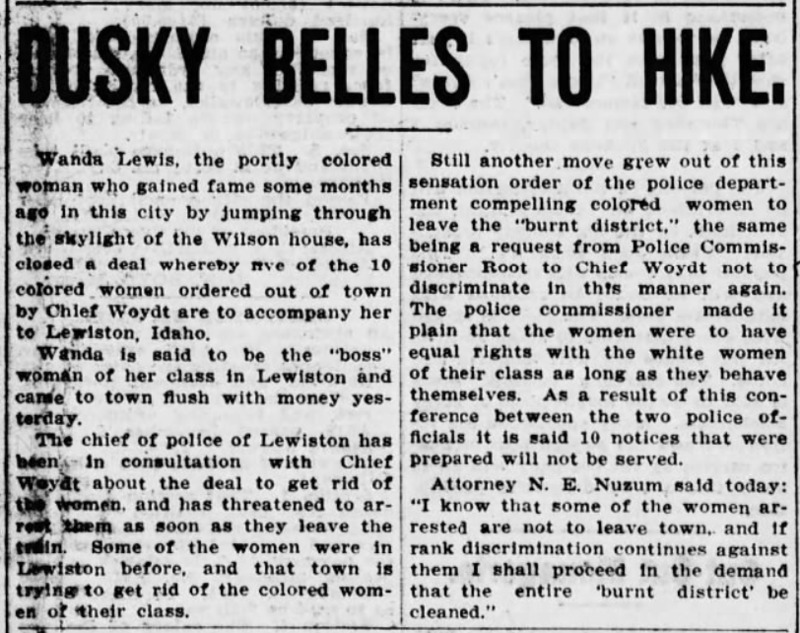
    <summary type="html"><![CDATA[<p><strong><em>Sometimes the law comes swift and unfairly as with the African American sex workers of downtown Spokane in the early 1900s.</em></strong></p><img src="https://spokanehistorical.org/files/fullsize/bc0de2d18a6eaf057dfb25849a43b4e2.jpg" alt="Dusky Belles To Hike" /><br/><p>Beginning early in the year of 1905, Chief of Police Leroy Cotman Waller unleashed a campaign against all “vagrants” designed to round up as many perceived undesirables as possible and place them in the city jail. As the war on crime progressed into the spring, police attention turned to the Black prostitutes in the downtown area, who Waller blamed for almost all the robberies in Spokane. On May 8th he officially announced that all Black women “engaged in unlawful occupations” were to leave town immediately or be arrested. Eight women had already left and four more were slated be jailed if they did not quickly follow. Two weeks later, police jailed seven women of color believed to be pickpockets. Some plead guilty and were fined $50 while others chose to fight their cases. Some had been charged with theft previously, but all were acquitted when witnesses did not show up in court.</p><p>After the May arrests police efforts to expel the women from the city slowed down. The newspapers still warned of the suspected roaming pickpockets, but there was no mention of further round ups.</p><p>This was not the first-time Black sex workers were forcibly expelled from Spokane. Two years prior twelve Black prostitutes were told to leave town immediately, and when they refused, five were caught and arrested by the police for vagrancy. Two had previous theft charges, so they left town on the advice of their lawyer N. E. Nuzum, while the others plead not guilty. Nuzum argued that of the 80 known prostitutes in Spokane, only the ten Black prostitutes remaining were facing charges. He threatened "if the rank discrimination continues against them I shall proceed in demand that the entire 'burnt district' be cleaned." The same day the five posted bail, three of the women were jailed a second time. Despite Nuzum’s best efforts, five were charged and fined, while the other five entered negotiations to leave town for Lewiston, Idaho, where the Chief of Police there said they would be arrested again.</p><p>Vagrancy was the charge brought against the sex workers in 1903 and likely would have been for the women in 1905. Vagrancy laws are designed broad intentionally, and make it illegal to be poor, suspicious, and idle in public or private spaces. Unsurprisingly, the law was used on the poor and minority groups lavishly until the 1960s when such laws were dismantled by the civil rights movement. Other charges such as disorderly conduct, loitering, and general misdemeanors were commonly used to punish "undesirables."</p><p>As 1905 pressed into late summer, Chief Waller remained the center of attention, but not likely in the way he anticipated. Waller and Deputy Assessor, Fred Leghorn, were brought before a grand jury for embezzlement. Waller and Leghorn were collecting fines from sex workers and pocketing the cash. The Judge explained that if they turned in the money, the courts would not have a case against the two men. It seemed they followed this advice as no further developments in the case were ever released. By October, Chief Waller was avoiding the subject of prostitution entirely and the previously expelled women slowly began to return to Main Avenue.</p><p><em><strong><a href="https://spokanehistorical.org/items/show/960">For more (including 3 images) view the original article</a></strong></em></p>]]></summary>
    <published>2023-11-27T23:45:25+00:00</published>
    <updated>2026-02-12T21:42:41+00:00</updated>
    <link rel="alternate" type="text/html" href="https://spokanehistorical.org/items/show/960"/>
    <id>https://spokanehistorical.org/items/show/960</id>
    <author>
      <name>Julianna Amante</name>
    </author>
  </entry>
  <entry>
    <title type="html"><![CDATA[1889 Building]]></title>
    <summary type="html"><![CDATA[<img src="https://spokanehistorical.org/files/fullsize/9ad1c5a5c717d288bee1443119167996.jpg" alt="1889 Inscription " /><br/><p>In 1889 a great fire swept across the fledging city of Spokane destroying most of the city's downtown. Many of the buildings hastily built after the fire were not of the best quality, workmanship, or materials. Of the 150 buildings that were built in the year following the fire, only ten remain. This building is the oldest. Originally named the Bodie Block this was a Single Room Occupancy that housed workers in the railroad, lumber, agriculture and mining industries. SRO's offered affordable private rooms that were meagerly furnished, and the concept was not unique to Spokane. Indeed, examples abound in major cities all over the United States.</p><p>Bodie Block was initially a modern design with references to Romanesque Revival. The building's three symmetrical bays that are dominated by a centered arched window is a great example of this popular design. Above the second floor, "1889" is carved into a sandstone panel. In 1974, due to the popular inscription on the structure, the Bodie Block was renamed the 1889 building. </p><p>The builders, and original owners of the block, were Richard T. Daniel, Antone Traut, and Eugene Chamberlin. Their stories are a window into the lives of early Spokane movers and shakers. Richard Daniel came to Spokane in a covered wagon in 1879. At the time of his death in 1949, he still owned several downtown buildings in Spokane. Antone Traut was born in Germany. He followed the gold rush trail west, which eventually led him to Spokane in 1883. Traut made money from mining in Montana and California. Mr. and Mrs. Pounder bought Bodie Block in 1973. The old building was an enjoyable project for the owners of Pounder's Jewelry. Their mission was to bring back the original idea of the building. </p><p><em><strong><a href="https://spokanehistorical.org/items/show/334">For more (including 6 images&#32;&amp;&#32;1 audio file) view the original article</a></strong></em></p>]]></summary>
    <published>2013-05-14T03:24:43+00:00</published>
    <updated>2026-02-12T21:42:34+00:00</updated>
    <link rel="alternate" type="text/html" href="https://spokanehistorical.org/items/show/334"/>
    <id>https://spokanehistorical.org/items/show/334</id>
    <author>
      <name>Lacey Sipos</name>
    </author>
  </entry>
  <entry>
    <title type="html"><![CDATA[1910:  The Palouse River Floods Colfax]]></title>
    <summary type="html"><![CDATA[<img src="https://spokanehistorical.org/files/fullsize/bc942435640859fa84b61bb71dc93097.jpg" alt="Colfax, March 1, 1910" /><br/><p>"Hundreds Homeless at Colfax - Driven to the Hillsides by Raging Floods - Houses Swept Away by the Rushing Waters"</p><p>The front-page headline of the March 3, 1910 edition of the Spokane Daily Chronicle described nearly 500 residents of Colfax as they were left without shelter as the Palouse River flooded homes, businesses and railroad depots.  Although it suffered the worst devastation, Colfax was, by no means, the only town affected by the raging waters of the relatively small, yet powerful and dangerous river.  Every community in the region near the Palouse River and even its tributaries, such as Pine Creek and Latah Creek, were subsequently inundated as well.  Residents of the Palouse region who lived near the rivers and creeks had learned to live with floods occurring every ten years or so, but never had they witnessed anything like the 1910 floods.  As settlers transformed the grasslands and forests of the Palouse to support industrialized agriculture and logging, they unleashed forces that would wreak havoc on their frontier communities.</p><p>As an unseasonably warm February in 1910 moved into March, the creeks and streams that flowed into the Palouse began turning into raging torrents.  The warm weather caused a dense snow-pack to melt, which, combined with recent heavy rains and winds, forced the river beyond its banks and into nearby towns and fields.  Before area residents had a chance to begin flood preparations, the river was already at flood stage.  On February 28, local newspapers mentioned the river rising rapidly and wondered of the possibility of a major flood.  By March 2, Hangman Bridge at Latah Creek was completely </p><p>washed-out and Colfax and Rosalia (among others) were under an average of three-feet of frigid, rushing water.  On March 4, as the waters began to recede, Colfax and Moscow were left "completely cut-off from the outside world" and were without trains, or even a telegraph wire.  In fact, the Spokane & Inland Empire train depot was washed from its foundation, slamming into another building over 200 yards away.  Colfax suffered an estimated loss of around $300,000.00.</p><p>The extreme damage created by the flood forced a Colfax Gazette reporter to ask, "Is this the winter of our discontent?"  Fortunately, there were no deaths caused by the floods and the afflicted communities immediately rebuilt.  If anything, Colfax was only strengthened as a community as a result of the rebuilding efforts and the stories of individual bravery which demonstrated the power of humanity in times of struggle.</p><p>Unfortunately, this was not the last flood that Palouse-area residents would experience.  Similarly devastating floods occurred again in 1933 and 1948, which eventually led to the Colfax Flood Control Project in 1962.  The project's construction involved the deepening of the Palouse River channel, building concrete-lined canals and retaining walls at a cost of $ 203,000.00.  Since the project was completed in 1964, the town has managed to stay dry and subsequently, has experienced no problems with the Palouse River since.</p><p><em><strong><a href="https://spokanehistorical.org/items/show/429">For more (including 8 images) view the original article</a></strong></em></p>]]></summary>
    <published>2014-05-09T02:56:11+00:00</published>
    <updated>2026-02-12T21:42:35+00:00</updated>
    <link rel="alternate" type="text/html" href="https://spokanehistorical.org/items/show/429"/>
    <id>https://spokanehistorical.org/items/show/429</id>
    <author>
      <name>Robert M. Lambeth</name>
    </author>
  </entry>
  <entry>
    <title type="html"><![CDATA[1917:  IWW Offices Raided &amp; Martial Law Declared]]></title>
    <summary type="html"><![CDATA[<img src="https://spokanehistorical.org/files/fullsize/452b6ff20a21f9cd301d5999cc50accb.jpg" alt="Industrial Workers of the World Poster" /><br/><p>In 1917, this building was the home of the Legal Defense Fund office of the Industrial Workers of the World--a union of unskilled workers whose vigorous tactics made them both feared and derided as the "Wobblies." Of the many Spokane offices of the IWW in the early 1900s, the only building that is still standing is right here.</p><p>The Wobblies first made a mark on Spokane in 1909, when a labor action they sponsored led to the "Free Speech Fight." As tempers flared between militant workers and area industrialists, the City of Spokane banned public speaking in 1909, hoping to stifle the various worker's movements. Within a few weeks of the new law, over 500 members of the Industrial Workers of the World (IWW) were arrested as they protested the unpopular law until the Spokane Jail was overfilled with the protesters. </p><p>The word was sent out by IWW leader James Rowan that all available supporters should report to Spokane to, as the IWW newsletter read, "Come Fill the Jail in Spokane." A picture of a jailed member on a poster is captioned, "Jailed: We are in here for you; you are out there for us." In a symbolic gesture of solidarity and protest, hundreds of Wobblies  arrived in Spokane in order to violate the ordinance for the sole purpose of getting arrested. The highly contested ordinance was overturned in March, 1910.</p><p>Over the next eight years, the Spokane IWW continued to expand its influence. In August of 1917, Rowan threatened a strike in all the state's industries, which was when the IWW discovered the breaking point of the local government. This prompted a brief military occupation of Spokane by the National Guard and a declaration of martial law by Governor Ernest Lister on August 17th. The main target of this ordinance was members of the Industrial Workers of the World and it was used as a means to prevent any further organization of mill workers and migrant harvest laborers who were striking for eight hour days and clean camp conditions. As a result of the IWW's refusal to comply, all three IWW halls in Spokane were raided, their documents seized and 94 members arrested.</p><p>When martial law was declared in 1917, the National Guard, under command of the US War Department, arrested anybody with a red card (IWW membership card) and arrested anybody engaged in "seditious activity", such as organizing workers. Although public speaking was banned, as a show of who the ordinance was geared toward, members of the patriotic organization, the Volunteers of America were still allowed to continue to speak freely.</p><p><em><strong><a href="https://spokanehistorical.org/items/show/291">For more (including 11 images) view the original article</a></strong></em></p>]]></summary>
    <published>2012-12-04T02:32:03+00:00</published>
    <updated>2026-02-12T21:42:33+00:00</updated>
    <link rel="alternate" type="text/html" href="https://spokanehistorical.org/items/show/291"/>
    <id>https://spokanehistorical.org/items/show/291</id>
    <author>
      <name>Robert Lambeth</name>
    </author>
  </entry>
  <entry>
    <title type="html"><![CDATA[1927 National Air Races at Felt&#039;s Field]]></title>
    <summary type="html"><![CDATA[<img src="https://spokanehistorical.org/files/fullsize/80da3b2891cf03688f2a27d901267e6c.jpg" alt="Admission to the Air Derby" /><br/><p>The 1920's heralded a gripping intrigue in aviation amongst Americans. With new, dangerous demonstrations in flight occurring each year, by 1927 aviators were becoming as popular and idealized as a star athlete in the NFL today. In that same year Charles Lindberg made his famous transatlantic flight, riveting the nation and sparking interest in aviation. With the craze in full swing, Spokane Valley's own Felt's Field was chosen as the finish line of one of the most successful and popular National Air Races in the country's history--the National Air Races.</p><p>The decision for Spokane, rather than say, a larger city like Los Angeles or San Francisco to host the races surely generated some skepticism. However, there had never been so much public enthusiasm before 1927 for aviation and Spokane "had in that day a live-wire business community that was willing to put its money where its mouth was and an active Chamber of Commerce." A key driving force behind the orchestration of the event was Major John "Jack" Fancher, who enlisted the help of local newspaper companies, investors, hoteliers, and various other organizations to gain financial support and influence for the occasion. The results would be unprecedented. </p><p>Newspaper articles from September 19-25th documented the festivities which attracted some 91, 989 attendees, with a grandstand that held 33, 421. Trains and automobile traffic flooded the roadways to Felt's Field, people even dusted off their outdated horse-drawn stagecoaches to reach the show. The main event was the $10,000 prize awarded to first to arrive of twenty four pilots who departed from New York on twenty four hour flight to Felt's Field. Spokane Valley's population increased by almost ten-fold as spectators gathered to observe not only the conclusion of the transcontinental race, but a host of other events that lasted days. </p><p>Precision air acrobatics, parachute drops, and local closed-course speed races kept audiences entertained for the week. One must not forget that this was a most perilous time in aviation, performing stunts was subject to stunting one's lifespan. Of the twenty four pilots departing New York, only sixteen would reach Spokane, the other's forced down by mechanical failures and adverse weather, a common occurrence at the time. The $10,000 grand prize went to Charles "Speed" Holman, who smashed the predicted time of twenty four hours finishing in nineteen hours and forty two minutes.  </p><p>The success of the National Air Races remain unparalleled today as the largest event to ever occur in the Spokane Valley. As a result of the races, "Spokane became known as a leader in our nation for aviation activity for the first time. In years that followed they were successfully held in Cleveland and Los Angeles and the country went forward into the air age. Spokane has been a part of it." </p><p><em><strong><a href="https://spokanehistorical.org/items/show/544">For more (including 3 images) view the original article</a></strong></em></p>]]></summary>
    <published>2015-03-17T00:23:36+00:00</published>
    <updated>2026-02-12T21:42:36+00:00</updated>
    <link rel="alternate" type="text/html" href="https://spokanehistorical.org/items/show/544"/>
    <id>https://spokanehistorical.org/items/show/544</id>
    <author>
      <name>Thomas Kassa</name>
    </author>
  </entry>
  <entry>
    <title type="html"><![CDATA[1994 B-52 Crash, Fairchild Air Force Base]]></title>
    <summary type="html"><![CDATA[<p><strong><em>The worst week in the history of Fairchild Air Force Base ended in a tragic, fiery explosion.</em></strong></p><img src="https://spokanehistorical.org/files/fullsize/cffef3aacf636754827f25c96e0de0d3.jpg" alt="Refueling B-52" /><br/><p>The week of June 19, 1994 was a dark time in the history of Fairchild Air Force Base. On June 20, 4 people were killed and 22 wounded in a murderous rampage carried out by a disturbed shooter. Just four days later, a B-52H Stratofortress, piloted by Lt Col Arthur "Bud" Holland, stalled, crashed into the ground, and erupted in a ball of flame and smoke. All four men aboard the plane were killed.</p><p>June 24, 1994, started out as any other ordinary summer day in Airway Heights, WA. It was partly sunny, with a predicted high of 75 degrees. A nice day for a flight. At 1:58 pm a B-52H, callsign Czar 52, took off at Fairchild Air Force Base with the purpose of practicing maneuvers for an airshow. Piloting the aircraft was Holland, and his copilot Lt Col Mark McGeehan. Rounding out the crew of four were radar navigator Lt Col Ken Huston and safety observer Col Robert Wolff.</p><p>Holland was a skilled pilot. However, he had a long history of pushing aircraft past their limits. It was ultimately determined that he was responsible for the crash, but his superiors were aware of his prior behavior. Lt Col McGeehan had complained about Holland’s reckless behavior and wanted him grounded, but he was unsuccessful. Holland only ever received verbal reprimands despite multiple occasions of reckless aviation. Official flight plans for bombers never included acrobatics or strenuous maneuverers, yet Holland frequently tested the aircrafts limits. </p><p>Czar 52 was flying along with a KC-135, which was also practicing maneuvers. After the KC-135 landed, Czar 52 was instructed to fly a missed approach. At an altitude of 250 feet, Holland banked left into a 360 degree turn around Fairchild’s control tower. The maneuver was too much for the aircraft and the results were devastating. Czar 52 went past 90 degrees, denying all airflow over the wings, and stalled. The low altitude made any attempt to recover impossible. Czar 52 crashed and was engulfed in a horrific fireball. It was 2:16 pm Pacific time. Four lives were lost.</p><p>An on base memorial, known as Memorial Grove, was established on August 2, 1994. Located in a park with red leaf maple and cherry trees, amongst others, the memorial is dedicated to the victims of both the shooting and the B-52 crash. </p><p><em><strong><a href="https://spokanehistorical.org/items/show/700">For more (including 3 images) view the original article</a></strong></em></p>]]></summary>
    <published>2017-03-14T20:56:14+00:00</published>
    <updated>2026-02-12T21:42:38+00:00</updated>
    <link rel="alternate" type="text/html" href="https://spokanehistorical.org/items/show/700"/>
    <id>https://spokanehistorical.org/items/show/700</id>
    <author>
      <name>Jonathan Succo</name>
    </author>
  </entry>
  <entry>
    <title type="html"><![CDATA[2011 MLK Parade Bomb Attempt: White Supremacist Brings Terror to Spokane]]></title>
    <summary type="html"><![CDATA[<p><strong><em>On a day of celebration and unity, tragedy in Spokane was narrowly averted. </em></strong></p><img src="https://spokanehistorical.org/files/fullsize/592dd4746a67c8e1be812af60c6c4b26.jpg" alt="Evidence photo of the backpack" /><br/><p>Monday, January 17, 2011, was a cold brisk morning, but there was reason to be in downtown Spokane. The annual Martin Luther King Jr. Unity March was about to begin and thousands of people prepared to march. As participants were lining up, around 9:26 AM, a city worker noticed a suspicious black backpack sitting on a bench at the corner of Main Avenue and Washington Street. Spokane Police officers recognized the potential danger and the Unity March was rerouted away from the area.</p><p>Inside the backpack was a homemade bomb, designed to kill and injure participants in the Unity March. Parts of the bomb were even laced with rat poison to maximize the amount of damage inflicted on the marchers. The Spokesman-Review reported that Spokane Police Chief Anne Kirkpatrick said of the bomb: “It’s not like some of the other types of devices I have seen in Spokane or in my career. This is one of sophistication.”</p><p>In addition to the bomb, the backpack also contained a couple of custom made t-shirts that would help investigators with their case. The investigation narrowed on a man named Kevin William Harpham of Colville. The 37-year-old ex-soldier was a member of the National Alliance, a white supremacist organization. Investigators were able to identify some of the components of the bomb. When police surveyed stores throughout the Pacific Northwest about purchases for the components they were able to link Harpham to the bomb. He was under federal surveillance for close to a month before a DNA sample that had been taken during his time in the Army was linked to the DNA found on the strap of the backpack that held the bomb. Harpham was sentenced to 32 years in prison in December of 2011.</p><p><em><strong><a href="https://spokanehistorical.org/items/show/665">For more (including 3 images) view the original article</a></strong></em></p>]]></summary>
    <published>2016-12-06T21:10:00+00:00</published>
    <updated>2026-02-12T21:42:38+00:00</updated>
    <link rel="alternate" type="text/html" href="https://spokanehistorical.org/items/show/665"/>
    <id>https://spokanehistorical.org/items/show/665</id>
    <author>
      <name>Josh Van Veldhuizen</name>
    </author>
  </entry>
  <entry>
    <title type="html"><![CDATA[20th Street Entrance: Manito Park Tour <br />
Spokane Park Highlights Tour]]></title>
    <summary type="html"><![CDATA[<img src="https://spokanehistorical.org/files/fullsize/a85ff828c6676a635636c5d3e48182b2.jpg" alt="Postcard - Entrance to Manito Park Spokane, Wash. Circa 1905" /><br/><p>The main entrance to Manito Park is now at 18th and Grand, but in earlier years the entrance was at 20th and Grand.  While today the area is green with grass and shaded by a few trees, in the first years of the twentieth century the "See Spokane Shine" archway made of hedge and flowers greeted visitors.  </p><p>Go stand at the corner of 20th and Grand, look into the park, and imagine what it would have looked like then.  There would be a graveled walk, a couple of street lights, and you would see the Balzer's house in the distance.  There would be landscaping with flowers and you may even see a few people sprinkled along the sides of the path eating their picnic lunches.  </p><p><em><strong><a href="https://spokanehistorical.org/items/show/115">For more (including 4 images&#32;&amp;&#32;1 video) view the original article</a></strong></em></p>]]></summary>
    <published>2012-05-09T19:03:31+00:00</published>
    <updated>2026-02-12T21:42:32+00:00</updated>
    <link rel="alternate" type="text/html" href="https://spokanehistorical.org/items/show/115"/>
    <id>https://spokanehistorical.org/items/show/115</id>
    <author>
      <name>Tracy L. Rebstock</name>
    </author>
  </entry>
  <entry>
    <title type="html"><![CDATA[26 Tons of Oddity: The top roadside attraction in Washington State resides right here in Spokane. ]]></title>
    <summary type="html"><![CDATA[<p><strong><em>The Red Radio Flyer wagon in Riverfront Park was born out of a lifelong love for this community by the Junior League of Spokane. It continues to fulfill its dedication promise.</p></strong></p><img src="https://spokanehistorical.org/files/fullsize/fc15be34e85e3d0e18af7ac99165d8d2.jpg" alt="[Untitled]" /><br/><p>The world’s largest Radio Flyer wagon “The Childhood Express” sits in Spokane’s Riverfront Park. It was commissioned by the Junior League of Spokane for the State centennial Celebration of Children  in 1989. The plaque reads: “This Sculpture is dedicated to Spokane’s children, as a reflection of the past, created in the present, to last into the future.” </p><p>Designed by local artist Ken Spiering, the Red Wagon weighs 26 tons and is made of steel and reinforced concrete. This mammoth wagon is designed to support the weight of up to 300 people (100 pounds per square foot). It took Spiering a full year of 17 hour days to complete the sculpture. </p><p>On any given day children and adults alike enjoy the slide. The Radio Flyer brand just celebrated its 100th birthday and the company commissioned a larger wagon that sits in downtown Chicago. The Spokane wagon has been voted by USA Today as the top roadside attraction in Washington.</p><p>Spiering has created statues around Riverfront Park including The Call and the Challenge, the fish sculptures that wrap around the Convention Center, and other public art. He created a sculpture for the City of Coeur d’Alene as well as furnishings for the Whitworth Presbyterian Church chancel. </p><p>The Junior League of Spokane (JLS) is a women’s service organization that started in Spokane in 1925. The JLS was among the first supporters of the Community Mental Health Center, Crosswalk, the Vanessa Behan Crisis Nursery, KPBX and many others. The JLS is currently focused on childhood literacy. At the 25 year celebration of “The Childhood Express”, Junior League President Lesley Culley expressed her love for the wagon. “The Red Wagon has become an iconic symbol for both visitors and residents of Spokane.” </p><p><em><strong><a href="https://spokanehistorical.org/items/show/819">For more (including 3 images) view the original article</a></strong></em></p>]]></summary>
    <published>2019-03-18T08:07:51+00:00</published>
    <updated>2026-02-12T21:42:39+00:00</updated>
    <link rel="alternate" type="text/html" href="https://spokanehistorical.org/items/show/819"/>
    <id>https://spokanehistorical.org/items/show/819</id>
    <author>
      <name>Melinda Barlass Bowman</name>
    </author>
  </entry>
  <entry>
    <title type="html"><![CDATA[A Brief History of Wallace, Idaho]]></title>
    <summary type="html"><![CDATA[<img src="https://spokanehistorical.org/files/fullsize/7620a5fff7627f95caa843acf5e31400.jpg" alt="Oscar Wallace" /><br/><p>At the heart of the Silver Valley, Wallace has always been a town of boom and bust.</p><p>Founded in 1884, the town is named for William R. Wallace, a local farmer. Silver mining would soon replace agriculture, and the community that emerged around Wallace's small cabin would soon develop into a regional center for the Silver Valley mining industry. The town boomed in 1884 with the discovery of the Poorman and Tiger silver lodes. Additional lodes of precious metals were soon discovered, forming one of the largest Silver deposits in the United States. By 1886, the town's population surpassed five hundred, continuing to grow with new access to the railroad. </p><p>In 1890, Wallace had its first brush with disaster when a fire tore through town, burning the town's timber buildings. After the fire, the town was reconstructed with brick, in the hopes of reducing the risk of fire. In August of 1910 the stage was set for a great fire storm which would ravage Washington and Northern Idaho. The heat and dry summer conditions aided in the spread of fire and its destructive wake. The fire, known as the "Big Burn" destroyed at least one-third of Wallace and killed over eighty people in the Inland Northwest. Wallace had no sooner recovered when a second disaster struck. The Great Flood of 1913, caused by heavy rains and a swollen river, unleashed a torrent of water in northern Idaho. Several towns were inundated with flood water, even washing a train from its tracks. </p><p>Each time Wallace rebuilt, financed by the apparently inexhaustible veins of silver in the surrounding mountains. Labor troubles as well as natural disasters roiled the Silver Valley as mine owners and their employees battled over working conditions and labor costs. In 1892, mining violence erupted between the two sides as the Frisco Mill was destroyed by explosives killing several people. Then, the following year, the price of silver collapsed causing many mines to temporarily shut down. By 1899, tensions grew as mine owners tried to break the unions, causing workers to resort to violence. After seventeen workers were terminated for joining a union, workers used dynamite to destroy the Bunker Hill and Sullivan mines. </p><p>Responding to the pleas of the mine owners and Idaho's Governor Steunenberg, President McKinley sent troops from Fort George Wright in Spokane to restore order to the region. These were African-American Buffalo soldiers. The use of black troops to suppress white miners was a great shock to many at a time when white supremacy was the law of the land.</p><p>Mining tapered off after World War II, and Wallace shrank in size and importance. Wallace's population peaked at nearly four thousand in 1940s and has slowly declined each decade since to less than 800 in 2010.  Today Wallace is a popular tourist destination. Visitors can walk the streets of town and catch a glimpse of mining life in Wallace. Filled with old buildings and mining history, the town of Wallace is an important link to the past of northern Idaho and Inland Northwest. Going to Wallace one takes a trip back in time, experiencing life as it was one hundred years ago. </p><p><em><strong><a href="https://spokanehistorical.org/items/show/485">For more (including 5 images) view the original article</a></strong></em></p>]]></summary>
    <published>2014-11-20T23:42:41+00:00</published>
    <updated>2026-02-12T21:42:35+00:00</updated>
    <link rel="alternate" type="text/html" href="https://spokanehistorical.org/items/show/485"/>
    <id>https://spokanehistorical.org/items/show/485</id>
    <author>
      <name>Sean Hiatt</name>
    </author>
  </entry>
  <entry>
    <title type="html"><![CDATA[A Frontier Doctor Rides into Rockford<br />
: Dr. William P. Grubbe Settles Down and Builds a Medical Practice]]></title>
    <summary type="html"><![CDATA[<p><strong><em>In 1880, Dr. William P. Grubbe and his companion were attacked by a band of Indians.  His friend and his horse killed, Grubbe grabbed the other horse and rode for his life. In Rockford, Washington he found a town in need of a doctor.</p></strong></p><img src="https://spokanehistorical.org/files/fullsize/2b663d38c6c093f54ad72df955eaa366.jpg" alt="View of the O. M. Rud Jewelry Store and Neighboring Buildings" /><br/><p>The early Spokane region lacked qualified medical doctors. In frontier towns, anyone could nail a diploma on the wall and begin treating patients. Townspeople saw having a skilled doctor as important as a saloon or newspaper for the growth of their communities.  When Dr. Grubbe rode into Rockford in search of safety, he found a village in need.  Upon hearing that this stranger was a doctor, the townspeople asked him to stay.  He agreed and settled down.</p><p>Grubbe, born in Missouri, was no stranger to frontier life.  As a boy, his family immigrated to Portland, Oregon and then to Oakland, California.  After finishing school, he attended a medical college in Salem, Oregon.  Upon graduation, Grubbe started his first practice in Pendleton. In the late 1870s, he relocated his practice near Amity.  After his arrival in Rockford, his built a large rural practice including Spokane, Teoka, Fairfield, and other small towns.  On May 16, 1884, he married the “prettiest girl in Rockford,” Miss Minnie Tozier.  Together they had four children, a boy and three girls.</p><p>In  1895, Dr. Grubbe hung up his stethoscope and went into real estate development.  He was elected as Spokane County’s Auditor in 1897 and served one term.  Tragedy struck the successful pioneer doctor when he fell ill with acute meningitis in 1889. He died within days, at the age of fifty-four.  </p><p>Minnie, now a widow, was expecting their fourth child.  Just over two months later, she gave birth to their youngest daughter, Willettie. Minnie remarried and moved away.  Their youngest daughter died in 1903.  Despite his premature death, Dr. Grubbe’s story demonstrated the need for qualified doctors in early Spokane. </p><p><em><strong><a href="https://spokanehistorical.org/items/show/733">For more (including 2 images) view the original article</a></strong></em></p>]]></summary>
    <published>2017-12-05T23:26:45+00:00</published>
    <updated>2026-02-12T21:42:38+00:00</updated>
    <link rel="alternate" type="text/html" href="https://spokanehistorical.org/items/show/733"/>
    <id>https://spokanehistorical.org/items/show/733</id>
    <author>
      <name>R. A. Schultz</name>
    </author>
  </entry>
  <entry>
    <title type="html"><![CDATA[A Gathering Place, The Historical Fort Sherman: A place of beauty, used for centuries as a gathering place, became the foundation of the city we know today as Coeur d’Alene.]]></title>
    <summary type="html"><![CDATA[<p><strong><em>The first rule of business is to be careful who you partner with. The beauty of Coeur d’Alene drew attention that changed the course of history for both the Coeur d’Alene people and the inland pacific northwest.</em></strong></p><img src="https://spokanehistorical.org/files/fullsize/fb833d9ee80a9a2d0cff78ca906ebec8.jpg" alt="Fort Sherman Chapel 1978, view from Northwest" /><br/><p>The beautiful plot of land known to the Coeur d’Alene people as Hnya ‘(pqi’nn (pronounced “hin-yap-keehn-un”) is where Lake Coeur d’Alene and the Spokane River meet. It has been used as a gathering place for centuries.</p><p>Long before the current city or historic fort existed, this plot of land was used by the Coeur d’Alene Indians as a place for hunting, fishing, gathering and trading. The folklore of the name, according to a local historian, comes from the history of fur trading between local Indians and French fur traders which was popular at this spot. The French fur traders who frequented the area were known for trying to take advantage of their equally clever Indian trading partners, which earned them the title of “men of small hearts”. The French traders liked the sound of the title “Coeur d’Alene” which mixed the French and Indian words together, and they over time began referring to the local tribe as the Coeur d’Alenes.</p><p>In 1877 General William T. Sherman (of Civil War fame) stopped by the area on a tour of inspection of western military posts, coming from Montana across the Mullan wagon road, en route to the Columbia river with a military escort in tow. The general was so impressed with the beautiful setting that he recommended the establishment of a fort to the federal war department, saying it was “vital to have a fort in the Idaho territory” to keep peace with the local Indians, to protect railroads and prospectors heading to the nearby mountain mines, the Canadian border, and migrants coming through the country in covered wagons. On April 16th, 1878 the war department established the official Camp Coeur d’Alene settlement. With the Fort, lucrative mining and attractive lake amenities, the adjacent city of Coeur d’Alene grew. However, tribal members were driven from their gathering place to a reservation near the southern tip of Lake Coeur d’Alene.</p><p>April 6th, 1887 the name was changed to Fort Sherman in honor of the general, three years after his retirement from the US Army. The Fort can be credited with bringing a hospital, library, school, chapel and amusement hall to the city, mainly housed in one building. The Fort Sherman Chapel is Coeur d’Alene’s oldest church, school, library and meeting hall.</p><p>With soldiers from the fort stationed in Cuba for the push on San Juan Hill with Theodore Roosevelt in 1898, the Fort officially became abandoned just after the Spanish-American war on March 5, 1900. A large push was made, with local demonstrations across eastern Washington and through Idaho, to utilize the buildings at the Fort for the purpose of a national soldier’s home. A memorial had been introduced to the Senate by multiple local Senators “in order that the men who defended the country’s flag in the time of peril may have a pleasant and healthful place to spend their last days.” However, the war department decided to formally abandon the place on July 1st, 1901, removing all portable property and transferring ownership to the interior department for further disposal action. The buildings and property were sold at public auction in 1905 to developers of the area. The worry was that the fort would be razed and turned into a resort due to its location and amenities, but that development never materialized and the property sat unused and under private ownership until after the area began to emerge from the Great Depression.</p><p>The idea of establishing a college in the area began during the Great Depression, as a way to lift spirits and create new opportunities in the area. Moritz Brakemeyer roused the support of community members and local organizations, as a result of his efforts he became the first President of Coeur d’Alene Junior College. Established on August 10th, 1933 with fifty-five students enrolled and located on the third floor of city hall. The Idaho state legislature passed a bill establishing organization and funding for junior colleges in 1939, and Kootenai County taxpayers endorsed new property taxes as a means for funding the newly minted North Idaho Junior College.</p><p>In 1949 land from the former Fort Sherman was donated to the college and it officially moved locations to its current site where the Spokane River and Lake Coeur d’Alene meet. Most of the early buildings from the Fort had deteriorated. During early college construction, you could have described the remaining buildings as little shanties with attached cesspools. A bulldozer had even fallen into one of the cesspools. In 1971 the college dropped the “Junior” title out of their name, now North Idaho College.</p><p>In 1979 the Fort Sherman Historic District was added to the National Register of Historic Places, the former powder magazine had been converted to house the Museum of North Idaho. A handful of original buildings were set for preservation with a few scheduled for demolition, and the chapel was donated to the Museum of North Idaho in 1984 for use and preservation.</p><p>In 1997, the college joined forces with the Coeur d’Alene tribe to form the Nine Points Agreement. This agreement was created to honor the tribe and respect the whole history of the area, creating a new and inclusive gathering space for all.</p><p><em><strong><a href="https://spokanehistorical.org/items/show/884">For more (including 5 images) view the original article</a></strong></em></p>]]></summary>
    <published>2020-12-15T10:14:47+00:00</published>
    <updated>2026-02-12T21:42:40+00:00</updated>
    <link rel="alternate" type="text/html" href="https://spokanehistorical.org/items/show/884"/>
    <id>https://spokanehistorical.org/items/show/884</id>
    <author>
      <name>Katherine Hentges</name>
    </author>
  </entry>
  <entry>
    <title type="html"><![CDATA[A History of Greenwood Cemetery]]></title>
    <summary type="html"><![CDATA[<img src="https://spokanehistorical.org/files/fullsize/6170ac5e301d0d6b1bffb1704f6c488f.jpg" alt="1889 Plat Map" /><br/><p>As Spokane outgrew its frontier beginnings, its old church graveyards were at risk of overflowing, and the small pioneer cemeteries got in the way of land development.  In order to solve both issues, A. M. Cannon and other prominent businessmen purchased and donated land west of town for the community's first modern burial site - an elegant garden cemetery.</p><p>At the time, the City Beautiful Movement was in full swing, which brought reform in architecture and city planning to communities across the nation, Spokane included.  Greenwood Memorial Terrace was strongly influenced by this movement, and can be seen throughout the cemetery's design, especially the first two terraces:  the flats and the bench.</p><p>The flats are the lowest level and contain the cemetery office, several memorials, and show how cemetery design and headstones have changed over time.  For example, there are old-fashioned upright headstones, some very ornate from the rural/garden cemetery era, along with grave markers flush to the ground common with today's lawn/memorial park design.  Another feature of the flats is the un-endowed section near the office.  Here you will find a more natural setting where the grounds are left mostly unkempt, and the graves range from simple wooden crosses to commemorate a loved one, to small fenced gravesites.</p><p>The bench is where many of Spokane's first high society people are buried, such as the A. M. Cannon family, the Amasa B. Campbell family, Mary Latham, and James and Susan Glover to mention a few.  It is full of family mausoleums, large family plots or memorials, and obelisks.  This level was originally designed to have a large water fountain, though it is unclear whether it ever worked, or was built for that matter.  It is also worth noting that the bench was designed to have a great view of the city and mountains beyond, but with time, the view disappeared as the trees grew.  Now the top holds the best view.</p><p>Speaking of the top, it is laid out primarily in the memorial park fashion, which is designed for ease of maintenance, and is the most modern section of Greenwood.  There are several military memorials, a children's section, and multiple columbarium walls which hold cremated remains and/or provide a place for people to visit their departed loved ones.  The top is also the site of the giant white cement Cross of Inspiration that was erected in 1961, which is where an interdenominational Easter sunrise service is held each year, along with other events throughout the year.</p><p><em><strong><a href="https://spokanehistorical.org/items/show/125">For more (including 5 images&#32;&amp;&#32;1 video) view the original article</a></strong></em></p>]]></summary>
    <published>2012-05-11T02:31:51+00:00</published>
    <updated>2026-02-12T21:42:32+00:00</updated>
    <link rel="alternate" type="text/html" href="https://spokanehistorical.org/items/show/125"/>
    <id>https://spokanehistorical.org/items/show/125</id>
    <author>
      <name>Julie Y. Russell</name>
    </author>
  </entry>
  <entry>
    <title type="html"><![CDATA[A Hospital For Washington&#039;s Insane : Changing the Way Washington Cared For the Mentally Ill]]></title>
    <summary type="html"><![CDATA[<p><strong><em>Eastern Washington Hospital For The Insane promised humane treatment for the mentally ill. </em></strong></p><img src="https://spokanehistorical.org/files/fullsize/ff72bb1a6d2d6e8b7a6b1e1bde783b10.jpg" alt="The original hospital built in 1890. " /><br/><p>Eastern Washington Hospital for The Insane opened in 1891. The first 122 patients were transfers from Western Washington Hospital for The Insane. </p><p>The hospital represented a break in the way that the mentally ill were cared for in Washington. The French theory and practice of "moral treatment" reached America. Moral treatment ended the use of chains and asked staff to treat mentally ill as patients rather than criminals. Moral treatment outlined orderly, regimented activities, such as access to a library, as part of the patients individualized treatment plan. It ended bloodletting, purgatives, emetics, and torturous hot and cold showers that had been all too typical of past treatments.</p><p>Eastern Washington State Hospital cherry-picked the best parts of moral treatment theory and left the rest behind. The fundamental course of treatment was isolation from family and friends, and those non-disabled patients worked on the hospital grounds. The use of restraints was limited and had to be authorized by the doctor.</p><p>Moral treatment became the standard of care in Washington just as it was falling out of favor in the rest of the nation. Moral treatment failed to cure most patients, and the pressures to do so lead to dishonest bookkeeping. Patients were discharged prematurely and hospitals used the word "recovered" loosely, which lead to a revolving door of patients being readmitted and released. Moral treatment, with its high cost and lack of promised results, lost favor with state legislators and began losing funding. </p><p>Not until the beginning of World War II was a clear change in treatment seen at Eastern State Hospital. Group and one-on-one counseling became part of patient treatment. Another advancement came in 1954 with the use of pharmaceuticals. In 1963 the federal government passed the Community Mental Health Center Act. The hope was that individuals could receive short-term out-patient care from new, smaller facilities rather than face long-term institutionalization. </p><p>Today only those suffering the most severe cases are sent to Eastern State Hospital.</p><p><em><strong><a href="https://spokanehistorical.org/items/show/731">For more (including 3 images) view the original article</a></strong></em></p>]]></summary>
    <published>2017-11-29T16:43:30+00:00</published>
    <updated>2026-02-12T21:42:38+00:00</updated>
    <link rel="alternate" type="text/html" href="https://spokanehistorical.org/items/show/731"/>
    <id>https://spokanehistorical.org/items/show/731</id>
    <author>
      <name>Angel L. Rios</name>
    </author>
  </entry>
  <entry>
    <title type="html"><![CDATA[A jackass, a big hill, and the community that loves them: This is the story of the lucrative jackass that started it all (up on a hill), the memory and embodiment of that jackass (and that hill), and the story of survival of a beloved ski area that was far from lucrative.]]></title>
    <summary type="html"><![CDATA[<p><strong><em>All ski areas have many ups and downs in their history, not just in relation to lift operations up and down the mountain. But the Jackass Ski Resort has had more downs than ups in its lifetime. It is safe to say that it has only survived because of the communities that love it, both the local ones and from a distance.</em></strong></p><img src="https://spokanehistorical.org/files/fullsize/2a8383ccc4d7346fbeb4d42227157aa6.jpg" alt="Skier on snow covered view of Wardner Peak" /><br/><p>Originally named “Jackass Ski Bowl” in honor of Bill the $12,000,000 burro who accidentally assisted in the founding of the Bunker Hill Mine near Kellogg. The ski area is located on lands leased from the Bunker Hill Mining Company, and is directly above some of the underground work areas. The original discovery site is not far from the bottom terminal of the ski lift. It was the brain child of the “Fabulous Valley Development Corporation” who sold shares of stock in the corporation to fund the building of the area. Many valley residents excitedly purchased stock with cash or traded work for shares of stock in the company to support the effort. The original ski area consisted of one Riblet chairlift serving 2 mountain ski bowls (Wardner Peak and Kellogg Peak), with a capacity of 900 skiers per hour, and the Tamarack Lodge was designed by local Coeur d’Alene architect Robert Nelson. The striking design of the lodge includes a roof that slants in almost every direction, designed to channel falling snow away from areas used by skiers. Opening day was December 16th, 1967 and many local big names attended the festivities. Due to a delay in the arrival of parts the lift was not in operation until December 23rd, along with plans for two rope tows near the lodge for beginner skiers.</p><p>The first few seasons were promising, with some plans for ski lift expansion. But following the poor fifth and sixth seasons, the area was liquidated in a foreclosure sale in 1973 and acquired by the Bunker Hill Mining Company for $100,100. The Shoshone Recreation Company, the subsidiary of Bunker Hill that was set to run the ski area, changed the name to Silverhorn as a nod to the Silberhorn ski area in the Bernese Alps. They built the cat shop that can still be seen from midway chair 4 today. But with the turbulent early history of labor disputes and the collapse of the mining economy in the late 70s/early 80s, they were forced to close the ski area in 1981.</p><p>Bunker Hill Limited, formed by Jack Simplot, Duane Hagadone, Harry F. Magnason and Jack Kendrick, bought the faltering ski area. It became quickly apparent that the cost of operation was more than the income generated, and in 1983 they began looking for another buyer for the ski area.</p><p>Silverhorn was accessed by a difficult and dangerous twisting mountain road, which climbed over 2,700 feet in just seven miles with an average grade of over seven percent. The road begins on the main street of Wardner, then follows the old Sierra Nevada road which was used by ore wagons in the early days, then winds around the mountain to the three-story, 10,000 square foot lodge. Bunker Hill Ltd paid $35,000 a year just for plowing to keep the road accessible for visitors. The Silver Valley cannot afford to lose another business, both for monetary reasons and local morale. So, in 1984 an arrangement was made between Bunker Hill Ltd and the city of Kellogg that allowed the city to operate the ski area in exchange for the payment of all property taxes levied against the ski area land. With the city managing road maintenance it would not make the ski area profitable, but it would reduce the yearly losses to a more manageable rate. The cost of an adult lift ticket increased from $12 to $14 for the first time since the ski area opened, but this was a happy exchange, allowing the operation cost to slow its rise while still affording the ability to keep the ski area open.</p><p>If the ski area was to attract more tourism affordably, a better way of reaching the mountain was sorely necessary. City Councilman Wayne Ross introduced a profound new idea: constructing a gondola from the valley floor up to an expanded ski and summer resort. This change could breathe new life into the area and stimulate a staggering economy, recently devastated by the loss of local mining and logging jobs. The Gondola Board applied for a grant from Congress to assist in the construction of the gondola, and in December 1987 they were awarded a $6.4 million dollar grant for the area.  September of 1988, the city of Kellogg voted to tax itself $2 million ($100,000 per year for 20 years) to help fund the new endeavor. The state government of Idaho and Washington Water Power Company also assisted with funding. The Von Roll Tramways, a Swiss lift manufacturing company, then agreed to guarantee the remaining funds needed for gondola construction.</p><p>April 25, 1989, construction on the “new” Silverhorn began. The original Jackass chair was renamed to Chair 4, plus the addition of 4 new chair lines and an assortment of other new expansions. The resort reopened with a brand new name of Silver Mountain in July 1989. In he city of Kellogg decided to redecorate and mimic the Bavarian alpine feel of Leavenworth, Washington. They added in murals, gingerbread trim and other design elements to the buildings and businesses around town. The new decoration was a heartfelt effort, but did not end up providing much benefit for tourism. </p><p>The world’s longest single-stage gondola opened on June 30th, 1990. It runs for 3.1 miles and climbs over 1000 meters (3400 feet) for nearly twenty minutes. There are longer gondolas in the world, but those either use “angle stations” or aren’t solely for carrying people. Unfortunately, there was significant spending beyond the original budget for the construction phase of the project and it lead to an insurmountable debt load for the city of Kellogg. The city council decided to search for a new owner and in June 1996 sold the assets to Eagle Crest, Inc (a subsidiary of Jen-Weld Corp).</p><p>Eagle Crest had some new and exciting ideas for the area and rushed to begin planning and construction. They envisioned a ski-in, ski-out resort village, and set out to construct the Morning Star Lodge condominiums, the Galena Golf Course, and the Silver Rapids Waterpark. Over the next decade they were met with success on all of their projects except for the ski-in, ski-out village. However, the financial crisis of 2008 took its toll on the resort and it was officially listed for sale. They budgeted to keep it open and operating year-round for a short term until a sale was made, still leaving room for improvements like revamping the bike park and reopening to the public in 2013. In October 2016 Silver Mountain was purchased for $5 million by Tryg Fortun, a Seattle-area businessman and Silver Mountain season pass holder. In total, Silver Mountain currently has 73 named trails covering 1,600 acres of skiable terrain, five chairlifts and 2,200 feet of vertical served by seven lifts. Will the resort finally be able to operate in the black? That history has not yet unfolded.</p><p><em><strong><a href="https://spokanehistorical.org/items/show/881">For more (including 5 images) view the original article</a></strong></em></p>]]></summary>
    <published>2020-12-14T03:14:02+00:00</published>
    <updated>2026-02-12T21:42:40+00:00</updated>
    <link rel="alternate" type="text/html" href="https://spokanehistorical.org/items/show/881"/>
    <id>https://spokanehistorical.org/items/show/881</id>
    <author>
      <name>Katherine Hentges</name>
    </author>
  </entry>
  <entry>
    <title type="html"><![CDATA[A Japanese Quaker Wedding in Spokane, WA]]></title>
    <summary type="html"><![CDATA[<img src="https://spokanehistorical.org/files/fullsize/6da613bddb5885af75f9c1b5976d9a73.jpg" alt="The Happy Couple" /><br/><p>On a warm August day, Japanese-American pacifist and civil rights activist Gordon Hirabayashi made headlines, marrying his college sweetheart, Esther Schmoe, in a simple Quaker ceremony at Spokane’s Lidgerwood Evangelical Church. While the happy couple was not the first to have an interracial marriage in Washington, it was one of the most publicized. Yet the newspapers were relatively tame about the Hirabayashi wedding, other instances of white women marrying Japanese men were sensationalized. </p><p>Fighting against the injustices of WWII Japanese-American related government policies, Gordon Hirabayashi was seen as a rabble-rouser. The son of vegetable farmers in Auburn, Washington, Hirabayashi was refused to register for relocation to Japanese internment camp in 1942, resulting in a Supreme Court case. As he explained in a 1985 piece for the New York Times, “I felt that the Constitution, as I understood it, gave me certain protections as a citizen under martial law.” Waiting the outcome of his trial, Hirabayashi moved to Spokane to work with the city’s chapter of the American Friends Service Committee. </p><p>When the Supreme Court unanimously upheld Hirabayashi’s conviction on June 21, 1943, Hirabayashi was escorted by the FBI to meet Spokane County’s District Attorney, Edward Connelly. Since his assigned prison was inside the internment zone, Hirabayashi faced two alternatives: he could spend his sentence locked up inside the Spokane County Jail, or he could escort himself down to Arizona and serve time with the Tucson Federal road camp. Preferring the outdoors, Hirabayashi hitchhiked his way down to Tucson, where he served his sentence alongside other pacifists and conscientious objectors. </p><p>After returning to Spokane in 1943, Hirabayashi was arrested again for refusing to fill out the “Statement of United States Citizen of Japanese Ancestry” (Selective Service Form 304A), used to determine Japanese-American loyalty and draft eligibility. While out on bail, Hirabayashi and his fiancée decided to get married on August 5, 1944. Shortly after, he was sentenced to another prison term. </p><p>After serving nearly two years in prison, Hirabayashi focused on his academic studies, earning a Ph.D. in sociology in 1951. Eventually, Hirabayashi’s cases were overturned, and helped prompt the federal government to apologize for its wartime treatment of Japanese-American citizens. As for the married couple, they separated in 1970 and passed away just hours apart on the same day in January 2012.</p><p><em><strong><a href="https://spokanehistorical.org/items/show/565">For more (including 6 images) view the original article</a></strong></em></p>]]></summary>
    <published>2015-05-28T21:06:50+00:00</published>
    <updated>2026-02-12T21:42:36+00:00</updated>
    <link rel="alternate" type="text/html" href="https://spokanehistorical.org/items/show/565"/>
    <id>https://spokanehistorical.org/items/show/565</id>
    <author>
      <name>Anna Harbine</name>
    </author>
  </entry>
  <entry>
    <title type="html"><![CDATA[A Short History of Cemeteries, Greenwood Cemetery]]></title>
    <summary type="html"><![CDATA[<img src="https://spokanehistorical.org/files/fullsize/99861b214f7b6d83efa602df96e04f33.jpg" alt="Church Graveyard" /><br/><p>As you tour Greenwood Memorial Terrace, starting from the main entrance on the first level and working your way through the second terrace, and up to the third, here's a bit of history to help you understand the different types of landscape design you will see. </p><p>Burial practices in the United States have changed quite a bit over the years.  For a long time, especially in the West, people simply buried their dead on their own property or in church graveyards in or near the city.  </p><p>Speaking of graveyards, let's distinguish between them and cemeteries.  Graveyards are generally considered the burial places next to churches, whereas cemeteries (not usually affiliated with any church) are large, landscaped grounds designed for the interment of the dead.  </p><p>Getting back to burial practices ... As populations grew, the practice of burying people within the city limits became impractical due to overcrowding at graveyards and the sanitation issues that go along with it.  As a result, burial sites were moved to the periphery of the city and thus, the rural cemetery (also known as garden cemetery) movement began in the in the early 19th Century.  The first rural cemetery opened in Paris in 1804 - the PÃ¨re Lachaise Cemetery; and the first for the United States was the Mount Auburn Cemetery in Boston, 1831.  These garden cemeteries, like the first and second terraces of Greenwood, were often developed in order to have a view of the city.  They were designed with great landscaping, artistic buildings, and fine sculptures - and as a result, became popular places to go for a leisurely stroll or to have a picnic on the weekends.  </p><p>The wealthiest citizens, to show off their wealth, often purchased large plots in these garden cemeteries to house several generations of the family, or built mausoleums and/or monuments to their name.  Examples at Greenwood are the burial sites for the Cannon, Dessert, and Sillman families on the second terrace, and the Cowles monument as you drive up to the third level.  Another option for affluent citizens was to purchase natural-looking headstones, like in the Armstrong photo, for individual burial plots.  On the other end of the economic scale, a popular practice for those less fortunate was to use the natural (or green) cemetery.  In these cemeteries, like the un-endowed section near the Greenwood Office building, bodies were buried without a casket and therefore, decomposed more rapidly and quickly became part of the natural environment.  </p><p>The next transition in burial practices was the turn to lawn and memorial park cemeteries in the early 20th Century.  Both types of cemeteries are designed with uniformity in mind - with graves lined up in rows, but the difference is in the type of grave markers used:  lawn-type gravestones are upright, whereas memorial park markers are fully embedded in the ground.  Greenwood's top terrace is a perfect example of this.  There you will find lush, sweeping lawns, with commemorative plaques flush to the ground rather than traditional headstones.  Another feature of lawn cemeteries was the introduction of columbarium walls, which feature the most recent evolutionary turn in burial practices - cremation.  These walls gave people a niche to commemorate their loved ones, and if they wanted to, it was also a place to leave the cremated remains.</p><p>Photo Credits:</p><p>Church Graveyard = Library of Congress</p><p>All Others = Julie Y. Russell, 2011</p><p><em><strong><a href="https://spokanehistorical.org/items/show/72">For more (including 7 images&#32;&amp;&#32;1 audio file) view the original article</a></strong></em></p>]]></summary>
    <published>2011-06-06T23:25:15+00:00</published>
    <updated>2026-02-12T21:42:31+00:00</updated>
    <link rel="alternate" type="text/html" href="https://spokanehistorical.org/items/show/72"/>
    <id>https://spokanehistorical.org/items/show/72</id>
    <author>
      <name>Julie Y. Russell</name>
    </author>
  </entry>
  <entry>
    <title type="html"><![CDATA[A Snapshot in the Life of John McAdams Webster: A Coast to Coast Adventure from West Point to Fort Spokane ]]></title>
    <summary type="html"><![CDATA[<p><strong><em>Plagued by poor health, John McAdams Webster served in the U.S Army at a time when military conflict was unlikely. But no matter where his career took him, he served with distinction. As a school superintendent and Indian Agent at Ft. Spokane, he earned a rare reputation for service to the local tribes. </em></strong></p><img src="https://spokanehistorical.org/files/fullsize/59bf81679905bd83affef77a0e22f6ba.jpg" alt="[Untitled]" /><br/><p>It was a long way from West Point to the remote frontier post of Ft. Spokane. John McAdams Webster, from Warrenton, Ohio, began his military career by joining the 197th Ohio Volunteer Infantry in 1865. Though he was only 16 years old, Webster was commissioned as a second lieutenant. In September of 1865 he went to West Point and due to health issues, he remained there for six years. His commission as a second lieutenant was to the 22nd Infantry, which was on frontier duty at the time. Promotions were hard to come by, and Webster would wait until 1879 to become first lieutenant and until 1891 to become captain. All the while, he served with quiet distinction in staff positions at several posts.</p><p>An accident in 1895 resulted in a spinal injury that restricted the use of his right leg, causing him to depend on a cane. Unable to participate fully in Army activities, Webster retired in December of 1898 and took up residence in his home state of Ohio. But in 1904, at the request of the commander of the Army, Webster was appointed to the Department of the Interior. This Superintendent appointment put him in charge of the Indian boarding school at Ft. Spokane.</p><p>In contrast to his predecessor, Webster is remembered for leading with awareness and sensitivity to the natives’ problems. According to some, Webster always took a “paternalistic posture” towards natives and attempted to “educate” them in the white man’s ways. Webster took over the Colville Indian Agency (August 1, 1904) after an embezzlement scandal ended Agent Anderson’s tenure. Webster aimed to reform the boarding school system, advocating for a day school where families would not have to send their children from far away.</p><p>As attendance at the school dwindled, Webster suggested that Ft. Spokane should become a clinic for tuberculosis. He reasoned that the tribes would be better served by a hospital when one out of every four Indians in the area suffered from tuberculosis. </p><p>As superintendent, Webster had authority over the Spokane, Colville, and Nez Perce reservations. His responsibilities included their general welfare and their legal relationship with the U.S. government. Webster could appoint tribal judges to oversee the Court of Indian Offenses. One of these judges was William Three Mountains (the younger,) who earned Webster’s admiration as a great leader who wanted the best for the Spokane people.</p><p>Webster's advocacy for Native Americans may have cost him his position. The Bureau of Indian Affairs forced his resignation February of 1912, saying that he had put his wards above his normal duties. He would later return to Eastern Washington as an Indian agent for the Spokane Reservation before resigning again. Webster finally returned to his home on Mackinac Island, Michigan, where he lived until his death in 1921.</p><p><em><strong><a href="https://spokanehistorical.org/items/show/689">For more (including 4 images) view the original article</a></strong></em></p>]]></summary>
    <published>2016-12-13T21:41:31+00:00</published>
    <updated>2026-02-12T21:42:38+00:00</updated>
    <link rel="alternate" type="text/html" href="https://spokanehistorical.org/items/show/689"/>
    <id>https://spokanehistorical.org/items/show/689</id>
    <author>
      <name>Ryan Yetter</name>
    </author>
  </entry>
  <entry>
    <title type="html"><![CDATA[A Soldier&#039;s Life at Fort Spokane]]></title>
    <summary type="html"><![CDATA[<p><strong><em>"Company Dismissed"</em></strong></p><img src="https://spokanehistorical.org/files/fullsize/83fef41efa864d7d0939cdad1fd19322.jpg" alt="Two Soldiers from Golf Company, 4th Infantry Regiment Pose  Recreation" /><br/><p>The officers and soldiers who served at Fort Spokane from its beginning in 1880 to its cessation in 1898 were the product of social contrasts that resembled the differences in the U.S. Army during the 1800's. </p><p>Many of the officers came from upper-class, "respectable" families from eastern cities who were successful in business and politics.  Many went to school at prestigious military academies.  In the aftermath of the American Civil War, many of the officers who still were part of the Army had served in that conflict.</p><p>By contrast, most of the enlisted soldiers after the Civil War were either European immigrants or Americans from poor, lower-class families.  Most had little formal education. Training was minimal for these men, most were not even taught to fire a weapon properly.</p><p>Built in 1880, Fort Spokane was established just three years after the death of General George Armstrong Custer and most of the 7th Cavalry at Little Bighorn. In the wake of that military disaster, the Army initiated a series of reforms to improve professionalism, particularly at isolated frontier posts throughout the West.</p><p>Lieutenant Colonel H.C. Merriam, the first post commander of Fort Spokane, embraced these reforms wholeheartedly. He instituted rigorous and repetitive training, meant at developing a sense of professionalism and purpose. A typical weekday began with reveille (first call) at 6 a.m. followed by morning chow at the mess hall, then various inspections, detail, guard duty, and parades before ending the day near sunset. Cavalry soldiers attended to and cared for their horses and saddles. Details included kitchen patrol, janitorial and quartermaster duties, cutting ice, amongst others.  </p><p>Enlisted soldiers also used their labor skills prior to enlisting in the army to conduct maintenance of buildings (i.e. plumbing, carpentry, blacksmith).  For lower enlisted privates, drill and ceremony were done twice a day.  Two primary skills for a soldier to master was firing a rifle correctly and signaling. </p><p>Still, soldiering was not 24 hours a day and downtime during the evenings and weekends provided an opportunity for much-needed rest and relaxation.  Soldiers could purchase items such as sundries, personal hygiene items, or beer from a concessionaire just off the post or go to the town of Miles a quarter mile away which consisted of a store, a saloon and two brothels. </p><p>Prostitution and alcoholism became a problem to units throughout the West and at Fort Spokane, officers began new alternative forms of recreation. Companies formed baseball teams where they played against each other and farming communities throughout the region. A gymnasium was converted out of a barracks to provide a venue for physical training.  Enlisted soldiers often resorted to playing cards and smoking cigars in their barracks; officers held balls, dances, and other formal engagements with their wives at Officer’s Row. Soldiers could go to the local photographer to have their portrait taken.  In 1892, the post exchange began where cheaper products could be sold to soldiers. </p><p>Off-duty hours also provided the chance for lower enlisted privates who were illiterate to learn English and U.S. history.  Officers also had evening schools called lyceums where they learned military law, regulations, tactics, and field engineering.  </p><p>For the soldiers of Fort Spokane who served there from 1880 to 1898, they became an early embodiment for millions of people who come to Lake Roosevelt National Recreation Area today to partake in activities for their life’s rest and relaxation.  </p><p><em><strong><a href="https://spokanehistorical.org/items/show/664">For more (including 3 images) view the original article</a></strong></em></p>]]></summary>
    <published>2016-12-06T07:18:51+00:00</published>
    <updated>2026-02-12T21:42:38+00:00</updated>
    <link rel="alternate" type="text/html" href="https://spokanehistorical.org/items/show/664"/>
    <id>https://spokanehistorical.org/items/show/664</id>
    <author>
      <name>Adrienne Sadlo</name>
    </author>
  </entry>
</feed>