<?xml version="1.0" encoding="UTF-8"?>
<feed xmlns="http://www.w3.org/2005/Atom">
  <title type="text">Spokane Historical</title>
  <updated>2025-10-01T06:30:25+00:00</updated>
  <generator uri="http://framework.zend.com" version="1.12.20">Zend_Feed_Writer</generator>
  <link rel="alternate" type="text/html" href="https://spokanehistorical.org/"/>
  <link rel="self" type="application/atom+xml" href="https://spokanehistorical.org/items/browse?output=rss2"/>
  <id>https://spokanehistorical.org/</id>
  <author>
    <name>Spokane Historical</name>
    <uri>https://spokanehistorical.org</uri>
  </author>
  <link rel="hub" href="http://pubsubhubbub.appspot.com/"/>
  <entry>
    <title type="html"><![CDATA[The “Invisible Empire” on Riverside Ave: The KKK of the 1920s and 1930s in Spokane – The Ku Klux Klan leadership operated out of offices in the Hyde Building located on W Riverside Ave in downtown Spokane.<br />
 ]]></title>
    <summary type="html"><![CDATA[<p><img src="https://spokanehistorical.org/files/fullsize/401400c2bd4d902067d05c8cd41c06e7.jpg" alt="An example of a Klansman robe from the 1920s-1930s" /><br/><p><strong><em>During the 1920s and 1930s, Spokane&#039;s Riverside Avenue was more than a bustling hub of downtown commerce—it was also a shadowy stronghold for the Ku Klux Klan. Behind unassuming office doors, the &quot;Invisible Empire&quot; quietly orchestrated its activities, embedding itself within the fabric of the city&#039;s political and social institutions.</em></strong></p><p>In the 1920s and 1930s, the Hyde Building on W. Riverside Avenue served as the headquarters for Spokane Ku Klux Klan. This building, located in the heart of downtown, also housed offices for the U.S. District Court in Spokane. The Klan used official letterhead with this address and held private meetings there to expand their influence not only in the Spokane area, but throughout Washington as well.<br />
 <br />
The Ku Klux Klan experienced a resurgence in the United States during the post-World War I period, and Spokane was no exception. At its height within Washington, the Klan boasted 40,000 paid members (approximately 1 out of 10 eligible native-born men in the state between the ages of 21 and 79). </p><p>
According to a July 1921 article in Spokesmen-Review, the KKK distributed a printed copy of their creed, promoting the values of &quot;white supremacy, limitation of foreign immigration, a closer relationship of pure Americanism, freedom of speech and press.” Nationally, the Klan capitalized on fears about immigration, changing social norms, and religious diversity, professing to uphold and defend “Americanism.” </p><p>
Locally, the group targeted immigrants, Catholics, and African Americans. One of their largest public events in Spokane was a rally in 1923 on Five Mile Prairie, where a 40-foot flaming cross was lit following a parade of over 200 cars. The Spokane Daily Chronicle reported that 50 new members were initiated during the event.<br />
 <br />
Prominent local figures played leadership roles in the Spokane Klan, as well as the statewide Klan. Reverend C.A. Rexroad of Corbin Park Methodist Church was the “Exalted Cyclops,” or head of the Spokane Klan, during the early 1920s. His public position as a pastor helped recruit new members. In the late 1920s, E.B. Quackenbush, a Spokane attorney, rose to the position of “Grand Dragon” for the entire Klan in Washington State. These two men were well acquainted. Coincidentally, in a 1924 lawsuit, Quackenbush represented Rexroad in a civil suit. Quackenbush’s influence extended beyond Spokane; in 1929, he was honored with a ceremonial key to the city of Bellingham by the town&#039;s mayor. These leaders used their positions to strengthen the Klan’s presence and influence throughout the region. </p><p>
The Klan’s activities in the Spokane area included inflammatory speaking events at local high schools, rallies, and initiation events, as well as more covert forms of intimidation, such as threatening letters. One such note was sent to Black residents in 1921 warning them to leave the city. The Klan publicly denied responsibility in the local press, but incidents like this contributed to their reputation for spreading fear and division.<br />
 <br />
Spokane’s African-American community actively resisted the Klan’s influence. Anchored by churches like Bethel African Methodist Episcopal and Calvary Baptist Church, the community organized to protect their rights. Political groups such as the NAACP and the Spokane County Colored Republican Club provided additional support. In one notable case, when a local drugstore denied service to Black patrons, the community challenged the discrimination in court and won a ruling affirming their right to equal treatment. </p><p>
Additionally, the Spokane Chronicle reported in July 1921 that &quot;colored citizens of the city will meet to form the &#039;colored citizens protective community.&#039; Rev. T. F. Jones of the Bethel A. M. E. church was quoted in the article, declaring &quot;we consider this action necessary because of rumors that a branch of the KKK is being formed in Spokane. We believe we must present a united front if the rights of the colored population are to be protected.&quot;<br />
 <br />
The Klan’s efforts to expand were challenged not only by the African-American community but also by local officials and media. Spokane’s newspapers reported critically on the Klan’s activities, while some city leaders worked to prevent the group from gaining more political influence. Indeed, in a 1921 editorial published in the Spokane Press, an anonymous author wrote &quot;Why should any person who intends to behave lawfully join the Ku Klux Klan...We don’t want any Ku Klux Klan!&quot; The Klan’s tactics often backfired, as public backlash grew against their extremist behavior – especially with the statewide defeat of a 1924 initiative targeting Catholic schools in Washington.<br />
 <br />
By the early 1930s, the Klan’s power in Spokane began to decline. National scandals surrounding the organization, internal corruption, and the economic pressures of the Great Depression weakened the Klan. Membership dropped sharply by the World War II era, and their public activities in the Pacific Northwest became less frequent. In Spokane, the combination of organized public opposition (especially from local marginalized groups) and shifting public priorities limited the Klan’s reach.<br />
 <br />
The story of the Ku Klux Klan in Spokane reveals how hate-fueled organizations manipulated societal anxieties to gain social influence and political power. At the same time, it highlights how the resilience and unity of those who opposed them demonstrated the enduring strength of compassion and community in overcoming fear.</p></p><p><em><strong><a href="https://spokanehistorical.org/items/show/964">For more (including 6 images), view the original article</a>.</strong></em></p><p><small>Download the Spokane Historical app for <a href="http://play.google.com/store/apps/details?id=com.dxysolutions.historical.spo">Android</a> and <a href="https://itunes.apple.com/us/app/id519094541">iPhone</a></small><br><small>Find us on <a href="https://www.facebook.com/SpokaneHistorical">Facebook</a>, <a href="https://twitter.com/SpokaneHistoric">Twitter</a> and <a href="http://www.youtube.com/user/SpokaneHistorical">Youtube</a></small></p>]]></summary>
    <published>2024-12-13T06:16:55+00:00</published>
    <updated>2025-01-22T06:19:07+00:00</updated>
    <link rel="alternate" type="text/html" href="https://spokanehistorical.org/items/show/964"/>
    <id>https://spokanehistorical.org/items/show/964</id>
    <author>
      <name>G. K. Freed</name>
    </author>
  </entry>
  <entry>
    <title type="html"><![CDATA[NAACP Protests Birth of a Nation – The Racist 1915 Silent Film Provoked Controversy]]></title>
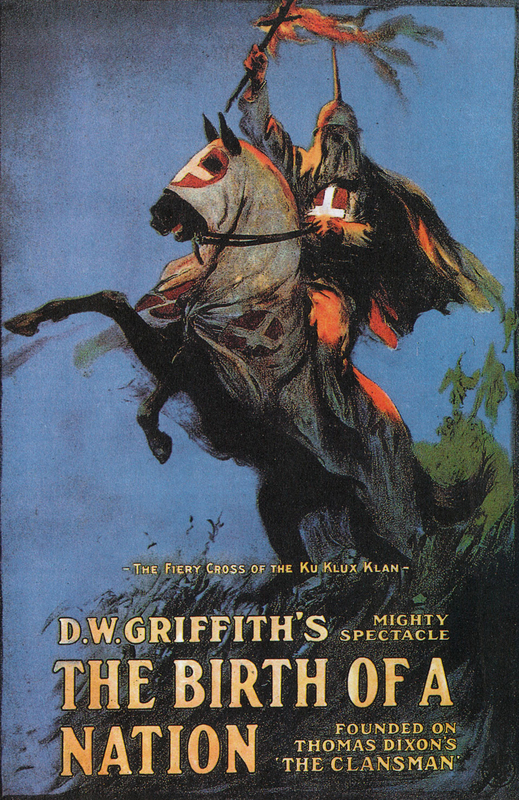
    <summary type="html"><![CDATA[<p><img src="https://spokanehistorical.org/files/fullsize/b72c54c2ea2a6cc6b747f6cbea52c3e3.jpg" alt="Birth of a Nation Poster" /><br/><p><strong><em>Following the 1915 release of DW Griffith’s racist film “Birth of a Nation,” the NAACP mobilized across the country, including Spokane, to protest the film.</em></strong></p><p>In 1915, the National Association for the Advancement of Colored People (NAACP) was a fledgling organization fighting for racial equality in the United States. The release of Birth of a Nation that year galvanized the young organization. The film was a landmark in early cinema but was also virulently racist. A historical melodrama, Birth of a Nation cast the Ku Klux Klan as heroic figures, and portrayed southern Blacks in racist stereotypes. Worst yet, the film sparked a revival of the KKK and increased racial violence against African Americans. </p><p>
The NAACP petitioned the National Board of Censorship to ban the film, and when that effort failed the organization continued petitioning for the most outrageous and inaccurate scenes to be removed. Throughout 1915 and 1916, activists protested scheduled showings of the film in their towns, including Tacoma, Portland, Los Angeles, and Spokane.</p><p>
When Birth of a Nation was scheduled to be shown in Spokane local activists challenged its arrival. They called for the newly added ‘race prejudice’ clause in Spokane’s Censorship Ordinance to be applied to the film, as it was likely to incite racial hatred or rioting in the city. JC Argall, a member of the censorship commission, had expressed distaste for the film and like-minded works and advocated for censoring or banning the showings. </p><p>
 In 1915 the NAACP said their efforts in Spokane had so far been unsuccessful. &quot;Despite protests,&quot; read an article in The Crisis, &quot;the play is running ... without the elimination of any of the objectionable scenes.&quot; The article reported that the most offensive scenes had been removed from the film before it showed in Chicago and Boston.</p><p>
In one case, protestors used violence. When the Clemmer Theater hired actors to dress as mounted Klansmen in front of the theater to promote the film in 1916, a mob of men pulled the faux Klansmen from their horses and beat them. “Rocks and sticks flew, yells were given, horses frightened, and a large crowd assembled,” reported the Spokesman-Review. The paper noted that “attacks had been made on the riders before.”</p><p>
The NAACP continued its fight against the film into the 1920s as it continued to make rounds in the country without much official intervention. The NAACP’s publication The Crisis followed the situation closely, reporting on protests in many major US cities and tracking the progress made towards censoring the film. Efforts to ban the film succeeded in Portland and New York City, but it took years of campaigning and raising awareness by NAACP activists.</p><p>
Opposition to The Birth of a Nation sparked the founding of the Spokane NAACP in 1919. The chapter continues its work today.<br />
</p></p><p><em><strong><a href="https://spokanehistorical.org/items/show/959">For more (including 3 images), view the original article</a>.</strong></em></p><p><small>Download the Spokane Historical app for <a href="http://play.google.com/store/apps/details?id=com.dxysolutions.historical.spo">Android</a> and <a href="https://itunes.apple.com/us/app/id519094541">iPhone</a></small><br><small>Find us on <a href="https://www.facebook.com/SpokaneHistorical">Facebook</a>, <a href="https://twitter.com/SpokaneHistoric">Twitter</a> and <a href="http://www.youtube.com/user/SpokaneHistorical">Youtube</a></small></p>]]></summary>
    <published>2023-11-27T22:34:55+00:00</published>
    <updated>2024-01-22T21:32:29+00:00</updated>
    <link rel="alternate" type="text/html" href="https://spokanehistorical.org/items/show/959"/>
    <id>https://spokanehistorical.org/items/show/959</id>
    <author>
      <name>Caroline Schwartz</name>
    </author>
  </entry>
  <entry>
    <title type="html"><![CDATA[Deer Lake Irrigated Orchard Company – A testament to the resolve of early Black Spokane]]></title>
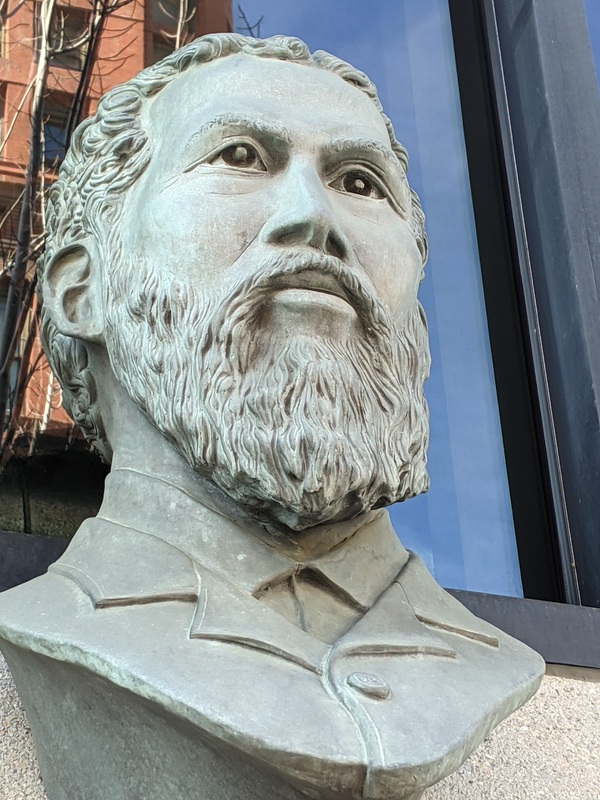
    <summary type="html"><![CDATA[<p><img src="https://spokanehistorical.org/files/fullsize/ac91cc8bc67e896eb0663498f26696ee.jpg" alt="Bust of Peter Barrow" /><br/><p><strong><em>Around the turn of the last century numerous African Americans migrated from the deep South to Spokane in hopes of building a freer and more prosperous life. In which some of them achieved this with the creation of the Deer Lake Irrigated Orchard Company.</em></strong></p><p>Founded by Peter Barrow in 1910, the Deer Lake Orchard Company consisted of 140 acres of farmland meant to provide an opportunity for Black workers trying in hope of to build their place in the Northwest. With the combined efforts of 45 investors from across the country, $18,000 dollars was raised, $15,600 of which was used to purchase the 140 acres that sat across the lake from Barrow’s homestead. </p><p>
Barrow&#039;s father, Peter B. Barrow escaped to fight with the Union Army during the Civil War. After his military career, which saw him reach the rank of sergeant. Barrow went on to serve in both chambers of the Mississippi state legislature. The racial violence of the Jim Crow South eventually forced him and others to seek more opportunity in the Spokane area where he and his wife helped to found the first Black church in the city.</p><p>
While Spokane was preferable to the South, it was still not welcoming to Black migrants.  The Barrow family like other Black pioneers would have experienced discrimination and limited job opportunities. And like many American Blacks in the Jim Crow era, they turned to entrepreneurship, founding their own businesses.  The younger Peter Barrow started his orchard on farmland that had been claimed by his father.</p><p>
A 1910 Spokesman Review article about the opening of the orchard illustrates how Barrow and early Black Spokanites were received at the time. The article applauded the project but only in its ability “To give work to the idle negroes now about the city and to eventually rid the city of the riff raff population of the colored race.”  Barrow was well aware of how public perception affected the opportunities of African Americans and took inspiration from Booker T. Washington who championed the use of skills and labor as tools to advance the Black community. The Deer Lake Irrigated Orchard accomplished this if only for a brief period of time. </p><p>
The orchard successfully contributed to the growing apple industry that Washington State is known for today. It grew to employ as many as 100 African Americans and eventually reached a net worth of over $175,000, but that success did not last.</p><p>
The company was only in operation for about 10 years. A combination of monetary and transportation issues challenged its viability, but other regional factors also influenced its fate.  One of which was the Arcadia Orchards. The 7,000 acre mega project located near Deer Park briefly dominated the region as the largest apple orchard in the world before it also closed down in 1924. </p><p>
The company&#039;s treasurer, Charles Parker Stewart cut his botanical teeth while working at the orchards and would go on to become a Professor of Botany at Howard University.  With the plant samples he had collected still being used today. The legacy of Barrow himself  lived on with his son Charles who co-founded the first Black newspaper in Spokane. While Charles&#039; daughter Eleanor, who would marry the first Black mayor of Spokane James Chase. So while the Deer Park Irrigated Orchard Company was not a permanent institution, it had a lasting impact on the Black community in Spokane.<br />
</p></p><p><em><strong><a href="https://spokanehistorical.org/items/show/958">For more (including 4 images), view the original article</a>.</strong></em></p><p><small>Download the Spokane Historical app for <a href="http://play.google.com/store/apps/details?id=com.dxysolutions.historical.spo">Android</a> and <a href="https://itunes.apple.com/us/app/id519094541">iPhone</a></small><br><small>Find us on <a href="https://www.facebook.com/SpokaneHistorical">Facebook</a>, <a href="https://twitter.com/SpokaneHistoric">Twitter</a> and <a href="http://www.youtube.com/user/SpokaneHistorical">Youtube</a></small></p>]]></summary>
    <published>2023-11-27T22:23:59+00:00</published>
    <updated>2024-09-02T00:51:31+00:00</updated>
    <link rel="alternate" type="text/html" href="https://spokanehistorical.org/items/show/958"/>
    <id>https://spokanehistorical.org/items/show/958</id>
    <author>
      <name>John Grieshaber</name>
    </author>
  </entry>
  <entry>
    <title type="html"><![CDATA[The Wednesday Art Club – Black Spokane&#039;s Leading Cultural Organization]]></title>
    <summary type="html"><![CDATA[<p><img src="https://spokanehistorical.org/files/fullsize/c220c8672040b1050ae2b46ae32a0a71.jpg" alt="Wednesday Art Club Members" /><br/><p><strong><em>The Wednesday Art Club of Spokane was much more than an art club. The African-American women-lead organization gave back to a city that did not always recognize them.   </em></strong></p><p>The Wednesday Art Club was founded in July of 1913 in Spokane Washington. The organization was lead by African-American women, who not only held art shows but strived to better the Black community in Spokane. The art shows that were held highlighted African-American artists from across the nation.</p><p>
In 1936 the organization held what historian Dwayne A. Mack called &quot;the clubs greatest connection to the broader black art world.&quot;  The art exhibit was held at the Grace Campbell museum which highlighted 28 prominent Black artists such as Teodoro Ramos Blanco, Malvin Gray Johnson, Aaron Douglas and William Arthur Cooper. Their works were diverse, from oil paintings to bronze statues. This type of event was done yearly by the club, Mayme Lee was often the women who chaired these exhibits. </p><p>
 The Wednesday Art Club also hosted a charity ball. The first was held a year after the club was founded in 1914, and raised money to provide a fund for “needy colored people of the city may be aided this winter.&quot; The club also held meetings with the community that centered important topics such as American citizenship or the role of churches on the home front. Cultural festivals were held as well, in 1972 the club hosted a “Negro Week,&quot; which featured performances and speakers such as Spokane civil rights leader Carl Maxey. They also hosted more lighthearted events such as comedy shows, that featured an all women cast.</p><p>
The Wednesday Art Club featured a program that taught Black history to the public, while also having a “Tiny Tim” fund in which gave college scholarships to students. Tuberculosis was on the rise in the early 1900s, so The Wednesday Art Club helped make Christmas seals to raise money for treatment.</p><p>
The Wednesday Art Club connected with other women-led groups throughout the community. The club had prominent members like Mrs. Eleanor Chase, wife of James Chase the first African-American mayor in the city. The members of this organization had a deep history, club member Marie Maley descended from one of the first black families in Spokane. She was the granddaughter of freed slaves and born on a slave plantation. Though the Wednesday Art Club seemed to disband somewhere in the 1980’s, their legacy in the Spokane community is still seen today as an organization that wanted better for all.</p></p><p><em><strong><a href="https://spokanehistorical.org/items/show/957">For more (including 5 images), view the original article</a>.</strong></em></p><p><small>Download the Spokane Historical app for <a href="http://play.google.com/store/apps/details?id=com.dxysolutions.historical.spo">Android</a> and <a href="https://itunes.apple.com/us/app/id519094541">iPhone</a></small><br><small>Find us on <a href="https://www.facebook.com/SpokaneHistorical">Facebook</a>, <a href="https://twitter.com/SpokaneHistoric">Twitter</a> and <a href="http://www.youtube.com/user/SpokaneHistorical">Youtube</a></small></p>]]></summary>
    <published>2023-11-27T21:18:14+00:00</published>
    <updated>2024-01-16T20:56:41+00:00</updated>
    <link rel="alternate" type="text/html" href="https://spokanehistorical.org/items/show/957"/>
    <id>https://spokanehistorical.org/items/show/957</id>
    <author>
      <name>Ehriza Chavez</name>
    </author>
  </entry>
  <entry>
    <title type="html"><![CDATA[Kurt Waldheim at EWU – Commencement Speaker, United Nations Secretary General, War Criminal]]></title>
    <summary type="html"><![CDATA[<p><img src="https://spokanehistorical.org/files/fullsize/add8f2d08af090536908367486b4e9b3.jpg" alt="Kurt Waldheim breaking ground for tree planted in his honor." /><br/><p><strong><em></em></strong></p><p>In 1982, Eastern Washington University set out to find a notable commencement speaker to celebrate their 100th anniversary. </p><p>
Invitations to participate in the centennial celebrations went out to notable alumni, state and federal congressional representatives, prominent writers, artists, and political leaders. Eastern was able to get former President of the United States, Gerald Ford, to deliver the “Founders Day” address on campus, setting the bar extremely high for whoever would be the commencement speaker. EWU found exactly what they were looking for when Dr. Kurt Waldheim agreed to come to Cheney to give the address. </p><p>
Born in Vienna in 1918, Waldheim served his home country of Austria in several political roles, including as the fourth Secretary General of the United Nations, making him one of the most respected diplomats in the world.  Eastern Washington University was excited to host someone so prominent on the world stage and began advertising his arrival in The Easterner, the university newspaper. </p><p>
At Eastern,  Waldheim delivered a powerful commencement speech where he spoke to the recent graduates about preventing the current political tensions around the world from turning into another world war, “I do not believe that any government has any intention of letting us drift into a third world war, but unless we are prepared to learn from the past and to make our international political institutions work as they were intended to work, that danger will always exist.” </p><p>
In addition to his rousing speech at the commencement ceremony, Waldheim took part in planting a ceremonial tree next to a plaque created in his honor that read, “Austrian Pine Commemorating EWU’s Centennial Commencement. June 11, 1982, Planted in Honor of Kurt Waldheim, 4th Secretary General of the United Nations.” Waldheim helped break ground with a painted golden shovel that he autographed while pictures were taken of the momentous occasion and the tree was planted. Overall, inviting Kurt Waldheim to take part in Eastern Washington University&#039;s centennial commencement had been a smashing success, or so everyone thought. </p><p>
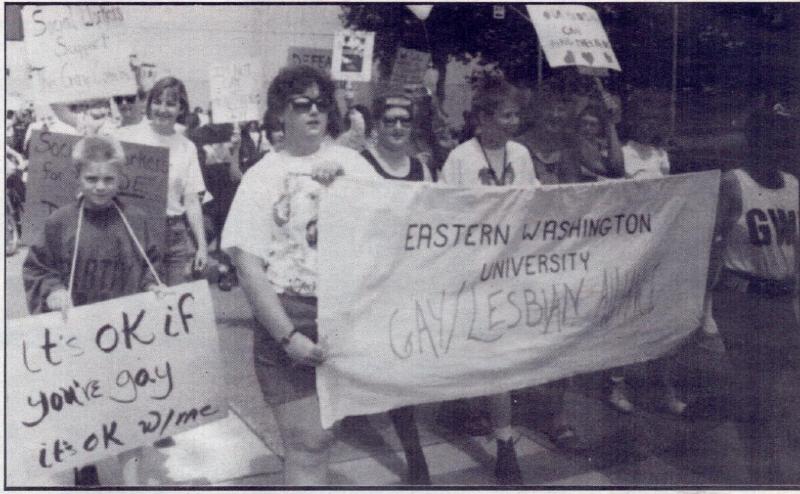
Just as plaques and monuments tarnish over time, so do people’s legacies. In 1991, The Easterner published an article titled “Waldheim Plaque to be Removed.” This decision, made by EWU President Marshall Drummond, was due to recent discoveries which uncovered that Kurt Waldheim was no longer permitted in The United States because he was suspected of committing war crimes as a Nazi during World War II. </p><p>
Waldheim  had always claimed to have served in the regular German army, the Wermacht, at the start of the war, but after being wounded on Russian front he had spent the rest of the war in law school.  This was not true. Although there wasn&#039;t concrete evidence of Waldheim’s direct involvement in committing genocide, archival and eyewitness accounts prove that he was a Nazi intelligence officer attached to a unit that deported around 60,000 Greek Jews to Auschwitz, as well as committed atrocities in The Balkans.  As evidence accrued over the years against Waldheim, his story continued to change up until his death in 2007.</p><p>
Despite there being a large amount of EWU documentation surrounding the planning of the 1982 centennial commencement, there is nothing aside from The Easterner article that addresses President Drummond’s decision to remove the plaque, the whereabouts of the tree that was planted, what was done with the plaque, or how the University intends to handle the knowledge of Waldheim’s disturbing past. In fact, until recently the story of Waldheim&#039;s visit appears to have been concealed. Meanwhile, on campus there is still an autographed shovel, autographed invitations to a dinner gala, and a tree planted by former Lieutenant Kurt Waldheim of The Wehrmacht. As for the plaque, it almost assuredly lies dormant somewhere in the same memory hole that the rest of this story has hidden in for the last 30 years. </p><p>
</p><p>
</p></p><p><em><strong><a href="https://spokanehistorical.org/items/show/945">For more (including 3 images), view the original article</a>.</strong></em></p><p><small>Download the Spokane Historical app for <a href="http://play.google.com/store/apps/details?id=com.dxysolutions.historical.spo">Android</a> and <a href="https://itunes.apple.com/us/app/id519094541">iPhone</a></small><br><small>Find us on <a href="https://www.facebook.com/SpokaneHistorical">Facebook</a>, <a href="https://twitter.com/SpokaneHistoric">Twitter</a> and <a href="http://www.youtube.com/user/SpokaneHistorical">Youtube</a></small></p>]]></summary>
    <published>2023-06-06T00:30:22+00:00</published>
    <updated>2024-01-16T21:40:20+00:00</updated>
    <link rel="alternate" type="text/html" href="https://spokanehistorical.org/items/show/945"/>
    <id>https://spokanehistorical.org/items/show/945</id>
    <author>
      <name>Matthew C. Schultz</name>
    </author>
  </entry>
  <entry>
    <title type="html"><![CDATA[The Spokane Mountaineers: From Walking to Summiting – The history of a local club with national impact]]></title>
    <summary type="html"><![CDATA[<p><img src="https://spokanehistorical.org/files/fullsize/0eae56d35d113b2bc571f9e25002e829.jpg" alt="Beginnings as a Group of Librarians Interested in Walking" /><br/><p><strong><em>Beginning as a group of active librarians, the Spokane Walking Club evolved to become the Spokane Mountaineers</em></strong></p><p>For over one hundred years now, the Spokane Mountaineers club has had a sizable impact on recreational sports and environmental stewardship in Eastern Washington and beyond. Founded on September 19th, 1915, by well-known public librarian Ora Maxwell, the organization was originally chartered as the Spokane Walking Club. The original fifteen or so members consisted solely of women librarians, joined together with a passion for long and challenging walks. A year later, in 1916, a contested vote would allow male members to join what had previously been an all-woman’s club. By 1921 they would change their name to the Spokane Mountaineers to reflect the increasingly ambitious adventures undertaken by those within the club. It was recorded a year later in 1922 that the club had sponsored over three hundred walks and that their membership was around fifty individuals strong (Kershner). In the following decades they would incorporate as Spokane Mountaineers Inc. (SMI), establish a members’ newsletter “The Kinnikinnick”, and continue to sponsor members in increasingly challenging summits (Spokane Mountaineers).</p><p>
In 1939 the Mountaineers joined the Spokane and Selkirk Ski Clubs in purchasing over 500 acres of Mount Spokane for recreational facilities (Arksey). A ski shack built on the mountain in the ‘30s would be replaced in the ‘50s by the ski chalet that stands there today. Situated on forty acres, the chalet was built by the Mountaineers themselves. The female members continued to be a driving force in the club, contributing manual labor to the chalet’s construction alongside male club members (Burge). The ski chalet is still in regular use today and is available as a perk of membership for ski trips and mountain getaways.</p><p>
Continuing to expand its reach, the club established biking activities and began its own Mountain School in 1939, a program focused on outdoor education, safety, responsibility, and stewardship that continues to this day in their many educational programs. While that year marked their official outdoor school opening, SMI has been focused on educating its members since its very earliest years. This focus can be traced back to prodigious mountaineer Elsa Hanft, who joined the club in 1921. A guide for Mt. Rainier at the time, Hanft had summited over 50 times and was instrumental in teaching technique to the early generations of Mountaineers (Burge). This legacy continued in 1937 with the first-ever Climbing Class, a six-session course that would eventually grow and evolve into the Mountain School that exists today. In addition to advancing the sport of climbing, the Spokane Mountaineers club has focused its efforts on preserving the natural resources its members enjoy. Members heavily lobbied for the founding of the North Cascades National Park and contributed to joint efforts in the management of the Idaho Panhandle National Forest. Some notable ongoing clean-up efforts have been active in Sun Lakes State Park, the Centennial Trail, and SMI-adopted lakes and trails around Stevens Peak in Idaho. In the present day, a portion of membership proceeds go towards continuing conservation efforts in the Inland Northwest. Current estimates put this at around $2000 a year (Burge).</p><p>
Throughout its years of operation, the Spokane Mountaineers has produced many notable members and sponsored historic firsts throughout the outdoor sporting world. Climbers John Roskelley, Chris Kopczynski, Kim Momb, and Dr. Jim States pictured here were the first team to complete an American ascent of the Himalayan peak Makalu. They did so without Sherpa support or oxygen tanks, and their accomplishment was heralded by the American Alpine Association as “a seminal moment in Himalayan climbing history” (Mazur). Throughout SMI’s history there have been members like these four who distinguished themselves as climbers not only on a local level, but on the world stage.</p><p>
Club membership did see a decrease over the Covid pandemic with membership rosters dipping to around 250 total. However, due to the lifting of restrictions and the resumption of the SMI Mountain School they have seen their numbers skyrocket to over 600 members this year (Burge). Club Historian Chic Burge, a member since 1984, says of the Spokane Mountaineers, “The club has always been a nurturing element in the community; it’s always been a family organization that promotes outdoor recreation..” In 2015 the club celebrated its 100th anniversary, and it shows no signs of slowing its forward momentum.</p></p><p><em><strong><a href="https://spokanehistorical.org/items/show/938">For more (including 2 images), view the original article</a>.</strong></em></p><p><small>Download the Spokane Historical app for <a href="http://play.google.com/store/apps/details?id=com.dxysolutions.historical.spo">Android</a> and <a href="https://itunes.apple.com/us/app/id519094541">iPhone</a></small><br><small>Find us on <a href="https://www.facebook.com/SpokaneHistorical">Facebook</a>, <a href="https://twitter.com/SpokaneHistoric">Twitter</a> and <a href="http://www.youtube.com/user/SpokaneHistorical">Youtube</a></small></p>]]></summary>
    <published>2023-01-14T20:54:17+00:00</published>
    <updated>2023-01-22T04:32:21+00:00</updated>
    <link rel="alternate" type="text/html" href="https://spokanehistorical.org/items/show/938"/>
    <id>https://spokanehistorical.org/items/show/938</id>
    <author>
      <name>Theo Bell</name>
    </author>
  </entry>
  <entry>
    <title type="html"><![CDATA[Whistalks Way – Fort George Wright Drive Renamed Whistalks Way ]]></title>
    <summary type="html"><![CDATA[<p><img src="https://spokanehistorical.org/files/fullsize/7acd11d918e6355397855bd780af255b.jpg" alt="Whistalks Way signage changed in 2020 following Spokane City Council decree" /><br/><p><strong><em>After Colonel Edward Steptoe&#039;s defeat by local Native tribes, Colonel George Wright was sent to avenge the U.S. military. Wright&#039;s murderous rampage resulted in a street sign memorial in his name. Prof. Margo Hill contributed to a protest that resulted in renaming the street in 2020 as Whistalks Way. </em></strong></p><p>In 1858, tensions between the white settlers and the native population grew in the Palouse. In May of 1858, Col. Edward Steptoe led an expedition meant to end at Fort Colvile. His plan was to suppress Indian resistance. Steptoe and his men were ill equipped for battle, though, being small in number and carrying outdated weapons. He and his soldiers encountered an overwhelming force of warriors from local tribes, which ended in his retreat to Fort Walla Walla, Washington. After his defeat at the Tohotonimmee battlefield, at the present-day Steptoe Butte, Colonel Wright was sent to restore order. </p><p>
Colonel Wright&#039;s invasion of the Spokane Valley was so  forceful and extreme that the Native resistance was immediately overwhelmed. On September 8, 1858, Wright slaughtered hundreds of Indian horses and demolished the tribe&#039;s food supply and economy. During his crusade, Wright also destroyed crops and food stores. He pronounced judgment <br />
upon and hung many Indians whom he considered to be insurgents. Wright&#039;s battles against the Spokane, Coeur d’Alene, Palouse, and Yakama tribes culminated in a final victory at the new Fort Spokane, which was formally renamed Fort George Wright in 1899. </p><p>
In Spokane, Washington, a street running alongside present-day Spokane Falls Community College was named Fort George Wright Drive in commemoration of Wright&#039;s military accomplishments. Margo Hill, a lawyer, Eastern Washington University Urban Planning professor, and member of the Spokane Tribe of Indians, became a spokesperson and contributed efforts to change the street name. In 2020, Hill united with African Americans, Asians, Muslims, Natives, and whites to conduct a protest march. On December 14th, 2020, the Spokane City Council unanimously approved the change and the street was officially renamed.</p><p>
The name accepted by all of those concerned was Whistalks Way. The name honored the daughter of Chief Polatkin and the wife of Qualchan. Whis-talks was a Native American warrior that fought in combat in 1858. She &quot;rode alongside her husband into battle and carried the medicine eagle feather staff into the U.S. military post to parley,&quot; Margo Hill wrote later. After Qualchan was hanged, Whis-talks and Lokout, Qualchan&#039;s half-brother, escaped Wright&#039;s grasp. They lived out their lives as domestic partners near the Spokane and Columbia rivers . Not only was the name change meant to honor the Native American warrior, but to honor Native American women in general.</p><p>
After the successful change of the street name, Margo Hill wrote the article that exhibits her belief that the actions of George Wright in 1858, were hate crimes against Native American people. She explains, in her article <br />
 that the city resolution pronounced Wright&#039;s name a &quot;continual stain&quot; because of his acts of terrorism and genocide. In her opinion, Wright went beyond his duties as a general by murdering Indigenous peoples and destroying supplies that led to the disruption of their economy. Hill believes Wright intentionally engaged in terrorist acts against the Spokane, Coeur d’Alene, Palouse, and Yakama tribes. </p><p>
Because of the successful efforts of the Spokane Tribe of Indians and other protestors, the city of Spokane now “honors the history of the original inhabitants, the Sp̓oq̓ínš, and their relationship to their sacred place. With ‘Whistalks Way,’ we honor women warriors and tell their story; we sing the songs of our ancestors and work to empower the next generation of Indigenous people,” Hill wrote. If you are driving near Spokane Falls Community College and see the street sign, remember the history and the struggles for change that resulted in Whistalks Way.</p></p><p><em><strong><a href="https://spokanehistorical.org/items/show/935">For more (including 4 images), view the original article</a>.</strong></em></p><p><small>Download the Spokane Historical app for <a href="http://play.google.com/store/apps/details?id=com.dxysolutions.historical.spo">Android</a> and <a href="https://itunes.apple.com/us/app/id519094541">iPhone</a></small><br><small>Find us on <a href="https://www.facebook.com/SpokaneHistorical">Facebook</a>, <a href="https://twitter.com/SpokaneHistoric">Twitter</a> and <a href="http://www.youtube.com/user/SpokaneHistorical">Youtube</a></small></p>]]></summary>
    <published>2022-12-14T18:54:46+00:00</published>
    <updated>2022-12-19T13:14:59+00:00</updated>
    <link rel="alternate" type="text/html" href="https://spokanehistorical.org/items/show/935"/>
    <id>https://spokanehistorical.org/items/show/935</id>
    <author>
      <name>HarleyQuinn Wahl</name>
    </author>
  </entry>
  <entry>
    <title type="html"><![CDATA[Susan Crump Glover: <br />
First Wife of James Nettle Glover – Notable for Her Absence in Local History]]></title>
    <summary type="html"><![CDATA[<p><img src="https://spokanehistorical.org/files/fullsize/0965f1788fffe747646aadaa7c5799f5.jpg" alt="Susan Crump Glover ca. 1881" /><br/><p><strong><em>Susan Crump Glover moved to Spokane Falls with her husband, James, in August 1873. Even though there is much historical information about James—the Father of Spokane—there is a curious lack of knowledge about Susan.</em></strong></p><p>In 1846, three-year-old Susan Tabitha Crump (1843-1921) and her family moved westward. The family arrived in the Oregon Territory near Salem. Susan lived with her family until marrying James Nettle Glover on September 1, 1868.</p><p>
In 1873, Susan’s husband James—a restless entrepreneur looking for the next score—visited the Washington Territory while she stayed home. He visited the Palouse region of the territory, looking for his next project. A shrewd businessman, he spent a night near the awe-inspiring Spokane Falls. Besides appreciating the beauty of the falls, he saw a financial opportunity. He bought the local sawmill near the falls, many acres of land, and returned home to collect provisions and his wife, Susan.</p><p>
It is difficult to say how Susan felt about leaving behind her family, friends, and the comfort of a familiar place. She didn’t keep a diary and did not seem to have written many letters. It is easy to imagine that she felt despondent as she and her husband packed up and traveled to the land where she would live for the next few decades.</p><p>
On August 19, 1873, Susan and her husband arrived at Spokane Falls. They made their home in a rough log cabin for a short time. Soon after, James built a store. The building also included two small apartments, one of which Susan and James occupied. Even though the apartment was tiny, Susan and James hosted many get-togethers.</p><p>
In 1883, James’s youngest sister Louisa Culver offered to send her daughter Lovenia north to keep Susan company. Susan and Lovenia shopped, called on friends, and hosted gatherings. In June of 1885, Lovenia returned home to Oregon. After that, Susan appears to have faded into the background of public life in the Spokane Falls region.</p><p>
In 1888, James purchased land on Eighth Avenue. He commissioned Kirtland K. Cutter to build a home. Including furnishings, it was reputed to cost close to $100,000. The house consisted of 22 rooms and had indoor plumbing. James and Susan moved into the home shortly before the Great Fire of August 4, 1889. Beyond the bits of information found in letters and reminiscences collected by Susan’s biographers, there is little historical documentation of her life in Spokane Falls. This absence seems significant.</p><p>
In August of 1891, Susan and James decided to separate rather than suffer the public humility of a divorce. James purchased Susan a comfortable home in Salem near her sister-in-law Louisa, as part of the separation agreement. Additionally, he agreed to provide her with a horse and carriage and a monthly allowance of one hundred dollars. Once separated legally from James, Susan bolted to Salem with little besides her personal effects. Only three months after his separation from Susan, James found a new woman and decided to pursue divorce. He alleged that Susan was infertile and that the couple was unsuitable as  life companions. </p><p>
On March 31, 1892, James claimed he had experienced cruel treatment from Susan. This “cruel treatment” claim waived the one-year “cooling off period” set for divorce proceedings. The divorce hearing was held. Susan was declared guilty of charges because she did not attend. All properties were awarded to James, who remarried two days later.</p><p>
For unknown reasons, Susan returned to the Spokane Falls region. She purchased a home at 316 South Ash and moved there In June 1899. The house no longer stands today. The land serves as a Grocery Outlet parking lot. Apparently, Susan neglected to make payment for her home purchase. The property owner resold the home, removed Susan’s belongings, and put them on the street. When Susan returned and found her belongings outdoors, she became confused and emotionally distraught. She was eventually taken into custody by the police.</p><p>
During a court hearing, Susan’s ex-husband and others provided testimony about her mental instability. Each received $2.20 in exchange for their testimony. After determining she could not care for herself, Susan was sent to Eastern Washington Hospital for the Insane on July 3, 1899. She lived there until, senile and suffering from pneumonia, she died on October 11, 1921. She was buried in the hospital cemetery with only a small concrete brick bearing the number 734 to represent her body’s resting place.</p><p>
In 1979, Susan’s grandnieces and others placed a memorial marker in the Greenwood Memorial Park, Spokane, WA. Several online ancestry sites mistakenly identify this memorial as Susan’s final resting place.<br />
When Susan’s ex-husband James later published his recollections of his life in Spokane Falls, he did not mention Susan. But then again, he didn’t mention his second wife, either.</p></p><p><em><strong><a href="https://spokanehistorical.org/items/show/933">For more, view the original article</a>.</strong></em></p><p><small>Download the Spokane Historical app for <a href="http://play.google.com/store/apps/details?id=com.dxysolutions.historical.spo">Android</a> and <a href="https://itunes.apple.com/us/app/id519094541">iPhone</a></small><br><small>Find us on <a href="https://www.facebook.com/SpokaneHistorical">Facebook</a>, <a href="https://twitter.com/SpokaneHistoric">Twitter</a> and <a href="http://www.youtube.com/user/SpokaneHistorical">Youtube</a></small></p>]]></summary>
    <published>2022-12-13T23:05:36+00:00</published>
    <updated>2022-12-18T14:38:39+00:00</updated>
    <link rel="alternate" type="text/html" href="https://spokanehistorical.org/items/show/933"/>
    <id>https://spokanehistorical.org/items/show/933</id>
    <author>
      <name>Mikelle Gaines</name>
    </author>
  </entry>
  <entry>
    <title type="html"><![CDATA[The Segregated South Hill – William H. Cowles, Jr.&#039;s push for an all-white neighborhood]]></title>
    <summary type="html"><![CDATA[<p><img src="https://spokanehistorical.org/files/fullsize/e6f7daf10b33c7e3efa33749c19a8b1c.jpg" alt="Comstock Park 2nd Addition" /><br/><p><strong><em>How one prominent Spokanite used racial discrimination to promote his real estate empire.</em></strong></p><p> One of the most prominent families in Spokane’s history is that of the Cowles. William H. Cowles, Sr. came to Spokane in 1891 with a vision of starting his own news company. By 1894 he was the majority owner of the Spokesman-Review, which is still in print and owned by the fourth generation of Cowles. Over the last 130 years the family has taken on many other business ventures. They include investments in the timber industry, KHQ Inc., and several real estate companies. </p><p>
Born on July 23, 1902, William Hutchinson Cowles, Jr. was raised to understand the empire his father started. At the age of 16, the young man began working for the newspaper. The circulation, the advertising, and the reporting were all very fascinating to him. After graduating from Yale in 1924, he would return home and help grow the family business. One of his first jobs after college would be director of the Inland Empire Paper Company. After his father died in 1946, he took over the reins and further expanded the various business ventures, including becoming more involved in real estate. </p><p>
A piece of land on the South Hill near where 29th Avenue meets High Drive was owned by the Cowles family. Cowles, Jr. decided in 1953 to divide up the land and sell it off. There were a total of almost 200 homes built across his five subdivisions and they all have one thing in common. Of the 150 or so homes that remain, all of them contain a multiple page document titled “Declaration of Protective Covenants,” which contained a section that restricted homes from being sold to people of color. The third clause of the document states that “No race or nationality other than the white race shall use or occupy any building on any lot, except that this covenant shall not prevent occupancy by domestic servants of a different race or nationality employed by an owner or tenant.” William H. Cowles, Jr. intentions were to create an all-white subdivision on the South Hill.</p><p>
In many communities across America, restrictive covenants were often written into property deeds in order to keep people who were not white from living in certain areas. For many years, these covenants were enforceable and those who violated them could lose their property. A case named Shelley v. Kraemer went before the United States Supreme Court in 1948 stating that these racial restrictive housing covenants could no longer be legally enforced. </p><p>
Why was Mr. Cowles writing racially restrictive covenants several years after the Supreme Court ruled them unenforceable? Even though they were now invalid, private parties were still able to add the language into the deeds. They were meant to tell the potential buyer what type of neighborhood they were moving into. It was not until 1968 that language like this was outlawed completely from all deeds due to the passing of the Fair Housing Act. However, the majority of the original racial covenants still remain in the property records today.</p><p>
The Comstock Addition and the racial covenants within the property records have been in the spotlight in recent years. In 2016, several homeowners became aware of the covenants and began the process of removing them. However, many other parties have pushed back from having these records erased. They claim that the covenants should be left alone because they are a valuable teaching tool from our past and can be used moving forward. Homeowners who have a home with a racial covenant are now able to file a request through the county auditor to legally get rid of the offensive language from these records. William H. Cowles Jr. passed away in 1970 and the next generation of Cowles took over. Since his passing the family put out a statement disassociating with the covenants. They stated that “such racial segregation is offensive and in no way represents our company or family values.”</p></p><p><em><strong><a href="https://spokanehistorical.org/items/show/930">For more (including 4 images), view the original article</a>.</strong></em></p><p><small>Download the Spokane Historical app for <a href="http://play.google.com/store/apps/details?id=com.dxysolutions.historical.spo">Android</a> and <a href="https://itunes.apple.com/us/app/id519094541">iPhone</a></small><br><small>Find us on <a href="https://www.facebook.com/SpokaneHistorical">Facebook</a>, <a href="https://twitter.com/SpokaneHistoric">Twitter</a> and <a href="http://www.youtube.com/user/SpokaneHistorical">Youtube</a></small></p>]]></summary>
    <published>2022-12-01T01:27:09+00:00</published>
    <updated>2022-12-08T06:47:36+00:00</updated>
    <link rel="alternate" type="text/html" href="https://spokanehistorical.org/items/show/930"/>
    <id>https://spokanehistorical.org/items/show/930</id>
    <author>
      <name>CJ Mason</name>
    </author>
  </entry>
  <entry>
    <title type="html"><![CDATA[Fast Times at the Hotel Emery – Brawls, thefts, scams, and scandals filled the brief life of this downtown hotel. ]]></title>
    <summary type="html"><![CDATA[<p><img src="https://spokanehistorical.org/files/fullsize/aa03ee28f1910c9f93e9eb4a93e52209.jpg" alt="Detail of &quot;Riverside Avenue, Looking West, Spokane, Wash.&quot; [Postcard.]" /><br/><p><strong><em></em></strong></p><p><p>One of the early hostelries for visitors to Spokane Falls was the Hotel Emery, a two-story brick building on Riverside between Washington and Bernard that opened in 1892. The building's first owner is generally given as F. Lewis Clark, although the obituary of Clark’s father, Jonathan Clark, indicates that he was the formal owner of the property. </p><p>The source of the Emery's name is not recorded, but it may be based on the Emery Hotel in Cinncinnati. The practice of borrowing names from well-known East Coast hotels was relatively common among Spokane hotels in this era, presumably as a way to evoke positive associations for potential guests. A hotel of the same name also operated in Medical Lake at this time, although in this case, it was named after the proprietor, W. W. Emery. </p><p>The Emery was a small hotel, with an office on the ground floor and several guest rooms on the second floor of the building. In 1906, a ‘light, airy, large, clean, and cool’ room at the Emery was $2 to $4 a week, or 50c to $1 if reserved per day. Like many hotels in Spokane at the time, the Emery’s primary clientele was miners, railroad workers, and farmworkers. Newspaper advertisements indicate that it also served as a base of operations for mesmerists, stockbrokers, hypnotists, and practitioners of "magnetic massage." Throughout its lifespan, the Emery appeared regularly in newspapers as the site of brawls, thefts, scams, and scandals. Some of the most notable are discussed below. </p><p><em><strong>Politicians Behaving Badly (1893) </strong></em><br />One of the Emery’s earliest appearances in Spokane newspapers was in September of 1893, when it was cited in a divorce suit against state representative Cornelius F. Westfall. Westfall's wife alleged that he committed adultery in the Hotel Emery on July 2nd and 3rd. Cornelius was far from the last to be accused of using the Emery for extramarital activities, but he was certainly the most prominent. </p><p><em><strong>Where Is Herbert? (1899) </strong></em><br />In 1899, a piano tuner from Chicago named C. E. Herbert was staying at the Hotel Emery with his wife. The Herberts were en route to Chicago from their hometown of San Francisco, a trip intended to allow C. E.’s parents to meet his bride. Because of high water further east, they stayed for a few days in Spokane. C. E. kept busy during their stay by tuning and polishing pianos around town. All was uneventful until he returned to the hotel room one day wearing a suit that his wife had never seen before. When she asked him about it, he made a strange statement to the effect that it was "well enough to change once in a while to throw people off." The next day, C. E. left, taking with him all their valuables in a suitcase. He was never seen again. Citizens of Spokane collected funds to help Mrs. Herbert return home. History does not record whether or not Mr. and Mrs. Herbert met up a few miles outside of town to split the profits from this endeavor.</p><p><em><strong>Saving the Sinful of Spokane (1900) </strong></em><br />At the turn of the century, the Hotel Emery hosted an enthusiastic young man named William Morrison. A Yukon miner, Morrison had never previously been particularly faithful until one day he heard a voice informing him that he was a missionary now and his home state of Kansas was the most sinful place in the world. This made sense to Morrison, who set out immediately. </p><p>En route to Kansas, Morrison was struck with the revelation that <em>Spokane</em> should be his destination, and changed his travel plans accordingly. After settling in at the Emery, he barged into the downtown office of one Dr. C. P. Thomas and “reeled off a lot of information in a disconnected way,” including thoughts about his mission and about crimes he had apparently committed. Morrison also noted during this recitation that everybody could read his mind, a fact he found troubling. </p><p>Dr. Thomas appears to have taken this in stride, but when Morrison returned the next day to give a repeat performance, Thomas discreetly summoned law enforcement. Morrison was taken into custody with a charge of insanity. After several months at the asylum in Medical Lake, Morrison was released on November 22nd of 1900. Records do not indicate whether he ever successfully reached the sinful Sunflower State. </p><p><em><strong>Three Bold, Bad Men (1901)</strong></em> <br />In 1901, "three bold, bad men" engaged in a multi-hour crime spree in and around the Emery. These three men first arrived at the Emery around 1 a.m. in the company of a fourth man, Harry Darby. They were assigned Room 14 by the clerk on duty, W. M. Haynes. Soon, Haynes heard a disruption on the second floor of the hotel. He went out onto the street to look for a police officer, but finding none, went back inside to investigate. </p><p>When he opened the door to Room 14, Haynes found Harry Darby kneeling on the floor and pleading for his life as the other men aimed revolvers at him. Two of them quickly turned their weapons toward Haynes, while the third used the butt of his revolver to beat Darby unconscious. When Haynes protested, one of the bandits fired at him. The bullet passed through Haynes' coat and into the door next to him, and in Haynes' own words, "after that I had no comments to make, as I did not want any more bullets coming that direction." </p><p>Under orders from the bandits, Haynes locked the unconscious Darby into Room 14. The foursome then proceeded downstairs to the hotel office. The youngest one declared his intentions to murder Haynes but was stopped by the oldest one, apparently his father, who said "we have done enough shooting for the present." During this time period, Darby awoke upstairs, realized he was locked in, and crawled out through the transom of Room 14. When he went downstairs to the hotel office, he was caught by his assailants and promptly returned upstairs, where they ordered Haynes to lock him into a different room. Darby then passed out and did not wake up until the next morning, when police arrived to question him. </p><p>The bandits and their victim were then interrupted by Mr. Dopp, an owner of the Bliss &amp; Dopp candy shop across Riverside. He had heard the disturbance and came to investigate, thereby becoming the second hostage. Dopp and Haynes offered the money from the hotel office to their captors, who declined, indicating that they were out for sport, not cash. </p><p>The trio took their hostages across the street to the candy shop and had Dopp let them into the back room. Over the next few hours, they forced their two victims to play cards, drink large amounts of beer, and to obey physical commands such as jumping onto furniture. After such a grueling night, Dopp and Haynes were surprised to find that their abductors lost interest in the games and simply decided to leave. Not long after the trio ambled away down Riverside, Haynes was able to finally find a police officer and report the incident.</p><p>Although Haynes, Dopp, and Darby were able to describe the perpetrators to police, none were able to provide names. Darby's assault and his intoxication eliminated most of his memory of his time with the trio, whom he had met only a few days earlier while traveling from Oregon to Spokane. The incident generated outrage, but seems to have generated few leads. If Spokane police looked further into this incident, the results of their investigation were not reported in Spokane newspapers. </p><p><em><strong>Clairvoyant Crime (1906)</strong> <br /></em>Mildred West was a practitioner of "scientific massage and magnetic treatment," Grant Chesterfield was the self-proclaimed "greatest living astral dead-trance clairvoyant of the ages." The two spent over a decade traveling from city to city together, plying their respective trades. Sadly, this productive partnership came to an end in Spokane in 1906.</p><p>According to Mildred’s version of events, Chesterfield had been “drunk all week” when the trouble began. He had run out of money and was living on her largesse. While they had lunch at White’s restaurant, only a few doors down from their hotel, he claimed to be ill and excused himself, rejoining Mildred some time later to resume their meal. When Mildred returned to her room at the Hotel Emery, she found her possessions disturbed and discovered that two diamond rings were missing. As everything had been normal when she left, and Chesterfield was in possession of Mildred’s room key when her diamonds disappeared, he was her prime and only suspect. She reported him to the police immediately.</p><p>When law enforcement officers caught up with Grant Chesterfield, he was in a downtown "shooting gallery" and had just pawned a diamond ring to the gallery’s owner for $60. The other ring was still on Chesterfield’s finger when he arrived at the police station, and the papers report that he attempted to slip the ring back to Mildred while in custody. It seems, however, that Mildred now saw herself as his victim, not his partner in crime, and was unwilling to help him conceal the evidence. A report on the arraignment notes that there was "no sign of mercy in her countenance." </p><p>As Chesterfield was thrown into a jail cell, the Spokane Chronicle jeered: "Why Didn't Grant Read His Own Palm (And Save Himself A Lot Of Trouble Over Diamonds)." If he did read his own palm, perhaps Chesterfield foresaw that this incident would present no more than a mild inconvenience and a measure of celebrity for him. While awaiting trial, he shared a cell with young Sidney Sloane, the Spokane teenager who earned national notoriety by murdering his own father with an axe. Chesterfield used his unique position to freely share anecdotes about Sloane with journalists covering the murder case. We have only Chesterfield's word that young Sidney chose to confide in his con-artist cellmate, but regardless of Chesterfield's trustworthiness, he became a key witness for the state’s prosecution strategy. Two weeks after Chesterfield gave his testimony in the Sloane case, his own charges were completely dismissed. He left Spokane promptly and resumed his career as a "famed seer," with his advertisements (and occasional arrests) appearing frequently up and down the West Coast. Although he would return to Washington State, he seems to have steered clear of Spokane. His visions may have warned him that such a lucky escape was unlikely to happen twice. </p><p><em><strong>The End of the Emery</strong></em><br />Beyond these incidents, the Emery was also home to more prosaic property thefts, fights, and romantic assignations of both the compensated and uncompensated varieties. Although it changed hands several times, with new owners often outlining an ambitious plan to expand and improve the hotel, none of these visions came to pass. The Emery ceased operation as a hotel in 1910, although the signs on the exterior lingered for years afterward and citizens still referred to the building by the Emery name. After a stint as a plumbing company and a furniture store, the building was demolished in 1940. Its former location is now the small parking lot next to the Onion restaurant. </p><p>While there’s nothing left to see of the Hotel Emery, nearly all of the other buildings on the block are the same ones that residents of the Emery would have seen when they stepped outside the hotel. The Dessert Block, immediately to the right of the hotel’s former location, was actually built while the Hotel Emery was in operation. Blasting for its foundation damaged the Emery’s wall, pushing it out several inches and separating it from the stairway. Directly across the street are the Robertson Building and the Raznick Building, both built in 1912. To their right is the Morgan Building, which was built in 1909 and was a single-occupancy hotel during the Emery’s heyday. Perhaps next time you admire these buildings, you can spare a thought for their vanished friend, the Hotel Emery. True, it was never the classiest hotel in Spokane, or the safest, or the most structurally-sound... but it was also never boring.</p></p></p><p><em><strong><a href="https://spokanehistorical.org/items/show/929">For more (including 7 images), view the original article</a>.</strong></em></p><p><small>Download the Spokane Historical app for <a href="http://play.google.com/store/apps/details?id=com.dxysolutions.historical.spo">Android</a> and <a href="https://itunes.apple.com/us/app/id519094541">iPhone</a></small><br><small>Find us on <a href="https://www.facebook.com/SpokaneHistorical">Facebook</a>, <a href="https://twitter.com/SpokaneHistoric">Twitter</a> and <a href="http://www.youtube.com/user/SpokaneHistorical">Youtube</a></small></p>]]></summary>
    <published>2022-11-30T18:32:45+00:00</published>
    <updated>2024-05-30T21:18:44+00:00</updated>
    <link rel="alternate" type="text/html" href="https://spokanehistorical.org/items/show/929"/>
    <id>https://spokanehistorical.org/items/show/929</id>
    <author>
      <name>Liz Wood</name>
    </author>
  </entry>
  <entry>
    <title type="html"><![CDATA[The Parsons Hotel – The historic Parsons Hotel has known good times and bad, mirroring the rest of downtown Spokane]]></title>
    <summary type="html"><![CDATA[<p><img src="https://spokanehistorical.org/files/fullsize/e640dc2d9b8577bc02ad989da83012d7.jpg" alt="The Parsons today" /><br/><p><strong><em></em></strong></p><p>Located on the southwest corner of Jefferson and First Avenue, the Parsons Hotel opened in 1910 as a family-oriented hotel with 104 rooms. It was built in 1909 by W. E. Parsons, a railroad man and real estate investor, at a cost of approximately $150,000. Parsons owned and operated the hotel for approximately 9 months before leasing it to George R. Kruegel, a former night steward at the Davenport Hotel. </p><p>
In its early years, the ground floor of the Parsons served as a showroom for the Foxter-Larson automobile dealership. A restaurant known as the Dutch Kitchen was also based in the Parsons. As with many hotels of this era, social clubs and interest groups used the Parsons to hold their meetings; one notable club was the Scribes, a &quot;story-writing club&quot; for women. </p><p>
After changing hands several times, the Parsons was purchased in 1926 by George Sillman, prolific Spokane builder and owner of the Hotel Sillman. Upon his death in 1953, the hotel passed to his daughter-in-law Katherine Sillman and grandson J. Gordon Sillman. Gordon Sillman had primary responsibility for the hotel until it was sold again in 1961, and remained as manager until his death in 1966.</p><p>
Like many downtown Spokane hotels in the mid-twentieth century, the Parsons suffered a regrettable decline through the 1950s and 1960s. The number of society events and positive newspaper mentions dwindled as reports of crime increased, and each time the property changed hands, its estimated value was lower. One bright spot during these years was the Scribes club, still going strong and now known as the Spokane Penwomen. As of 1956, the twenty active members of the club had published 21 books and hundreds of shorter articles and stories. In this era, the coffee shop and restaurant downstairs was known as the Showboat Restaurant, while the accompanying lounge was called the Paddleboat Lounge.  </p><p>
By the late 1970s, the Parsons was in serious disrepair and largely unoccupied. Its owner, Dennis Swartout, closed the hotel to the tourist trade in 1975, leaving only longer-term tenants on the upper floors; he then closed these upper floors in 1977, citing prohibitively high costs of heating the old building. Approximately 75 long-term tenants of the Parsons were forced to relocate, many of whom were elderly and low-income. The card room, restaurant, and lounge on the ground floor remained open. Swartout told the Spokesman-Review that he expected the building was likely to “sit until the land value warrants tearing the building down.”</p><p>
Fortunately, Swartout’s dire prediction did not come to pass. In 1979, the Parsons was granted an unexpected reprieve from an unlikely source: the Spokane City Council voted to turn the decrepit hotel into the Spokane Housing Authority’s first housing project. Unexpected structural problems, cost overruns, and election-related political maneuvering kept the Parsons in the news for the next few years as the old building was restored and reconfigured. Despite these challenges, the housing project successfully opened as &quot;The Parsons&#039;&#039; in November of 1982. The 104 rooms on the upper floors of the hotel were converted into 50 living units with kitchen facilities. These housing units were then made available to low-income seniors and people with disabilities, using a sliding-scale rent system and need-based application process.</p><p>
This incarnation of the Parsons survives to the present day, providing affordable apartments for eligible residents. According to the Spokane Housing Authority, the Parsons was &quot;acquired and remodeled by Parsons LLLP in 2016, using Low-Income Housing Tax Credits (LIHTC) and tax exempt bonds. This $6.9 million project will extend the affordability of the project for an additional 40 years.&quot; Once nearly doomed to demolition, the Parsons has now found a promising path forward into its second century. <br />
</p></p><p><em><strong><a href="https://spokanehistorical.org/items/show/917">For more (including 5 images), view the original article</a>.</strong></em></p><p><small>Download the Spokane Historical app for <a href="http://play.google.com/store/apps/details?id=com.dxysolutions.historical.spo">Android</a> and <a href="https://itunes.apple.com/us/app/id519094541">iPhone</a></small><br><small>Find us on <a href="https://www.facebook.com/SpokaneHistorical">Facebook</a>, <a href="https://twitter.com/SpokaneHistoric">Twitter</a> and <a href="http://www.youtube.com/user/SpokaneHistorical">Youtube</a></small></p>]]></summary>
    <published>2022-08-10T22:46:56+00:00</published>
    <updated>2024-05-30T23:08:27+00:00</updated>
    <link rel="alternate" type="text/html" href="https://spokanehistorical.org/items/show/917"/>
    <id>https://spokanehistorical.org/items/show/917</id>
    <author>
      <name>Liz Wood</name>
    </author>
  </entry>
  <entry>
    <title type="html"><![CDATA[“Uncle Dan” Drumheller, Spokane’s beloved Murderer? – How a Spokane icon got away with murder--perhaps?]]></title>
    <summary type="html"><![CDATA[<p><img src="https://spokanehistorical.org/files/fullsize/21e35eafaf3854f73e6653e9cd312b81.jpg" alt="&quot;Riverside Avenue in Stagecoach Days&quot;" /><br/><p><strong><em>Charged with the Murder of an Indian man in 1883, Dan Drumheller was never found guilty—but there&#039;s more to the story than meets the eye. </em></strong></p><p>Daniel Drumheller, A pioneer of the Northwest and early Mayor of Spokane was perhaps one of Washington’s most iconic pioneers. Traveling across the plains from St. Joseph, Missouri, all the way to Sacramento, California, at age 14 in 1854, “Uncle Dan” Drumheller had already seen more of the new world than most kids would ever imagine seeing.</p><p>
Drumheller was an adventurous young man, and luck was often on his side. After arriving in Sacramento, young Dan quickly became a full-time cowboy in northern California and eventually eastern Washington. He fought in the Pyramid Lake Indian War and allegedly served in the Pony Express covering a section known as the Carson Sink in Nevada, a notoriously dangerous stretch of “road.”</p><p>
In 1860, at the ripe old age of 20, Dan decided it was time to move his roots to Walla Walla country. There he began to run sheep and cattle, and provided meat to a rapidly growing white population. In 1880 he made his way north to the pioneer village of Spokane Falls, becoming one of its earliest and most prosperous citizens.</p><p>
Sometime shortly after the construction of the first bridge across the Spokane river in 1883, an apparently inebriated Indian man thought it would be funny to spook Drumheller and his sheep while Drumheller was crossing the bridge.  An enraged Drumheller struck the Native man with a stick, and the Indian left and returned with a gun. At that point, a police officer intervened and arrested the Indian, whose name is not given in any of the surviving accounts.</p><p>
The Indian was placed in the town&#039;s makeshift jail, a rude timber structure with wide gaps between the logs. Like most prisoners in the unsecured and unguarded jail, he was chained to a large rock to prevent escape and left for the night. </p><p>
The next morning it was discovered that the man had been shot. &quot;Atrocious! A Dastardly Deed!&quot; cried The Spokane Falls Review. It was reported that the killer had place a stub of candle on one of the logs and shot the Indian with a shotgun. </p><p>
A week later, the Review reported that the wounded man was in pain and dying. “There is no one in this community who excuses the crime,” the paper said. An update at the end of the article read, “P.S. We understand that the Indian died Friday evening.” </p><p>
Suspicion immediately fell on Drumheller as the possible murderer.  Even before the victim died, it was reported that &quot;Friday evening Mr. Dan Drumheller was arrested on a warrant sworn out by an Indian named Lewis, and released on his own recognizance. Of course, no one believes that Drumheller was implicated in the shooting, but as he struck the man on the bridge the Indians have an idea that he must have desired the death of the prisoner.&quot;</p><p>
Drumheller was quickly acquitted of the murder; a report on the proceeding claimed that: “A number of witnesses were examined but nothing new was elicited.”</p><p>
Did Dan Drumheller murder the Indian man? We cannot say for sure. This brief run-in with the law in no way slowed the rise of Daniel Drumheller.  He build a slaughterhouse on the northern edge of the growing city at a site that today is known as Drumheller Springs.  One of the largest cattle ranchers in Eastern Washington, he had a herd of as many as 14,000 cattle. He organized the Traders National Bank in 1885, which eventually became a part of Seattle-First National Bank. Drumheller was elected  Mayor of Spokane in 1891. </p><p>
In the early 20th century, an elderly Dan Drumheller was a beloved reminder of Spokane&#039;s frontier past. He was often a participant in parades and ceremonies, and in the 1910s he told his life story to a newspaperman, whose columns about Drumheller were combined into a popular book, Uncle Dan Drumheller Tells Thrills Of Western Trails In 1854.  </p><p>
When he died in 1925, Daniel Drumheller left an estate of $118,000 to his seven children. In the newspapers, he was lauded as &quot;one of the real pioneers of the Inland Empire.&quot; But no one ever mentioned that time in 1883, when he was charged with murdering an Indian man.</p></p><p><em><strong><a href="https://spokanehistorical.org/items/show/878">For more (including 2 images), view the original article</a>.</strong></em></p><p><small>Download the Spokane Historical app for <a href="http://play.google.com/store/apps/details?id=com.dxysolutions.historical.spo">Android</a> and <a href="https://itunes.apple.com/us/app/id519094541">iPhone</a></small><br><small>Find us on <a href="https://www.facebook.com/SpokaneHistorical">Facebook</a>, <a href="https://twitter.com/SpokaneHistoric">Twitter</a> and <a href="http://www.youtube.com/user/SpokaneHistorical">Youtube</a></small></p>]]></summary>
    <published>2020-12-11T00:02:58+00:00</published>
    <updated>2022-11-25T23:50:15+00:00</updated>
    <link rel="alternate" type="text/html" href="https://spokanehistorical.org/items/show/878"/>
    <id>https://spokanehistorical.org/items/show/878</id>
    <author>
      <name>Jackson Gospodarek</name>
    </author>
  </entry>
  <entry>
    <title type="html"><![CDATA[Baxter Hospital – Mercy on a Grand Scale]]></title>
    <summary type="html"><![CDATA[<p><img src="https://spokanehistorical.org/files/fullsize/a18effccb2d64b682d3be55774011dcd.jpg" alt="After Baxter" /><br/><p><strong><em>Called the City of Mercy and containing more than 2000 beds this hospital was its own self-contained community.</em></strong></p><p>When the United States first entered World War 2 there was a rush to create new military facilities across the country, including an urgent need for new hospitals. The army declared that the existing military hospitals were ill-equipped and understaffed, and a plan was formed by Army Surgeon General James Carre Magee to construct new hospitals throughout the nation while simultaneously recruiting and training doctors. Due to its strategically viable inland location Spokane housed facilities for every branch of the United States military during the war, this also made it an ideal site for one of the new military hospitals. </p><p>
It was announced in April of 1942 that the city had been awarded a contract to build a new military hospital designed to accommodate 1,000 beds and with an estimated cost of $3,500,000. Construction began in July and on August 21, 1942, the Baxter General Hospital was officially activated and 41 staff members had arrived to operate what facilities had been completed. The hospital was considered operational the following March with a total of sixty wards finished containing 2001 beds. With sixty wards and 200 completed buildings, the hospital operated like a miniature city within Spokane with its own restaurants, post office, movie theater, church, and library to ensure that the staff and patients lived comfortably during their stays. </p><p>
 On June 24, 1943, the hospital’s first 187 patients arrived. These men brought from the Pacific Front were the first real glimpse of the war for Spokane, and the local newspapers reported their injuries and stories during the following days. While these men were the first patients they were far from the last as during the first year of operation over 3000 wounded or sick soldiers were sent to Baxter General for treatment.  </p><p>
In August of 1944, the Hospital was changed from a general health treatment hospital to one that specialized in thoracic injuries and surgery. This change increased the number of patients admitted to over 200 per month and the hospital was often full. Partially due to these changes, Baxter Hospital began to focus on efficiently rehabilitating soldiers and returning them to service in ways that other hospitals had failed to do in the past.  The number of patients continued to increase in the Hospital’s final year of operation with over 5000 sick or wounded soldiers admitted in 1945. </p><p>
In October 1945 it was announced that the hospital was closing, and on November 6 Baxter was deactivated. The hospital officially closed on December 31st after all the remaining patients had been released or transferred to other facilities. After the hospital closed the city of Spokane struggled to find a use for the buildings and equipment left at the site and by 1949 every building had been auctioned or sold to outside interest and removed. In October 1949 a section of the hospital grounds was used to construct what is now Joe Albi Stadium. In 1950 another section of the property became a new Veterans Affairs Hospital.<br />
</p></p><p><em><strong><a href="https://spokanehistorical.org/items/show/874">For more (including 5 images), view the original article</a>.</strong></em></p><p><small>Download the Spokane Historical app for <a href="http://play.google.com/store/apps/details?id=com.dxysolutions.historical.spo">Android</a> and <a href="https://itunes.apple.com/us/app/id519094541">iPhone</a></small><br><small>Find us on <a href="https://www.facebook.com/SpokaneHistorical">Facebook</a>, <a href="https://twitter.com/SpokaneHistoric">Twitter</a> and <a href="http://www.youtube.com/user/SpokaneHistorical">Youtube</a></small></p>]]></summary>
    <published>2020-12-02T14:18:43+00:00</published>
    <updated>2024-05-30T23:18:28+00:00</updated>
    <link rel="alternate" type="text/html" href="https://spokanehistorical.org/items/show/874"/>
    <id>https://spokanehistorical.org/items/show/874</id>
    <author>
      <name>Devrick Barnett</name>
    </author>
  </entry>
  <entry>
    <title type="html"><![CDATA[Brown Industries – From Sheet Metal to Airplanes]]></title>
    <summary type="html"><![CDATA[<p><img src="https://spokanehistorical.org/files/fullsize/5668eab080e9853441e5031c0fb4086a.jpg" alt="Brown Metal Works on First" /><br/><p><strong><em>Brown Metal Works started as a sheet metal production business but during World War 2 the Brown Brothers&#039; passion for aviation led to shifting the companies focus.</em></strong></p><p>During the Second World War businesses across the nation began to shift their production to help focus on supporting the war effort. One such business located in Spokane was Brown Metal Works, later called Brown Industries.</p><p>
Located on the corner at East Sprague Ave and North Grant St., Brown Metal Works was founded in 1889 by six brothers who moved to Spokane after the Great Fire and began manufacturing sheet metal products. The company moved away from producing roof shingles and other sheet metal construction materials and began producing buses, dump trucks, trailers, and other metal automobile parts. </p><p>
In 1929, brothers Thoburn and William Brown took over the family business. Thoburn was interested in aviation and in 1930 the two brothers unveiled their first all-metal airplane design. They produced two more planes, but ultimately the economic downturn forced them to focus on the more profitable automobile. </p><p>
When the United States entered World War II Brown Metal Works, now Brown Industries, moved production to Felts Field and gained contracts to produce parts for military aircraft under Boeing, Lockheed, and Douglas. Using aluminum from the nearby Kaiser Aluminum plant Brown produced parts for B-17 bombers and A-26 attack-bomber planes.</p><p>
After the war, Brown Industries returned to producing automobiles. Brown was contracted to outfit a local bookmobile and in the end, produced one of the first aluminum-bodied cargo vans in the country. Brown was able to expand to a nationwide market with this new line of vehicles. In 1959 Brown Industries was bought by Clark Equipment Company a business out of Michigan. Today after changing owners and parent companies several times Brown Cargo Van Inc based in Kansas still produces trucks and moving equipment. <br />
</p></p><p><em><strong><a href="https://spokanehistorical.org/items/show/873">For more (including 6 images), view the original article</a>.</strong></em></p><p><small>Download the Spokane Historical app for <a href="http://play.google.com/store/apps/details?id=com.dxysolutions.historical.spo">Android</a> and <a href="https://itunes.apple.com/us/app/id519094541">iPhone</a></small><br><small>Find us on <a href="https://www.facebook.com/SpokaneHistorical">Facebook</a>, <a href="https://twitter.com/SpokaneHistoric">Twitter</a> and <a href="http://www.youtube.com/user/SpokaneHistorical">Youtube</a></small></p>]]></summary>
    <published>2020-11-18T13:44:07+00:00</published>
    <updated>2021-01-21T03:25:09+00:00</updated>
    <link rel="alternate" type="text/html" href="https://spokanehistorical.org/items/show/873"/>
    <id>https://spokanehistorical.org/items/show/873</id>
    <author>
      <name>Devrick Barnett</name>
    </author>
  </entry>
  <entry>
    <title type="html"><![CDATA[The Evolution of Sunset Field – How the United States Military Repurposed Spokane’s Airfield]]></title>
    <summary type="html"><![CDATA[<p><img src="https://spokanehistorical.org/files/fullsize/c636bb8133747b4449c2e5556346e735.jpg" alt="Geiger Field Postcard" /><br/><p><strong><em>When the United States was pulled into World War Two thousands of American businesses were repurposed to better support the war effort. It was this direct response to an overseas threat that influenced the War Department to purchase and rename Spokane’s famous “Sunset Field.”<br />
</em></strong></p><p>In 1938 a growing Spokane County decided to develop a local commercial airfield and acquired land on the West Plains where “Sunset Field” was born. Sunset Field ran commercially until 1941 when it was purchased by the War Department. By 1942 it became one of the most important airbases in the West.</p><p>
The Army renamed the airfield to honor the late Major Harold Geiger, a pioneer of air travel. Geiger Field soon replaced Felts Field as the region’s primary airbase, as Geiger’s long landing strips and wide-open area allowed a wider variety of planes to operate. Felts, which had been serving as the Air Force’s main operating center in the area for years, was turned into an auxiliary base alongside Fairchild Air Force Base.</p><p>
During the war, B-17’s and other aircraft from Boeing ran training operations during all hours of the day. Recruits spent hundreds of hours preparing for conflicts both in Europe as well as the Pacific. The little airfield just West of Spokane became a militarized hub full of trainees and teachers, with new technology and weapons arriving constantly. The field operated in this fashion into 1945 when the war ended.</p><p>
After the end of the second World War Geiger was temporarily shut down. Most of the military planes were removed and Fairchild inherited many of its previous duties. In 1948 the base was sold back to Spokane County by the War Assets Administration but during the Cold War Geiger once again was used as a military facility while still operating as a commercial airport. Due to the proximity to Hanford and the Grand Coulee Dam Interceptors with the 116th Fighter-Interceptor Squadron,  part of the 141st Air Defense Group, as well as the 84th Fighter Group were kept in the hangers at Geiger to serve as the first line of defense. The 84th Fighter Group was deactivated in 1963. In 1976 the 141st joined Strategic Air Command and shifted focus from interception missions to refueling. The switch from interceptors like the F-94b and F-106 to KC-135 Stratotankers necessitated their move to Fairchild. Today the Spokane International Airport still operates using the location identifier GEG for Geiger Field. <br />
</p></p><p><em><strong><a href="https://spokanehistorical.org/items/show/870">For more (including 5 images), view the original article</a>.</strong></em></p><p><small>Download the Spokane Historical app for <a href="http://play.google.com/store/apps/details?id=com.dxysolutions.historical.spo">Android</a> and <a href="https://itunes.apple.com/us/app/id519094541">iPhone</a></small><br><small>Find us on <a href="https://www.facebook.com/SpokaneHistorical">Facebook</a>, <a href="https://twitter.com/SpokaneHistoric">Twitter</a> and <a href="http://www.youtube.com/user/SpokaneHistorical">Youtube</a></small></p>]]></summary>
    <published>2020-10-16T07:29:49+00:00</published>
    <updated>2021-02-04T08:03:57+00:00</updated>
    <link rel="alternate" type="text/html" href="https://spokanehistorical.org/items/show/870"/>
    <id>https://spokanehistorical.org/items/show/870</id>
    <author>
      <name>Dylan Steele</name>
    </author>
  </entry>
  <entry>
    <title type="html"><![CDATA[Spokane’s Red Tail – Spit Fire, Jack D. Holsclaw ]]></title>
    <summary type="html"><![CDATA[<p><img src="https://spokanehistorical.org/files/fullsize/f7c0da792a6284ea7d023656ffcd8bee.jpg" alt="Lt. Colonel Holsclaw in his P-51" /><br/><p><strong><em>Born and raised in Spokane, Jack D. Holsclaw spent World War II flying as a Tuskegee airman. </em></strong></p><p>Though the US military was still racially segregated during the Second World War The 332nd Fighter Group of the Army Air Corps gained fame as an all-Black unit of pilots. Known as the Tuskegee Airmen due to training in the Tuskegee Institute in Alabama the group held one of the highest success rates defending American bombers throughout the war. </p><p>
Jack D. Holsclaw was born in Spokane in 1918. Holsclaw graduated from North Central Highschool in 1935 and attended Whitworth College before transferring to Washington State College. In his senior year, he transferred again, this time to Western States College in Portland. Holsclaw graduated from college in 1942 with a degree to practice chiropractic. </p><p>
Rather than go on to be a chiropractor in October 1942 Holsclaw enlisted in the U.S. Army. As he had received a civilian pilot license while studying in Oregon, Holclaw applied for the pilot’s program and went to the Tuskegee Institute where he was trained to fly combat aircraft. Holsclaw completed his training in July 1943 and in December was sent to Italy as part of the 100th Fighter Squadron of the 332nd Fighter Group. </p><p>
In Europe Holsclaw flew 68 missions protecting bombers from German fighter planes. On July 18, 1944, the 100th Fighter Squadron with Holsclaw as its flight leader engaged 300 German fighters to protect a group of B-17 bombers. While leading the 16 man squadron during the battle, he shot down two enemy aircraft. For his actions that day Holsclaw was awarded the Distinguished Flying Cross. </p><p>
After the war, Holsclaw continued to serve in the military having a long career training new pilots before retiring in 1965 with the final rank of Lieutenant Colonel. Today his childhood home in Spokane honors his service with a historic marker placed by the Jonas Babcock Chapter Daughters of the American Revolution reminding pedestrians passing by of Black pilot from Inland Northwest. </p><p>
The House is a private residence, please respect the residents’ privacy by remaining on the sidewalk as you examine this historic home and marker.</p></p><p><em><strong><a href="https://spokanehistorical.org/items/show/865">For more (including 4 images), view the original article</a>.</strong></em></p><p><small>Download the Spokane Historical app for <a href="http://play.google.com/store/apps/details?id=com.dxysolutions.historical.spo">Android</a> and <a href="https://itunes.apple.com/us/app/id519094541">iPhone</a></small><br><small>Find us on <a href="https://www.facebook.com/SpokaneHistorical">Facebook</a>, <a href="https://twitter.com/SpokaneHistoric">Twitter</a> and <a href="http://www.youtube.com/user/SpokaneHistorical">Youtube</a></small></p>]]></summary>
    <published>2020-06-17T12:05:28+00:00</published>
    <updated>2024-05-30T23:14:54+00:00</updated>
    <link rel="alternate" type="text/html" href="https://spokanehistorical.org/items/show/865"/>
    <id>https://spokanehistorical.org/items/show/865</id>
    <author>
      <name>Devrick Barnett</name>
    </author>
  </entry>
  <entry>
    <title type="html"><![CDATA[The Hotel Aberdeen – and Carrie Harris]]></title>
    <summary type="html"><![CDATA[<p><img src="https://spokanehistorical.org/files/fullsize/54e75c66ab6ba8ac54e354b5b8567b98.jpg" alt="" /><br/><p><strong><em>In a time before women had the right to vote, Carrie Harris was financially independent and a successful businesswoman.</em></strong></p><p>Developed by Carrie Harris, the Hotel Aberdeen is a corner-lot brick building that captures the stories of working-class Spokanites who came to Spokane at the turn of the 20th century to work in growing regional industries such as mining, lumber, and railroad. The three-story structure was built in 1898 as single room occupancy housing (SRO) in Spokane’s East Downtown Historic District, an area characterized by warehouses and commercial buildings with working-class affordable living accommodations on the upper floors and businesses catering to those residents on the ground floor. </p><p>The Hotel Aberdeen was home to working class Spokanites, but it was also an investment property for Carrie Harris, a female property developer who was active in the first decade of the 20th century. After divorcing her husband in 1900, Carrie Harris, now thirty-seven years old, quickly put her money to work. She moved to Los Angeles, California with her daughter where she had a stately home built for herself. She then began developing single family homes near the University of Southern California. </p><p>Simultaneously to her real estate ventures in Los Angeles, Carrie Harris was accumulating and developing property in Spokane. In 1903 she developed the high-end seven-story Hotel Victoria in<br />Downtown Spokane’s central business district. The Hotel Victoria, demolished in 1979, was a stunning Second Empire influenced hotel with a mansard roof and second floor balcony wrapped with wrought-iron railings above the sidewalk. In 1906, Harris fiananced another high profile development, the Westminster Aparments which are still extant in Browne's Addition.</p><p>When Nelson Durham’s History of the City of Spokane and Spokane Country Washington was published in 1912, just one year after Carrie Harris died, he explained that her real estate investments made her “one of the wealthiest woman in Spokane.” He continues his praise saying that she was “the brightest businesswoman in Spokane” and “one of the most beloved women of the city.”</p></p><p><em><strong><a href="https://spokanehistorical.org/items/show/839">For more (including 4 images), view the original article</a>.</strong></em></p><p><small>Download the Spokane Historical app for <a href="http://play.google.com/store/apps/details?id=com.dxysolutions.historical.spo">Android</a> and <a href="https://itunes.apple.com/us/app/id519094541">iPhone</a></small><br><small>Find us on <a href="https://www.facebook.com/SpokaneHistorical">Facebook</a>, <a href="https://twitter.com/SpokaneHistoric">Twitter</a> and <a href="http://www.youtube.com/user/SpokaneHistorical">Youtube</a></small></p>]]></summary>
    <published>2019-05-21T07:07:41+00:00</published>
    <updated>2020-10-05T21:02:38+00:00</updated>
    <link rel="alternate" type="text/html" href="https://spokanehistorical.org/items/show/839"/>
    <id>https://spokanehistorical.org/items/show/839</id>
    <author>
      <name>Logan Camporeale</name>
    </author>
  </entry>
  <entry>
    <title type="html"><![CDATA[The Pirates Den  – An African American Owned and Operated Harlem Renaissance-Style Dine and Dance Club]]></title>
    <summary type="html"><![CDATA[<p><img src="https://spokanehistorical.org/files/fullsize/4aa77c1e835ab5d1a477856c54f112d5.jpg" alt="Harlem Musicians" /><br/><p><strong><em>During the time of segregation in the Spokane area, one club owned and operated by an African American wrote their own history one dance and one meal at a time. </em></strong></p><p>In the 1920s, Ernest James Brown (E.J. for short) settled in Spokane with his wife Myrtle (known as Theo). After opening a successful restaurant in 1927 called the Sawdust Trail on Sprague Avenue and Havana Street, E.J. and his wife embarked on a new business venture.</p><p>
Beneath a marquee sign flashing “Dine-Dance, Dine-Dance” just off the old Sunset Highway (which later became Sprague Avenue), the Pirates Den became the hippest most hoppinest joint just outside the city limits of Spokane. Opened in 1929, it offered a dining room with enough seating for 350 people and a dance floor. Customers such as Sammy Davis Jr., Nat King Cole, and Louis Armstrong stopped by for food and a little jazz music when traveling through Spokane.</p><p>
At some point in the 1930s, E.J. changed the name from the Pirates Den to the Harlem Club after it was said by some that it reminded them of the Cotton Club in Harlem. Like most such businesses during this period, the clientele of the Harlem Club was predominantly white. However, one night a week E.J. would open the club to the black community for special dance events.</p><p>
In 1951, faulty electrical wiring caused a fire that destroyed the building entirely. It was a tremendous loss to both the white and black communities of Spokane. Brown and his family who had been living in apartments above the building moved just down the road, and many of his children were able to go to college because of the success of the Harlem Club.<br />
</p></p><p><em><strong><a href="https://spokanehistorical.org/items/show/818">For more (including 4 images and 1 video), view the original article</a>.</strong></em></p><p><small>Download the Spokane Historical app for <a href="http://play.google.com/store/apps/details?id=com.dxysolutions.historical.spo">Android</a> and <a href="https://itunes.apple.com/us/app/id519094541">iPhone</a></small><br><small>Find us on <a href="https://www.facebook.com/SpokaneHistorical">Facebook</a>, <a href="https://twitter.com/SpokaneHistoric">Twitter</a> and <a href="http://www.youtube.com/user/SpokaneHistorical">Youtube</a></small></p>]]></summary>
    <published>2019-03-15T07:36:17+00:00</published>
    <updated>2019-05-23T05:55:19+00:00</updated>
    <link rel="alternate" type="text/html" href="https://spokanehistorical.org/items/show/818"/>
    <id>https://spokanehistorical.org/items/show/818</id>
    <author>
      <name>Kendall R. Floyd</name>
    </author>
  </entry>
  <entry>
    <title type="html"><![CDATA[Alberto Ricardo: Walla Walla’s First Mexican Success Story – A Story of Forgotten Mexican Pioneers]]></title>
    <summary type="html"><![CDATA[<p><img src="https://spokanehistorical.org/files/fullsize/b505bc7e56b15332abbc04a6bd1e3a0b.jpg" alt="A Busy Day in the Early 1900s" /><br/><p><strong><em>Among the very first Mexican immigrants to eastern Washington, Alberto Ricardo overcame intense prejudice to become a successful printer, newspaper owner, and town father in Dayton, Washington. </em></strong></p><p>To many early white settlers, “Mexican” was synonymous with criminal. In 1867, the Walla Walla Statesman Review published several editorials, which, defined Mexicans as deceitful, jealous, and fickle. The Walla Walla Statesman editorialized that “The Mexican is not a man or a brother he is a totally different creature from Americans.” The editor went on: “The Mexican as a man is probably the lowest specimen of moral testimony that can be produced to prove the equality of the human race … they are as jealous as Turks; deceitful as mules, and fickle as the wind.&quot;</p><p>
Despite such prejudice, Alberto Ricardo was a perfect example of a Mexican individual who rose to become a successful and assimilated American citizen. Ricardo was born in Mexico in 1854. Perhaps it was there that Ricardo and his wife, who was also listed in the census as a Mexican-born printer, learned their trade. It is unclear when Ricardo left Mexico but by 1885, he migrated into the city of Walla Walla. Upon his arrival in Walla Walla, Ricardo became the newspaper manager for the Walla Walla Statesman Review--the same newspaper that published various anti- Mexican editorials since 1867.</p><p>
Ricardo’s success continued beyond the Palouse hills and the Blue Mountains of the Walla Walla Valley and into the Columbia County. By 1900 Ricardo established his permanent home in Dayton, Washington. Ricardo became the owner of two newspapers, the Courier and the Press. </p><p>
The Ricardos spent the rest of their lives in the city of Dayton, where they were respected citizens. Alberto became assimilated, at least outwardly, going by the name of Al instead of Alberto. Perhaps because of his success, Ricardo never had the necessity to return back to Mexico. Lyman’s suggested that through his success in the newspaper industry “Ricardo gave emphasis to his Spanish heritage rather than his Mexican nationality.”<br />
</p></p><p><em><strong><a href="https://spokanehistorical.org/items/show/736">For more (including 2 images), view the original article</a>.</strong></em></p><p><small>Download the Spokane Historical app for <a href="http://play.google.com/store/apps/details?id=com.dxysolutions.historical.spo">Android</a> and <a href="https://itunes.apple.com/us/app/id519094541">iPhone</a></small><br><small>Find us on <a href="https://www.facebook.com/SpokaneHistorical">Facebook</a>, <a href="https://twitter.com/SpokaneHistoric">Twitter</a> and <a href="http://www.youtube.com/user/SpokaneHistorical">Youtube</a></small></p>]]></summary>
    <published>2017-12-07T20:20:22+00:00</published>
    <updated>2018-10-02T21:07:42+00:00</updated>
    <link rel="alternate" type="text/html" href="https://spokanehistorical.org/items/show/736"/>
    <id>https://spokanehistorical.org/items/show/736</id>
    <author>
      <name>Jessica Silva</name>
    </author>
  </entry>
  <entry>
    <title type="html"><![CDATA[Hangman or Latah Creek? – What’s in a name? The Strange Saga of Hangman Creek]]></title>
    <summary type="html"><![CDATA[<p><img src="https://spokanehistorical.org/files/fullsize/06e5069aa028fea669bc6f949ac7dac9.jpg" alt="Vinegar Flats" /><br/><p><strong><em>Is the creek in front of you called Hangman or Latah Creek? It depends on who you ask.</em></strong></p><p>Spokane is steeped in Native American history, the name itself derived from the Spokan tribe, and many roads, creeks, and wildlife names also provide evidence of this native history. </p><p>
The creek appears on the The area officially listed as Latah Creek with Spokane’s county commissioners and the Federal government is known locally by a name that bears witness to a particularly brutal time in Washington’s past.</p><p>
Lewis and Clark learned about the creek from native informants and placed it on their map as the &quot;Lau-taw River.&quot; The name derives from a Nez Perce word meaning roughly &quot;place to fish,&quot; a tribute to the salmon that once swam up its reached. In 1858 Colonel George Wright recorded the creek name as Ned-Whauld or Lahtoo--though the actions he took on its banks would change the name for many.</p><p>
In 1858 Wright hanged, without trial, the Yakima Chief Qualchan and several other Indians at a spot a few miles south of here. Locals began to call the creek Hangman Creek soon thereafter. </p><p>
In 1899 the name was changed back to Latah Creek by a Federal Act but local people and mapmakers continued to list the area as both Latah and Hangman. Even when the Spokane county commissioners in 1997 declared all maps to now list the area as Latah, Federal USGS maps continued to show both names. This historic dual place name continues to elicit various opinions – while some people believe Latah should be used to honor the original name, some others, including many tribal members, believe that ‘Hangman’ should stay to remind people of the 1858 atrocities.</p><p>
</p></p><p><em><strong><a href="https://spokanehistorical.org/items/show/694">For more (including 2 images), view the original article</a>.</strong></em></p><p><small>Download the Spokane Historical app for <a href="http://play.google.com/store/apps/details?id=com.dxysolutions.historical.spo">Android</a> and <a href="https://itunes.apple.com/us/app/id519094541">iPhone</a></small><br><small>Find us on <a href="https://www.facebook.com/SpokaneHistorical">Facebook</a>, <a href="https://twitter.com/SpokaneHistoric">Twitter</a> and <a href="http://www.youtube.com/user/SpokaneHistorical">Youtube</a></small></p>]]></summary>
    <published>2016-12-14T23:30:32+00:00</published>
    <updated>2018-10-02T21:07:42+00:00</updated>
    <link rel="alternate" type="text/html" href="https://spokanehistorical.org/items/show/694"/>
    <id>https://spokanehistorical.org/items/show/694</id>
    <author>
      <name>Joanne Percy</name>
    </author>
  </entry>
  <entry>
    <title type="html"><![CDATA[A Snapshot in the Life of John McAdams Webster – A Coast to Coast Adventure from West Point to Fort Spokane ]]></title>
    <summary type="html"><![CDATA[<p><img src="https://spokanehistorical.org/files/fullsize/59bf81679905bd83affef77a0e22f6ba.jpg" alt="" /><br/><p><strong><em>Plagued by poor health, John McAdams Webster served in the U.S Army at a time when military conflict was unlikely. But no matter where his career took him, he served with distinction. As a school superintendent and Indian Agent at Ft. Spokane, he earned a rare reputation for service to the local tribes. </em></strong></p><p>It was a long way from West Point to the remote frontier post of Ft. Spokane. John McAdams Webster, from Warrenton, Ohio, began his military career by joining the 197th Ohio Volunteer Infantry in 1865. Though he was only 16 years old, Webster was commissioned as a second lieutenant. In September of 1865 he went to West Point and due to health issues, he remained there for six years. His commission as a second lieutenant was to the 22nd Infantry, which was on frontier duty at the time. Promotions were hard to come by, and Webster would wait until 1879 to become first lieutenant and until 1891 to become captain. All the while, he served with quiet distinction in staff positions at several posts.</p><p>
An accident in 1895 resulted in a spinal injury that restricted the use of his right leg, causing him to depend on a cane. Unable to participate fully in Army activities, Webster retired in December of 1898 and took up residence in his home state of Ohio. But in 1904, at the request of the commander of the Army, Webster was appointed to the Department of the Interior. This Superintendent appointment put him in charge of the Indian boarding school at Ft. Spokane.</p><p>
In contrast to his predecessor, Webster is remembered for leading with awareness and sensitivity to the natives’ problems. According to some, Webster always took a “paternalistic posture” towards natives and attempted to “educate” them in the white man’s ways. Webster took over the Colville Indian Agency (August 1, 1904) after an embezzlement scandal ended Agent Anderson’s tenure. Webster aimed to reform the boarding school system, advocating for a day school where families would not have to send their children from far away.</p><p>
As attendance at the school dwindled, Webster suggested that Ft. Spokane should become a clinic for tuberculosis. He reasoned that the tribes would be better served by a hospital when one out of every four Indians in the area suffered from tuberculosis. </p><p>
As superintendent, Webster had authority over the Spokane, Colville, and Nez Perce reservations. His responsibilities included their general welfare and their legal relationship with the U.S. government. Webster could appoint tribal judges to oversee the Court of Indian Offenses. One of these judges was William Three Mountains (the younger,) who earned Webster’s admiration as a great leader who wanted the best for the Spokane people.</p><p>
Webster&#039;s advocacy for Native Americans may have cost him his position. The Bureau of Indian Affairs forced his resignation February of 1912, saying that he had put his wards above his normal duties. He would later return to Eastern Washington as an Indian agent for the Spokane Reservation before resigning again. Webster finally returned to his home on Mackinac Island, Michigan, where he lived until his death in 1921.</p></p><p><em><strong><a href="https://spokanehistorical.org/items/show/689">For more (including 4 images), view the original article</a>.</strong></em></p><p><small>Download the Spokane Historical app for <a href="http://play.google.com/store/apps/details?id=com.dxysolutions.historical.spo">Android</a> and <a href="https://itunes.apple.com/us/app/id519094541">iPhone</a></small><br><small>Find us on <a href="https://www.facebook.com/SpokaneHistorical">Facebook</a>, <a href="https://twitter.com/SpokaneHistoric">Twitter</a> and <a href="http://www.youtube.com/user/SpokaneHistorical">Youtube</a></small></p>]]></summary>
    <published>2016-12-13T21:41:31+00:00</published>
    <updated>2018-10-02T21:07:42+00:00</updated>
    <link rel="alternate" type="text/html" href="https://spokanehistorical.org/items/show/689"/>
    <id>https://spokanehistorical.org/items/show/689</id>
    <author>
      <name>Ryan Yetter</name>
    </author>
  </entry>
  <entry>
    <title type="html"><![CDATA[Buried and Forgotten – St. Paul&#039;s Mission Cemetery]]></title>
    <summary type="html"><![CDATA[<p><img src="https://spokanehistorical.org/files/fullsize/1949eece6de61fde1f0b5951742407d8.jpg" alt="Christine McDonald" /><br/><p><strong><em>Beneath the pine needles that cover this historic cemetery lie generations of native and fur trade families.</em></strong></p><p>Missionaries conducted their final service at St. Paul’s Mission on August 14, 1875. Without the stewardship of the clergymen and parishioners the building quickly fell into disrepair. But although the church was no longer in use, locals continued to bury their dead in the mission&#039;s cemetery. </p><p>
Records for this cemetery are incomplete, but the earliest burials probably occurred soon after the mission was built in the 1840s. Proper funeral rites were an important part of the Catholic mission, including burial in consecrated ground. For their part, the Indians were suffering increased mortality in the 1800s as white settlers brought new diseases to the area.  There are dozens of known burials here, and perhaps many more, but only a handful of grave markers remain.</p><p>
One small cross memorializes the 1892 death of Thomas McDonald, the five year old grandson of Angus McDonald.  The McDonalds were representative of the culturally diverse families that arose during the fur trade era, when white traders (Scottish, English, and French) often married Indian women. Angus was a Scottish fur trader with the Hudson Bay Company at  Fort Colvile. He married Catherine Baptiste, the daughter of a Nez Perce chief. Angus and Catherine had many children together including a daughter, Christina, who said two of her brothers were buried at this cemetery. It seems that the McDonalds continued to use this as the burial location for their family until the turn of the 20th century. </p><p>
Newspaper obituaries record additional burials here, including an Indian named Charles Hope and two European immigrants. There may also be a number of graves at this cemetery that were relocated from the Mary Barnard cemetery in Ferry County to avoid the rising waters of Lake Roosevelt. </p></p><p><em><strong><a href="https://spokanehistorical.org/items/show/680">For more (including 4 images and 1 sound clip), view the original article</a>.</strong></em></p><p><small>Download the Spokane Historical app for <a href="http://play.google.com/store/apps/details?id=com.dxysolutions.historical.spo">Android</a> and <a href="https://itunes.apple.com/us/app/id519094541">iPhone</a></small><br><small>Find us on <a href="https://www.facebook.com/SpokaneHistorical">Facebook</a>, <a href="https://twitter.com/SpokaneHistoric">Twitter</a> and <a href="http://www.youtube.com/user/SpokaneHistorical">Youtube</a></small></p>]]></summary>
    <published>2016-12-12T03:15:21+00:00</published>
    <updated>2018-10-02T21:07:42+00:00</updated>
    <link rel="alternate" type="text/html" href="https://spokanehistorical.org/items/show/680"/>
    <id>https://spokanehistorical.org/items/show/680</id>
    <author>
      <name>Logan Camporeale</name>
    </author>
  </entry>
  <entry>
    <title type="html"><![CDATA[The Chamberlin House – The work of a forgotten Spokane builder.]]></title>
    <summary type="html"><![CDATA[<p><img src="https://spokanehistorical.org/files/fullsize/73721099a068f64f574ad883024e48b1.jpg" alt="" /><br/><p><strong><em>In the early years of the 20th century, Gilbert Chamberlin and his son Ernest created much of the West Central neighborhood.</em></strong></p><p>Spokane was a booming city in the early part of the twentieth century attracting a great many land prospectors from across the country. Newcomers such as William Nettleton and William Pettet may have platted the West Central area in 1887 but it was Gilbert Chamberlin and his son Ernest who designed and constructed many of the first houses. Chamberlin had already made a name for himself in other areas and had built several suburban neighborhoods in Kansas and Utah before arriving in Spokane in 1899. By 1912 he had built hundreds of homes for the bustling west central neighborhood. He credited his success to being a good businessman and a fair dealer. He also noted that the area was in great demand; streetcars were popular and the Natatorium Park brought families and visitors to the area in their hundreds. </p><p>
In 1912, Chamberlin had provided simple bungalows to over four hundred new residents to West Central and continued to invest in real estate. Historian, N.W. Durham, wrote of Chamberlin, “many of the successful men of today owe their advancements in part to the Chamberlin companies, whereby they have been enabled to gain homes of their own and make a start in life.” Much like the Sears Catalogs, the Chamberlin Real Estate company also created catalog designs of homes  that were very distinctive and helped shape the look of the neighborhood. </p><p>
A wonderful example of the Chamberlin design is the house at 2627 W Gardner. Although the interior of the home has been modified over the years, the exterior of the house has remained the same and still features many distinctive architectural details of a classic Queen Anne bungalow including the pitched roof, multiple cross gables, and decorative corbelled chimney cap. The house was also featured in the 1907 edition of Spokane’s Home Builders and is now on the Spokane Register of Historic Places. Take a look at this beautiful home and see if you can spot other Chamberlin homes in the area!<br />
</p></p><p><em><strong><a href="https://spokanehistorical.org/items/show/648">For more (including 2 images), view the original article</a>.</strong></em></p><p><small>Download the Spokane Historical app for <a href="http://play.google.com/store/apps/details?id=com.dxysolutions.historical.spo">Android</a> and <a href="https://itunes.apple.com/us/app/id519094541">iPhone</a></small><br><small>Find us on <a href="https://www.facebook.com/SpokaneHistorical">Facebook</a>, <a href="https://twitter.com/SpokaneHistoric">Twitter</a> and <a href="http://www.youtube.com/user/SpokaneHistorical">Youtube</a></small></p>]]></summary>
    <published>2016-11-15T23:19:17+00:00</published>
    <updated>2018-10-02T21:07:42+00:00</updated>
    <link rel="alternate" type="text/html" href="https://spokanehistorical.org/items/show/648"/>
    <id>https://spokanehistorical.org/items/show/648</id>
    <author>
      <name>Joanne Percy</name>
    </author>
  </entry>
  <entry>
    <title type="html"><![CDATA[Willie Willey: Spokane&#039;s Nature Boy – Short on clothes but long on intrigue]]></title>
    <summary type="html"><![CDATA[<p><img src="https://spokanehistorical.org/files/fullsize/6a2b0421ab001f95a2c0f28431752351.jpg" alt="Willey Ice Skating" /><br/><p><strong><em></em></strong></p><p>Short on clothes but long on intrigue, Willie Willey and his choice in dress (or lack thereof) made an impression on twentieth century Spokane.  Born in 1884, Willis (Willie) Willey grew up in Iowa but moved to Spokane in 1905. As a young twenty year-old man he worked odd jobs to support himself including farming, hunting, and fishing. In 1920 Willey purchased a forty acre plot of land just east of Hillyard to be his permanent home and sanctuary.</p><p>
This ordinary life changed to extraordinary shortly after his move. There are many stories about why Willie stopped wearing clothes. Some say it was the death of his mother, others claim it was a dispute with his church, still others claim a failed romance. Whatever the reason, Willey stopped wearing traditional clothing in favor of khaki shorts. In all weather he stuck to this uniform only adding a green sun visor in the summer and rubber boots in the winter. </p><p>
Spokane area newspapers began paying special attention to Willey because of his appearances in court wearing only khaki shorts and a long beard. He became involved in a dispute with a nephew over his property, his nephew suing him for $141.70. Willey refused to pay and in return the court ordered his land sold at a sheriff’s auction and Willey to serve jail time. This was just the beginning of his problems with the law. After serving jail time, and his property sold to another owner, Willey refused to leave the land he believed was rightfully his. The new owner took issue with this and continually contacted the police in an effort to remove Willey from the land. </p><p>
In 1933 Willey decided to get out of Spokane for a time and travel across the country to the World’s Fair in Chicago. His plan was to sell photographs of himself along the way and at the fair. Willey was not met with open arms in many of the cities he visited, spending time in jail in both Portland and Chicago. Because of his arrest, Willey did not get to spend much time at the World’s Fair but he headed on to his home state of Iowa to visit family and hopefully escape further persecution.</p><p>
Willey headed back to Spokane and to his former property in 1940. After turning his truck into a camper he left again in 1946 with his pets: one coyote, one bull snake, two dogs, five skunks, six white rats, and twelve guinea pigs. He again returned to Spokane in 1951, having added a few more pets to his entourage. They lived out of his camper while Willey went back to work attempting to recover the land he once owned. Willey was never able to regain ownership. </p><p>
On May 13th, 1956 Willey died in a car accident at the age of 72. Known across the country as “Spokane County’s Wild Man” this eccentric individual&#039;s death was reported as far as Ottowa, Canada. </p><p>
Long gone, Willie Willey has not been forgotten. In 1978, a large rock in the Spokane River was named Willie Willey Rock. And in 2015, a new mural at the corner of Division and Sprague features a smiling Willie-with a strategically-posed marmot in front of him, symbolizing Willie’s love of nature and covering what he would not.</p></p><p><em><strong><a href="https://spokanehistorical.org/items/show/642">For more (including 3 images), view the original article</a>.</strong></em></p><p><small>Download the Spokane Historical app for <a href="http://play.google.com/store/apps/details?id=com.dxysolutions.historical.spo">Android</a> and <a href="https://itunes.apple.com/us/app/id519094541">iPhone</a></small><br><small>Find us on <a href="https://www.facebook.com/SpokaneHistorical">Facebook</a>, <a href="https://twitter.com/SpokaneHistoric">Twitter</a> and <a href="http://www.youtube.com/user/SpokaneHistorical">Youtube</a></small></p>]]></summary>
    <published>2016-05-11T18:58:03+00:00</published>
    <updated>2018-10-02T21:07:42+00:00</updated>
    <link rel="alternate" type="text/html" href="https://spokanehistorical.org/items/show/642"/>
    <id>https://spokanehistorical.org/items/show/642</id>
    <author>
      <name>Allie Honican</name>
    </author>
  </entry>
  <entry>
    <title type="html"><![CDATA[Helga Estby&#039;s Walk Across America]]></title>
    <summary type="html"><![CDATA[<p><img src="https://spokanehistorical.org/files/fullsize/e5e6b3a272c6a4bb494025e5fb2ab589.jpg" alt="Helga (left) with her daughter Clara, 1897" /><br/><p><strong><em>A suffragist marches coast to coast to save the family farm.</em></strong></p><p>In 1887, Norwegian-born Helga and Ole Estby purchased 160 acres of land in “Little Norway,” an enclave in the town of Mica Creek, 25 miles southeast of Spokane. Shortly after the Panic of 1893, Ole injured his back and was unable to work the family farm. </p><p>
In a desperate attempt to keep their land and support their eight children, Helga and her daughter Clara took up a $10,000 offer to walk from Spokane to New York. Under the conditions of the contest, the ladies had seven months to finish their journey, could only begin their trip with five dollars, had to wear bicycle skirts, were not allowed to beg, must visit political leaders in every state capital, and were forbidden to use the railroad.</p><p>
The two set out on May 6, 1896, leaving the remaining seven children at home. Mother and daughter walked 25 to 35 miles a day on a seven-month trip. </p><p>
The Etsby&#039;s began their walk in Spokane and headed south to Walla Walla. Their light pouches contained only the necessities--including a Smith-and-Wesson revolver and a curling iron for Clara’s hair. Washington’s residents refused to sell food to the ladies because they were considered vagrants; it was popular opinion that a woman’s place was in the home with her family. As a suffragist, Helga hoped to prove otherwise.</p><p>
After ten rainy days they arrived in Boise, where residents were much more hospitable and offered cooking and cleaning opportunities. The Estby women followed railway routes to avoid getting lost. In La Grande, Oregon, the ladies were threatened by a tramp so Helga shot him in the leg.</p><p>
The kindness of strangers outweighed their fears and the women continued their journey through rain, wind, and heat. They crossed the desert, slept in railroad depots, hiked through the Laramie Mountains in Wyoming, and hoofed through Colorado, where Clara sprained her ankle. In Ohio, the ladies met with President-elect William McKinley before finally reaching their goal at the World newspaper office on Manhattan Island on December 23.</p><p>
Tragically, not only did the sponsor refuse to honor the $10,000 wager, but two of Helga’s children died from diphtheria days apart from each other while she was stuck in Brooklyn, earning money to get home. Finally, a New York railroad titan, Chauncy Depew, gave the women railroad passes and the Estbys made it back to Spokane. The Estby farm went into foreclosure in 1901 and they moved to 1528 E. Mallon Avenue. </p><p>
After trekking nearly 3,500 miles, Helga and Clara proved that women were resilient and strong, not the typical opinion of Victorian women. In Spokane, Helga became actively involved in the suffragist movement.</p></p><p><em><strong><a href="https://spokanehistorical.org/items/show/619">For more (including 3 images), view the original article</a>.</strong></em></p><p><small>Download the Spokane Historical app for <a href="http://play.google.com/store/apps/details?id=com.dxysolutions.historical.spo">Android</a> and <a href="https://itunes.apple.com/us/app/id519094541">iPhone</a></small><br><small>Find us on <a href="https://www.facebook.com/SpokaneHistorical">Facebook</a>, <a href="https://twitter.com/SpokaneHistoric">Twitter</a> and <a href="http://www.youtube.com/user/SpokaneHistorical">Youtube</a></small></p>]]></summary>
    <published>2016-03-15T17:37:56+00:00</published>
    <updated>2018-10-02T21:07:42+00:00</updated>
    <link rel="alternate" type="text/html" href="https://spokanehistorical.org/items/show/619"/>
    <id>https://spokanehistorical.org/items/show/619</id>
    <author>
      <name>Nicolle Southwick</name>
    </author>
  </entry>
  <entry>
    <title type="html"><![CDATA[A.K. Mozumdar and the Problem of Whiteness – A Spokane immigrant and an historic court case]]></title>
    <summary type="html"><![CDATA[<p><img src="https://spokanehistorical.org/files/fullsize/85268098070b175fd42257d60db6e86e.jpg" alt="One of the earliest known portraits of Mozumdar, probably taken in 1908;" /><br/><p><strong><em>The crowds who came to see Akhay Kumar Mozumdar at this church in 1916 considered him a holy man, possibly even a miracle worker. But was he white? Few today know the story of Mozumdar, or how this Spokane resident became a national test case for the idea of whiteness, one hundred years ago.<br />
</em></strong></p><p>White Americans of the early 1900s were often obsessed with concepts of race and whiteness. But what did they mean by "white?" In 1912 a recent immigrant from India to Spokane would put the idea to the test.</p><p>Born in Calcutta in 1880, A. K. Mozumdar was trained in Hindu spirituality from an early age. In 1905 he arrived in Seattle, and found a receptive audience for his teachings, which combined Christianity with Hindu meditative practice. He lectured all over the country, but in Spokane, where he lived and wrote for many years, he was best known for this downtown Christian Yoga Church on 3rd Avenue.</p><p>But through it all, Mozumdar dreamed of becoming an American citizen. The law at the time offered citizenship only to “free born whites,” but offered no clear-cut legal definition of the term. So in 1912, Mozumdar applied for naturalization, ready to challenge the meaning of "whiteness".</p><p>Arguing before judge Frank H. Rudkin in a Spokane courthouse, Mozumdar testified about his ancestry: As a member of the ruling caste in India, he argued, he was of unmixed Aryan blood, and should be considered white under the law. There was no legal precedent for or against him, so as one newspaper account put it, the court had leeway to consider his ancestry “neither white nor black, but shading toward the former.” Judge Rudkin deliberated on the matter for months, but finally issued a judgement in May of 1913. Mozumdar, officially “white” in the eyes of the law, became the first Hindu to become a U.S. citizen. While the precedent did not help Hindus of lower castes or Sikhs, who made up most of the Indians then living in the U.S., it did create a path to citizenship for a number of other Hindus.</p><p>While in Spokane, Mozumdar wrote his most influential book, <em>The Life and the Way</em>. His Sunday services were popular throughout his time in Spokane, and encouraged a number of other alternative spiritual groups around the country. He also gave lectures about life in India. In 1919 he moved to California, where he continued to grow his church at a new campus in the San Bernardino Mountains. He even traveled to Hollywood to produce a film, "Beyond the Veil," in 1924.</p><p>When he died in 1953, Mozumdar had spent almost half of his life in the U.S. A 1923 Supreme Court ruling overturned his victory, ruling that Hindus were not “free born whites” after all and stripping him of his citizenship. A 1946 law allowed him to apply again. But these reversals of fortune would not diminish his legacy. Today, Mozumdar is remembered best as a spiritual leader, but he also had a historic role as one of the first Indian-Americans.</p></p><p><em><strong><a href="https://spokanehistorical.org/items/show/618">For more (including 4 images), view the original article</a>.</strong></em></p><p><small>Download the Spokane Historical app for <a href="http://play.google.com/store/apps/details?id=com.dxysolutions.historical.spo">Android</a> and <a href="https://itunes.apple.com/us/app/id519094541">iPhone</a></small><br><small>Find us on <a href="https://www.facebook.com/SpokaneHistorical">Facebook</a>, <a href="https://twitter.com/SpokaneHistoric">Twitter</a> and <a href="http://www.youtube.com/user/SpokaneHistorical">Youtube</a></small></p>]]></summary>
    <published>2016-03-15T14:56:26+00:00</published>
    <updated>2018-10-02T21:07:42+00:00</updated>
    <link rel="alternate" type="text/html" href="https://spokanehistorical.org/items/show/618"/>
    <id>https://spokanehistorical.org/items/show/618</id>
    <author>
      <name>Charlie Byers</name>
    </author>
  </entry>
  <entry>
    <title type="html"><![CDATA[John R. Monaghan Statue: Martyr to An Obscure War – Killed by Alfred Thayer Mahan]]></title>
    <summary type="html"><![CDATA[<p><img src="https://spokanehistorical.org/files/fullsize/b7b9472b433630181d5692023163b35e.jpg" alt="" /><br/><p><strong><em>This dashing young man who perches in front of the Spokane Club, leaning on his sword and staring down the traffic on Monroe with steely-eyed determination is John R. Monaghan, who died because of a book.</em></strong></p><p><p>In 1890, Alfred Thayer Mahan published his magnum opus, <em>The Influence of Seapower Upon History</em>. Thayer was a geopolitical strategist and an admiral in the United States navy, and he argued that throughout history great empires had flourished by ruling the seas. America, Mahan wrote, should build up its fleet and seize islands that could function as naval coaling stations around the world. The book had a huge influence on policymakers in Washington D.C. and the world over--and would eventually prove fatal to a jug-eared Spokane teen named John R. Monaghan. </p><p>Monaghan's father James was an early settler of the region who made a fortune in mining and railroads. He sent his son to Gonzaga College, where John was in the first graduating class of 18 students. As ambitious as he was privileged, young Johnny went east to the Naval Academy, the first person from Washington State to attend that institution. Fueled by the admiral's writings, the great age of American Imperialism was underway, and Monaghan was its eager instrument. </p><p>The U.S. Navy of the 1890s was the cutting edge of empire. Aboard the battleship Olympia, Monaghan saw service across the wide Pacific. He took part in naval shows of force in China and Japan. He participated in the ceremonies marking the forced annexation of Hawaii into the American domain in 1898. He helped intimidate Nicaragua, where America was considering building a canal to link the seas. It was heady work for a young naval officer from Spokane. </p><p>Monaghan's luck ran out the next year, in Samoa. Since the 1880s the islands had been caught in an imperial tug-or war between the United States, Britain, and Germany--none of whom thought the Samoans themselves had a particularly strong claim to their homelands. </p><p>The conquest of the islands was a brutal affair. In 1899 the USS Philadelphia, where Monaghan served as an officer, shelled and destroyed native villages, with sailors and marines going to shore to burn out any survivors. It was on such an action on April 1, 1899, that Monaghan was killed.</p>
<p>The Samoans ambushed a combined American and British force at <span>the Second Battle of Vailele. </span>The leader of the expedition fell under heavy fire, as did a number of the enlisted men. Monaghan tried to rally the men and rescue his wounded commander, but the allies were outgunned in unfamiliar terrain. Monaghan died, and the survivors beat a hasty retreat. He was 26 years old.</p>
<p>The Americans and British soon conquered the islands in a campaign of naval shelling, that included some of the first uses of powerful chemical explosive shells. One witness was Fanny Stevenson, widow of the writer Robert Louis Stevenson. She later recalled, "shells bursting everywhere; the cries of the bedridden and the helplessly wounded burning alive in their blazing hours; women in the pangs of childbirth ... mangled children crawling on the sands." The Samoans soon surrendered and their islands were divided between Britain, Germany, and the United States.</p><p>A defeat such as the one at <span>Vailele</span>, far more than a victory, needs a hero. Monaghan was pressed into service one more time. "The men were not in sufficient numbers to hold out any longer, and they were forced along by a fire which it was impossible to withstand. Ensign Monaghan did stand." the official report would read. "He stood steadfast by his wounded superior and friend—one rifle against many, one brave man against a score of savages. He knew he was doomed. He could not yield. He died in heroic performance of duty."</p>
<p>On October 26, 1906, the Ensign John R. Monaghan Memorial was dedicated in Spokane with suitable pomp and circumstance. Five thousand Spokanites turned out for what the Spokesman-Review described as "eloquent addresses" and a "magnificent parade" a mile in length, that included every active military man, veteran, and marching band the city had to offer.</p>
<p>If you go to see the memorial today you may be struck by the melodramatic bronze bas-relief panel on the pedestal, supposedly depicting the death of Ensign Monaghan at the hands of the Samoans. Monaghan is pictured at the very moment of his death, falling heroically in the familiar 19th-century manner of Davy Crockett or George Custer. Strangely, the Samoans look more like Africans than Polynesians, and in place of the modern weaponry they carried that day are shown using bows and spears. The artist rewrote the history of the incident to play up the very stereotypes of "savages" that were used to justify things like conquering and annexing islands on the other side of the world.</p>
<p>And what of Alfred Thayer Mahan, whose book might be said to have sent young Monaghan off to war in the first place? He continued to teach at the Naval Academy, eventually running the place. He died just before the outbreak of the First World War, itself in part a product of the rising tensions of the naval arms race his thinking had produced.</p></p></p><p><em><strong><a href="https://spokanehistorical.org/items/show/600">For more (including 5 images and 1 sound clip), view the original article</a>.</strong></em></p><p><small>Download the Spokane Historical app for <a href="http://play.google.com/store/apps/details?id=com.dxysolutions.historical.spo">Android</a> and <a href="https://itunes.apple.com/us/app/id519094541">iPhone</a></small><br><small>Find us on <a href="https://www.facebook.com/SpokaneHistorical">Facebook</a>, <a href="https://twitter.com/SpokaneHistoric">Twitter</a> and <a href="http://www.youtube.com/user/SpokaneHistorical">Youtube</a></small></p>]]></summary>
    <published>2016-03-11T00:28:38+00:00</published>
    <updated>2021-03-05T03:56:15+00:00</updated>
    <link rel="alternate" type="text/html" href="https://spokanehistorical.org/items/show/600"/>
    <id>https://spokanehistorical.org/items/show/600</id>
    <author>
      <name>Larry Cebula</name>
    </author>
  </entry>
  <entry>
    <title type="html"><![CDATA[Float Homes of Bayview – Floating homes, Lake Pend Oreille]]></title>
    <summary type="html"><![CDATA[<p><img src="https://spokanehistorical.org/files/fullsize/091a1e81a2bb0599f882b9d107f47605.jpg" alt="The two story float homes resemble little cabins on the lake." /><br/><p><strong><em>The &quot;Floating Village&quot; near Bayview, Idaho has been part of the community&#039;s history since 1910. These homes are fully equipped for full time residents or vacationing families.</em></strong></p><p>Float Homes of Bayview</p><p>
The “Floating Village” at Bayview, Idaho has been a unique community for over 100 years. There are over 200 of the historical floating homes in Idaho with about 100 of them being in one central location of Scenic Bay on Lake Pend Oreille.</p><p>
The float homes started appearing along the shoreline in the early 1900’s.  The original homes were simple fishing shacks to shelter fishermen that came to the lake for the Kokanee salmon. The homes were connected to the shore by crude plank walkways. The shacks had been built on a deck covering large cedar logs that had been tied or chained together forming a type of raft. The homes could be moved from job site to job site along the lake. </p><p>
As fishing, boating and vacationing on the lake became more popular, more float homes appeared in all of the marinas.  Families would spend weekends and holidays on the lake in their homes.  By the 1970s float homes had been built in all five marinas in the bay. Each home was unique from the others and no longer as mobile as in the past. Permanent docks stretched into the bay from shore and the float homes occupied boat slips along those docks. By 1991 due to environmental concerns the homes were required to be connected to the sewer system on shore creating a more permanent location. </p><p>
New float homes are not allowed to be constructed.  The last home that the state approved was in the 1970s.  Home owners are allowed to remodel existing homes as long as they retain the original “footprint” meaning the existing flotation system of cedar logs. The homes could not be expanded in width, but a second story could be added.  A few home owners realized the hard way that with a second story the home becomes unstable and could tip on its side.  Several homes met this fate in January 2015 due to the heavy snowfall. Now plastic 55 gallon barrels called “totes” are put in a stainless steel cage and bolted to the logs under the home.  This helps stabilize the home and supports extra weight.</p><p>
Owning and living on a float home is not as cheap as it was in the early 1900s. Today, the home is considered personal property and the owner pays a personal property tax to the county like they would a car or motor home.  The State of Idaho charges the marina about $250.00 for each float home on submerged land and that cost is handed down to the owner in the form of rent (moorage). This rent is determined by the square footage of the float home. The home owners were concerned that the marinas would unduly increase the rent to cover the state charges and make a profit.  Another concern that arose was the threat of eviction in order to free up space for rental homes by the marinas. It is not an easy task to pack up and move a float home.</p><p>
In 1995 the Floating Homes Association was founded to maintain moorage fees and prevent homes from being forcibly moved to a location with a lesser view. In 1998 Idaho passed the Floating Homes Residency Act (Title 55 Chapter 27) to protect the homes and owners from unfair moorage increases and evictions. </p><p>
Setting aside the economic complications, waking up every morning to the sound of water lapping at your door and the ospreys welcoming the day would be truly awesome!<br />
</p></p><p><em><strong><a href="https://spokanehistorical.org/items/show/590">For more (including 6 images), view the original article</a>.</strong></em></p><p><small>Download the Spokane Historical app for <a href="http://play.google.com/store/apps/details?id=com.dxysolutions.historical.spo">Android</a> and <a href="https://itunes.apple.com/us/app/id519094541">iPhone</a></small><br><small>Find us on <a href="https://www.facebook.com/SpokaneHistorical">Facebook</a>, <a href="https://twitter.com/SpokaneHistoric">Twitter</a> and <a href="http://www.youtube.com/user/SpokaneHistorical">Youtube</a></small></p>]]></summary>
    <published>2015-11-12T04:12:23+00:00</published>
    <updated>2018-10-02T21:07:42+00:00</updated>
    <link rel="alternate" type="text/html" href="https://spokanehistorical.org/items/show/590"/>
    <id>https://spokanehistorical.org/items/show/590</id>
    <author>
      <name>Mary Garrison</name>
    </author>
  </entry>
  <entry>
    <title type="html"><![CDATA[Fire Lookouts – From Hermit&#039;s Castles to Weekend Get-A-Ways – Fire Lookouts]]></title>
    <summary type="html"><![CDATA[<p><img src="https://spokanehistorical.org/files/fullsize/fcb2f3349d20a93e947ba64fdcc74a02.jpg" alt="Coeur d&#039;Alene fire lookout in 1928." /><br/><p><strong><em>The fire lookout started as a means of early detection of forest fires.  Today its new role is as a week-end get-a-way.</em></strong></p><p>Fire Lookouts – From Hermit’s Castles to Weekend Get-A-Ways<br />
Fire lookouts once dotted maps of the American West. In 1905 President Theodore Roosevelt created the United States Forest Service (USFS) under the Department of Agriculture. The agency was responsible for protecting America’s forests. Forest managers quickly realized that the key to suppressing wildfires was to discover them while they were still small, and rangers were sent to the top of mountains to watch for smoke. The first lookouts were primitive, being a one man pup tent near a tall tree that was climbed to look for smoke. After the devastating fires of 1910 the Forest Service made early fire detection the priority. The Civil Conservation Corp (CCC) in the 1930s was responsible for the construction of more than 8,000 towers with panoramic views around the United States. This included 989 in Idaho, 639 in Montana and 656 in Washington. The high metal towers were discovered to attract lightning, and lookouts were fitted with grounding devices after a few lightning strikes resulted in the death of the spotters. The new model of towers changed the roles of the smoke spotters for the next 20 years. They now watched for smoke; mapped the location, size and other information of the fire using the Osborne fire finder, and reported the fire to headquarters via messenger, telephone line, or radio.</p><p>
The life in a lookout was solitary and took a man or woman with a strong sense of humor. A spotter at the Squawman Lookout in northeast Washington once reported monkeys were throwing coconuts at the tower. A lookout on Timber Mountain on the Colville National Forest wrote a poem in 1948:<br />
I like FS biscuits;<br />
Think they’re mighty fine.<br />
One rolled off the table<br />
And killed a pal of mine.</p><p>
I like FS coffee;<br />
Think it’s mighty fine.<br />
Good for cuts and bruises<br />
Just like iodine.</p><p>
I like FS corned beef;<br />
It really is okay.<br />
I fed it to the squirrels;<br />
Funerals are today.</p><p>
The need for fire lookouts declined during the 1940s with the arrival of air patrol and modern technology. During the 1960s and 1970s most towers were abandoned, and subsequently removed to restore wilderness values and to prevent vandalism. There are 17 lookout towers that remain standing in North Idaho, and only the Middle Sister Lookout tower in the Idaho Panhandle Forest of Shoshone County is still manned (with volunteers). However, the USFS has started a new program allowing people to rent a lookout for as little as $40.00 a day at www.recreation.gov.  You may not have Wi-Fi or big screen television, but the views are breath-taking.  Don’t forget your camera!<br />
</p></p><p><em><strong><a href="https://spokanehistorical.org/items/show/588">For more (including 5 images), view the original article</a>.</strong></em></p><p><small>Download the Spokane Historical app for <a href="http://play.google.com/store/apps/details?id=com.dxysolutions.historical.spo">Android</a> and <a href="https://itunes.apple.com/us/app/id519094541">iPhone</a></small><br><small>Find us on <a href="https://www.facebook.com/SpokaneHistorical">Facebook</a>, <a href="https://twitter.com/SpokaneHistoric">Twitter</a> and <a href="http://www.youtube.com/user/SpokaneHistorical">Youtube</a></small></p>]]></summary>
    <published>2015-11-09T03:13:51+00:00</published>
    <updated>2018-10-02T21:07:41+00:00</updated>
    <link rel="alternate" type="text/html" href="https://spokanehistorical.org/items/show/588"/>
    <id>https://spokanehistorical.org/items/show/588</id>
    <author>
      <name>Mary Garrison</name>
    </author>
  </entry>
  <entry>
    <title type="html"><![CDATA[The River Pigs of Logging – Logging on the River]]></title>
    <summary type="html"><![CDATA[<p><img src="https://spokanehistorical.org/files/fullsize/5a094ddb2595572feb02475e9d41ac4c.jpg" alt="The Diamond Match Company&#039;s bateau on Priest River" /><br/><p><strong><em>Logging Companies used rivers and lakes to move logs from the logging camps to the mills.  The brave men that guided the logs on the journey were called the River Pigs.</em></strong></p><p>The River Pigs of Logging</p><p>
The remote virgin forests of northern Idaho represented a fortune in timber--if it could be brought to market. In areas not immediately adjacent to a railroad, the fast-moving rivers offered an economical way to get timber to the sawmills. However, it was not as simple as it sounds. Logs would get stuck on rocks, lodge in bends in the river, or snag on the bottom. Untended, a single stuck log could quickly become a vast logjam, difficult to remove. The men who undertook the dangerous task of guiding the logs downstream were known as “river pigs.”</p><p>
<br />
River Pigs had three roles:  (1) the driver pushed, pried and pulled the logs off rocks and debris.  (2) the rear (Sacking) crew searched for logs that were stuck along the way. And (3) the elite jam were in front of the flow of logs clearing any initial jams or obstacles. The tools of the trade for the river pig was a pair of sturdy cork boots with rows of spikes on the soles to help the driver to walk on the slippery logs, a 12 ft pole used to push logs, and a peavey.  The peavey was a special tool consisting of a 30 inch to 50 inch handle with a metal spear on one end and a moveable hook slightly above the spear.  It enabled the driver to grasp the log to move it downstream. The crews were ferried up and down the river by a large, flat bottom boat called a bateau, when they weren’t in the icy water directing logs.  </p><p>
A River Pig had to be remarkably sure-footed to move across the bobbing logs without falling in. Contemporaries often referred to River Pigs “waltzing” across the rolling logs in the white water. Their fancy footwork appeared graceful as they glided from one log to the next. It sounds dangerous and it was. One slip and a log driver could be drowned or crushed between a moving log and an immovable obstacle. But each day the brave men gracefully balanced on the moving timber insuring the progress to the mill. They were the key to a successful river drive.</p><p>
North Idaho lumber companies utilized the creeks, rivers and lakes as modes of transport from 1900 to 1948.  Timber was sometimes harvested in the winter when it could be skidded with oxen or steam donkeys across the ice and snow to the riverbanks. There it would be stacked waiting for spring run-off to sweep the logs downstream towards the mill. When multiple timber companies used the same drainage, the logs were either branded on the end or a mark was cut into the side allowing them to be sorted as they arrived downstream.  Similar to cattle ranching on the open range, each company had its own unique mark that had to be registered through Idaho State. </p><p>
The era of the River Pigs came to an end before 1950 with the depletion of timber, pending law suits from land owners over damages, and environmental concerns.  The river of logs created flooding to nearby farmland and altered the course of the rivers.  Several land owners and farmers filed law suits against the lumber companies for the damage done. As governmental offices became more aware of the environmental impact of the river logging and especially the splash dams, regulations and restrictions were put into place. The last log drive on Priest River was in 1949 and the last log drive in Idaho was on the Clearwater River in 1971. Logging techniques modernized with the invention of trucks, heavy equipment and helicopters and the River Pig became a part of history. <br />
</p></p><p><em><strong><a href="https://spokanehistorical.org/items/show/587">For more (including 6 images), view the original article</a>.</strong></em></p><p><small>Download the Spokane Historical app for <a href="http://play.google.com/store/apps/details?id=com.dxysolutions.historical.spo">Android</a> and <a href="https://itunes.apple.com/us/app/id519094541">iPhone</a></small><br><small>Find us on <a href="https://www.facebook.com/SpokaneHistorical">Facebook</a>, <a href="https://twitter.com/SpokaneHistoric">Twitter</a> and <a href="http://www.youtube.com/user/SpokaneHistorical">Youtube</a></small></p>]]></summary>
    <published>2015-11-09T02:53:40+00:00</published>
    <updated>2018-10-02T21:07:41+00:00</updated>
    <link rel="alternate" type="text/html" href="https://spokanehistorical.org/items/show/587"/>
    <id>https://spokanehistorical.org/items/show/587</id>
    <author>
      <name>Mary Garrison</name>
    </author>
  </entry>
</feed>