Spokane Shows Its Pride: “We’re Here. We’re Queer. We’re Fabulous- Get Used To It!”
In 1992, Spokane’s first pride march moved forward under restriction and threat, as participants took to the sidewalks to demand visibility in a city that had yet to make space for them.
Text
In 1992, participants in Spokane’s first Pride march were relegated to the sidewalks rather than able to take to the streets. The decision was based on the Chamber of Commerce’s belief that a gay pride event was not ‘parade material’. The march began at city hall and moved through downtown. Forced to the margins, demonstrators were allowed a presence yet not fully included. The visible ostracization of Spokane’s Pride march was deliberate. The Chamber had scheduled the occasion for a Sunday when they believed foot traffic would be lower, thus containing both its reach and impact.
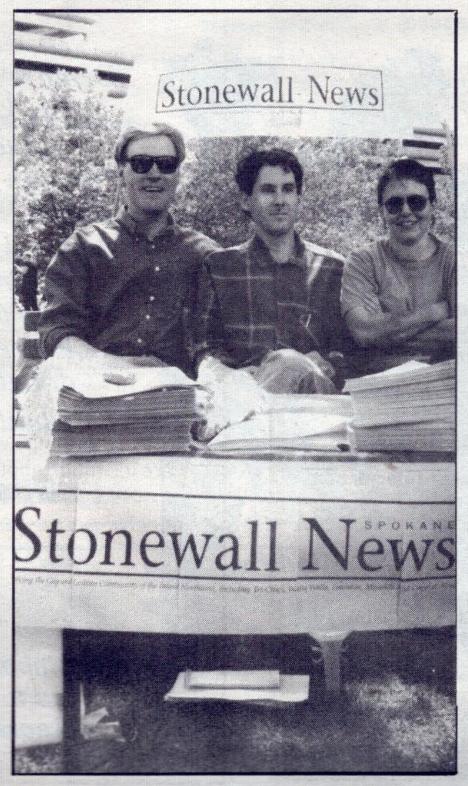
Spokane was not unique in this regard. Across the early 1990s, LGBTQ individuals faced increasing levels of social, legal, and physical harm. Reports documented a rise in anti-LGBTQ violence, including the bombing and shuttering of gay businesses. At the same time, LGBTQ parents were continually denied custody of their children while hundreds of service members were discharged annually based on sexual orientation. The vulnerability queer people faced was also evident in AIDS activism. In 1991, the activist network ACT UP organized a “Day of Desperation” in New York to protest federal inaction during the AIDS crisis, using public demonstrations to call attention to the scale of loss. In Spokane, this climate was already apparent. Just years after the city’s first confirmed case of AIDS, funding for local support services was cut. In the months leading up to the city’s first Pride march, gay bashing incidents made regional headlines, prompting the creation of a community hotline. During the same period, the Washington State Senate rejected a proposal to include sexual orientation in an expanded hate crime bill. Locally, Stonewall News Spokane, a LGBTQ newspaper, reported receiving “enormous amounts of hate mail on a weekly basis”, showing the persistence of hostility within the city.
Even so, organizers moved forward with the march. Helen Bonser, a founding member of Spokane’s chapter of Parents, Families, and Friends of Lesbians and Gays (PFLAG), recalled being told “you can’t have a parade. You can have a march- on the sidewalk”. In response, organizers established and promoted strict behavioral guidelines. Participants were to “conduct themselves with dignity in the positive spirit of pride and respect for the Spokane community.” To reinforce these expectations, internal peacekeepers were set up along the route to redirect any disruptions. Though the event emphasized peace, the police department received numerous threats, including one warning that if queer people were allowed in the streets, they would be ‘shot as they marched’. As a precaution, plain-clothed officers and unmarked police cars were positioned alongside demonstrators, with ambulances stationed nearby in case violence occurred. PFLAG reached out to Emmanuel Metropolitan Community Church, a local church that provided space for a LGBTQ congregation, for help supporting and hosting the march.
Despite these threats, around 500 members of the queer community showed up on June 7th to take part in Spokane’s first Pride march. Still, there were those among the crowd that remained apprehensive. Fearing job loss or familial retribution, many went unnamed in news coverage, with some donning paper bags or large hats to mask their identities. Yet the march itself unfolded without incident. The Spokane Chronicle reported dozens of people shouting and honking their horns in support. At the end of the route, a picnic was held in Riverfront Park, with those in attendance marking the festive atmosphere brought on by songs and celebration. Officers initially assigned to manage potential confrontations instead directed traffic. The march brought LGBTQ presence into public space without the expected conflict. Ultimately, the demonstration was noted as “a significant and historic step toward equal rights for gays and lesbians in Spokane.”
Initial reactions among Spokane residents were varied. Some were simply confused in their response, stating that they “hadn’t realized there were so many” queers living among the citizens of Spokane. One dissenter in the Spokane Chronicle called the gathering a “sodomite parade” and a betrayal from the city council. Another criticized the publication's coverage as failing to represent the greater community at large. Though the response was tepid at first, the LGBTQ community went on to establish the Odyssey Youth Group. In the following years, participation only grew. In 1993, the theme was “Our Community. Your Community. Our community.” Not only did it have a larger number of attendees, sitting at around 800, the event itself was also granted a permit to march in the streets. The mayor of Spokane, Sheri Bernard, opened the rally saying, “there’s no room in Spokane for bigotry and hatred.” By 1994, the march had over 1000 participants all moving under the banner of “Family of Pride.” In 2004, the Spokane Pride march was officially granted the status of a parade.
Files
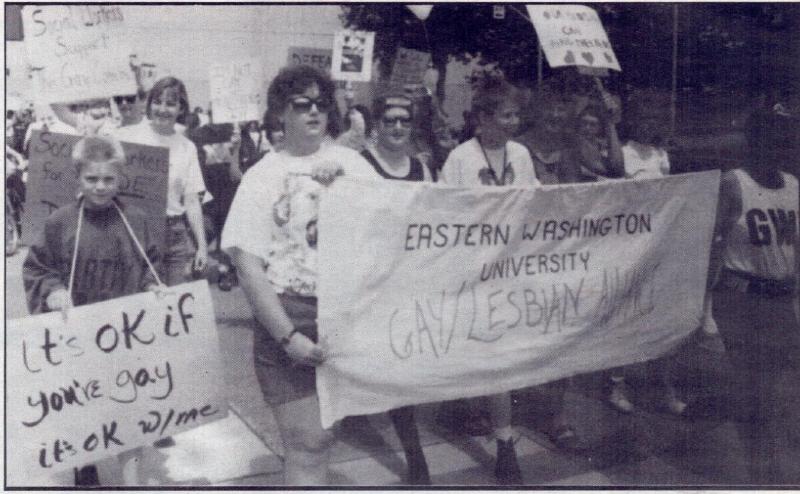
Students of Eastern Washington State University's Gay and Lesbian Alliance march in the city's first Pride event.
Even as they joined in the march, students at EWU faced threats back in the halls of their university and dorms. | Source: Image Courtesy of Stonewall News Spokane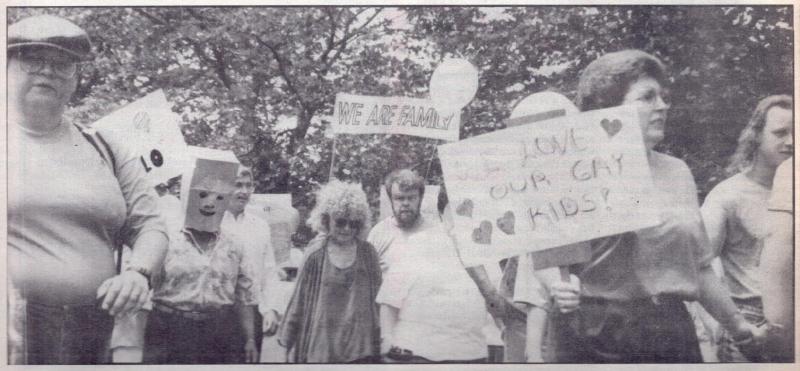
Bagged for Safety at Spokane Pride is Power march, 1992
Fearing societal backlash, some of the participants chose to mask their faces during the festivities. | Source: Image Courtesy of Stonewall News Spokane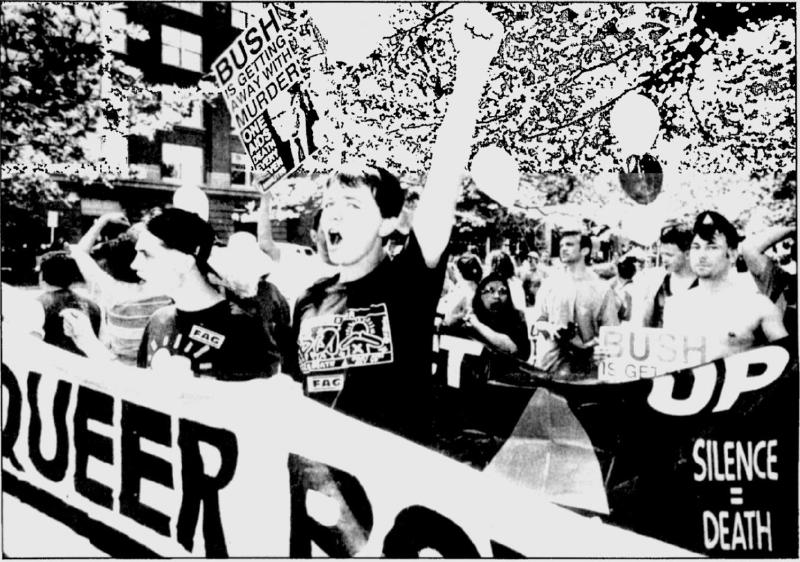
Pride is Power
LGBT activists march in solidarity in Spokane's first Pride event. | Source: Image Courtesy of The Spokane Chronicle