Fire Lookouts – From Hermit's Castles to Weekend Get-A-Ways: Fire Lookouts
The fire lookout started as a means of early detection of forest fires. Today its new role is as a week-end get-a-way.
Text
Fire Lookouts – From Hermit’s Castles to Weekend Get-A-Ways
Fire lookouts once dotted maps of the American West. In 1905 President Theodore Roosevelt created the United States Forest Service (USFS) under the Department of Agriculture. The agency was responsible for protecting America’s forests. Forest managers quickly realized that the key to suppressing wildfires was to discover them while they were still small, and rangers were sent to the top of mountains to watch for smoke. The first lookouts were primitive, being a one man pup tent near a tall tree that was climbed to look for smoke. After the devastating fires of 1910 the Forest Service made early fire detection the priority. The Civil Conservation Corp (CCC) in the 1930s was responsible for the construction of more than 8,000 towers with panoramic views around the United States. This included 989 in Idaho, 639 in Montana and 656 in Washington. The high metal towers were discovered to attract lightning, and lookouts were fitted with grounding devices after a few lightning strikes resulted in the death of the spotters. The new model of towers changed the roles of the smoke spotters for the next 20 years. They now watched for smoke; mapped the location, size and other information of the fire using the Osborne fire finder, and reported the fire to headquarters via messenger, telephone line, or radio.
The life in a lookout was solitary and took a man or woman with a strong sense of humor. A spotter at the Squawman Lookout in northeast Washington once reported monkeys were throwing coconuts at the tower. A lookout on Timber Mountain on the Colville National Forest wrote a poem in 1948:
I like FS biscuits;
Think they’re mighty fine.
One rolled off the table
And killed a pal of mine.
I like FS coffee;
Think it’s mighty fine.
Good for cuts and bruises
Just like iodine.
I like FS corned beef;
It really is okay.
I fed it to the squirrels;
Funerals are today.
The need for fire lookouts declined during the 1940s with the arrival of air patrol and modern technology. During the 1960s and 1970s most towers were abandoned, and subsequently removed to restore wilderness values and to prevent vandalism. There are 17 lookout towers that remain standing in North Idaho, and only the Middle Sister Lookout tower in the Idaho Panhandle Forest of Shoshone County is still manned (with volunteers). However, the USFS has started a new program allowing people to rent a lookout for as little as $40.00 a day at www.recreation.gov. You may not have Wi-Fi or big screen television, but the views are breath-taking. Don’t forget your camera!
Files

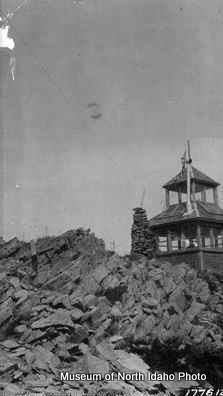
Coeur d'Alene fire lookout in 1928.
Coeur d’ Alene Mountain Fire Lookout in 1928. The tower started in 1913 as a crow’s nest. Several modifications were made until 1963 changing it to a timber tower. The lookout was gone by 1979. Courtesy of the Museum of North Idaho.
Bumblebee Lookout.
Bumblebee Lookout featured a panoramic window room with outside platform. An Osborne Fire Finder sat in the middle of the room. The tower was destroyed in 1975. Courtesy of the Museum of North Idaho.
The Middle Sisters Peak lookout.
The Middle Sisters Lookout in the St Joe National Forest was originally built in 1923 as a log cupola cabin. It was replaced in 1951 with the 35 ft tower that burned in 1953. The tower was replaced in 1954 and remains the only active fire lookout in North Idaho. The tower is manned by volunteers during the summer and fire seasons. Courtesy of the USFS Coeur d’ Alene district.
Squaw Peak Lookout in 1960.
Squaw Peak Lookout in 1960. This lookout was in the Bitterroot National Forest of central Idaho. Horses and pack animals were the only available transportation to the tower. Courtesy of the Museum of North Idaho.