Union Pacific Rail Depot: Lost Architectural Masterpiece
Unlike the Great Northern Station which has left its mark on downtown Spokane, nothing remains of the elegant Union Station instead the Red Rider Wagon play area occupies its former location.
Text
Walking in Riverfront Park today, it might be hard to imagine it any other way. However, what once occupied that space was one of the grandest, most elegant rail depots in Spokane, the Union Pacific Depot or Union Station. When former Union Pacific publicist and builder of the North Coast Railroad, Robert E. Strahorn, drove the golden spike into the ground in 1914 signifying the grand opening of Union Station, he completed a decade long plan to incorporate Spokane into the Union Pacific Railroads system. The creation of Union Station had been part of an agreement made by Strahorn, and Edward H. Harriman, the president of Union Pacific Railroads. Harriman secretly funded Strahorn's North Coast Railroad in order to boost his influence over the Washington railroads system and to keep others from beating him to it.
Union Station was constructed on the north side of Trent, now Spokane Falls Boulevard, and directly faced its rival the Great Northern Station, across the river. In fact, the location for the station was chosen because of the fact that it blocked the view of the Great Northern Station from downtown Spokane, preventing pedestrians in the area from even seeing its competitor. Union Station serviced the Milwaukee Road and subsidiaries of Union Pacific such as the Oregon and Washington Railroad Navigation Company (O.W.R. & N) and Strahorn's North Coast Railroad. A series of elevated tracks were utilized to allow the trains to come into the downtown station over the Spokane River and city streets.
While Union Pacific saw success with moving industrial materials in the area it never gained a stronghold in the Inland Empire for passenger routes. However, crowds did gather outside Union station when President Harding visited Spokane in 1923. Even with the occasional boost in passenger traffic, only eleven passenger trains came into the station daily in the 1920s. By 1953 business had slowed down with just five passenger trains stopping at the station in a day, this was further reduced to just one train arriving and departing a day by 1973.
In the 1970s the effort to recreate the city’s downtown image saw the elevated railroad tracks that once ran through the heart of the city rerouted elsewhere and in preparation for Expo ‘74, Union Station was to be demolished. The last-minute Save Our Station campaign made an effort to save both the Union and Great Northern stations. A citywide vote was held to attempt to save the stations, however, the lack of support caused the vote to fail. In 1973 Union Station was torn down. While the clock tower of the rival Great Northern Station still stands visible to the north, nothing remains of Union Station and where it once stood is now the Childhood Express Red Wagon.
Files
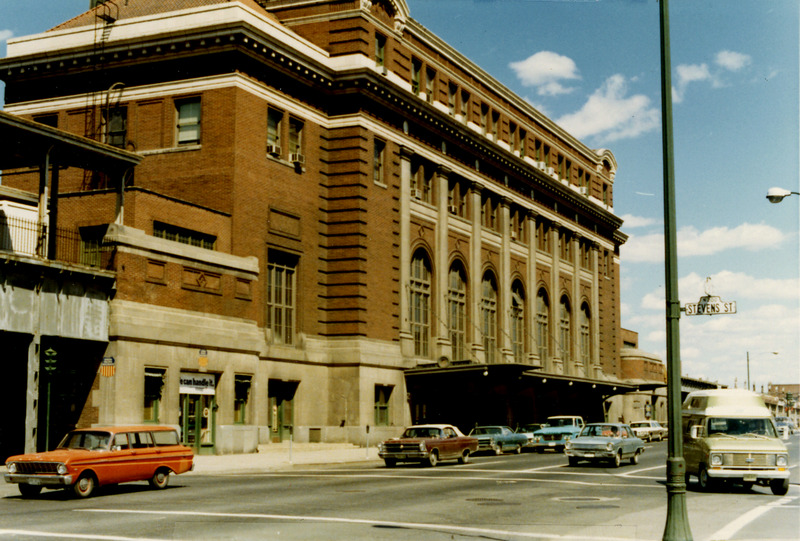
Union Station 1972
The Save Our Stations campaign fought to preserve the two stations until the bitter end. Even Reaching out to Governor Dan Evans in a last ditch attempt to keep the buildings from being demolished. | Source: Washington State Archives, Governors, Daniel J. Evans Administration, General Subject and Agency Files, Box 2S-2-636 | Date: July, 1972
Postcard depicting Union Station
A postcard showing Union Station. Trent Avenue is now Spokane Falls Boulevard | Source: http://vintagespokane.blogspot.com/2015/03/union-station.html | Date: 1920
Great Northern Station and Union Station
Union Station, seen to the right, was originally intended to be constructed elsewhere in town but designers opted to place it in the middle of downtown in order to block the view of rival Great Northern from the city center. | Source: Spokane City Historic Preservation Office Photographic Collection, Office of the Secretary of State, Washington State Archives, Digital Archives, http://digitalarchives.wa.gov, Spokane Municipal Government, Historic Preservation, General Photographic Collection, 1900-1974, Eastern Regional Branch, Washington State Archives, Cheney, WA. https://www.digitalarchives.wa.gov/Record/View/2594008A8A777CF1D9A70866BD6D3CB2
Dedication of Union Milwaukee Trestle
In order to get trains into Union Station Union Pacific and the Milwaukee Road created an elevated trestle that passed directly over the Monroe Street bridge. The dedication of the Union High Bridge on Sept 16, 1914 marked the completion of Union Station. The use of elevated trestles was necessary due to Robert Strahorn's bold, yet impractical idea to place the station in the center of downtown. | Source: Spokane City Historic Preservation Office Photographic Collection, Office of the Secretary of State, Washington State Archives, Digital Archives, http://digitalarchives.wa.gov, Spokane Municipal Government, Historic Preservation, General Photographic Collection, 1900-1974, Eastern Regional Branch, Washington State Archives, Cheney, WA. | Date: September 16, 1914
Interior of Union Station
Union Station was designed every intention of being more grandiose than the Great Northern Station, with high ceilings, large arched windows, and grand chandeliers. The waiting area was on the second floor and accessed through a large staircase from the lobby below. | Source: Quinn, Jerry. “The Effort to Save the Union Station in Spokane..” Evergreen Railroad Club, 14 Nov. 2011, evergreenrr.blogspot.com/2011/11/effort-to-save-union-station-in-spokane.html.