Carving a Legend: What remains of the 1977 Leonard totem pole
There were once two totem poles on this island in the river. This is the story of the one that is gone.
Text
Setting the Stage
In November of 1969, two unprecedented candidates were in contention for the position of City Council Member for Spokane's District 1: James E. Chase, who had spent much of the past two decades as head of the Spokane NAACP, and Margaret J. Leonard, a community organizer and accountant who was usually described in contemporary newspaper articles as "a housewife." The race was a nail-biter: fewer than a thousand votes ultimately separated the winner from the loser. In the end, it would be Leonard who took office later that month, becoming Spokane's first female member of city council. Chase's time would come a few years later: he became Spokane's first Black city council member in 1975 and Spokane's first Black mayor in 1981.
Margaret J. Leonard served on the council for several terms, concluding her service in 1977 in order to run for mayor. 1977 was also when she first encountered a man called Chief Wobay Kitpou at an event sponsored by the Inland Northwest Big Game Council (later the Inland Northwest Wildlife Council). The precise details of the conversation were not recorded, but Leonard announced on April 14, 1977 that "she and two members of the Inland Northwest Big Game Council, Kent Hall (sic) and William B. Rollins Jr. have persuaded the owners of a large totem pole to donate it to the city."
Kitpou had evidently encountered Leonard at the INBGC event and offered to turn a large, uncarved cedar pole into a totem pole "as a goodwill gesture." The Parks Board accepted the proposal, noting that the totem pole would be carved for free by "Chief Wobay Kitpou, a shaman, or medicine man, of the Algonquin Indians and a member of the Canadian Parliament from Nova Scotia." Kitpou later acquired a local assistant, Colville tribe member and District 81 curriculum specialist Michael Paul, to participate in the pole carving.
Creating the Pole
The totem pole carving took place on the Howard Street bridge in Riverfront Park. The first cuts into the wood were made on August 15, 1977. They were hewed by Margaret Leonard herself (with some assistance from Kitpou and Paul). For the occasion, the councilwoman had dressed in "a red Indian overblouse with leather ties." According to a Spokesman-Review reporter, "the first figures to be cut at the top of the pole represent 'two men creating this for a woman.'" Kitpou added, "we call her Mayor, we are so sure." Other symbols on the totem pole were intended to represent "the wisdom of the tribes."
The carving and painting of the pole went rapidly, as Kitpou and Paul used chainsaws rather than traditional hand tools. It was raised into place only eleven days later, on August 26, and was formally dedicated on August 27th, 1977. This occurred in conjunction with a parkwide Harvest Festival, and activities on Canada Island included "displays of Native American foods, arts, crafts, and entertainment." Now there were two totem poles on Canada Island.
Who was Wobay Kitpou?
Algonquin Chief Wobay Kitpou was a Canadian man also known as James Albert Munster. Munster abruptly "went total Indian" (his wife's words) one night around 1960 when he walked into the woods and had a vision. He assembled his own ensemble of regalia, began introducing himself as Wobay Kitpou, and began describing himself as both a chief and a shaman or medicine man.
Kitpou's claims over the years included that he:
- Attended Eton, Cambridge and Oxford, where he was a star rugby player.
- Was a member of the Canadian Parliament.
- Earned a PhD in psychology.
- Served in both the Canadian and British navies.
- Commanded his own 37-man naval vessel.
- Spoke Algonquin, Micmac, Chippewyan, Ojibway, Penobscott, Abanaki, "some Cree," "can manage in Blackfoot" and "the now-defunct language of the old Algonquin chants."
- Served as a medical translator in Frobisher Bay, Goose Bay, and Greenland.
- Was born a shaman.
- Inherited his shamanic powers from his father in 1952.
- Learned his shamanic abilities as a young man from his grandfather, who lived to be 104.
- Was born to indigenous parents and adopted as an infant by a white couple, thus growing up without any knowledge of his heritage.
- Grew up living with his indigenous family and was close with his father, a tribal chief who eventually gave custody of him to his honored friend, King George V.
- Lived for "between eight months and two years" each with the Navajo, Apache, Cree, Yellowknife, Dogrib, and Samwin.
- Descended from 16 generations of shamans and chiefs.
- Personally met Queen Elizabeth II and other members of the British royal family four separate times.
- Had an extensive career in television and film while on leave from his Navy service, appearing in Little Big Man, Stagecoach, Wagon Train, The Warriors, Rifles '66, How The West Was Won, F Troop, A Man Called Horse, and Indian Paint,
- Survived the London Blitz.
- Was one of only 12 survivors of the sinking of the HMCS Louisburg.
- Inherited his light skin and blue eyes from a Norse great-grandmother who married into a local tribe in the 1700s after being shipwrecked.
Some of these claims have a kernel of truth (such as his navy service), some are unfalsifiable, and others are easily disproven. For instance, in 1972, Kitpou claimed that he had played "the medicine man" on NBC comedy F Troop (1965-1967). This character was actually played by vaudeville veteran Edward Everett Horton. Similarly, Munster is not listed as being among the survivors of the HMCS Louisburg - of whom there were far more than 12.
The cornerstone of Chief Wobay Kitpou's appeal was his ability to produce an endless stream of intriguing but fact-free statements about "Indian ways." In Spokane, he told people that it was "bad luck to measure the height" of a totem pole. In Minneapolis, he told people that by tribal law, a totem pole "belongs to all children under the age of 12 for 50 miles around." He claimed that "an eagle is always on top of the pole" and that the symbols on totem poles exist to "explain behavior patterns." He said that Native women had been using marijuana during childbirth for hundreds of years and that all true peace pipes contain marijuana. He also said that the indigenous peoples of North America were one of the lost tribes of Israel and that Vikings taught Algonquins how to smelt copper.
Kitpou often positioned himself as the sole surviving keeper of traditional knowledge, claiming that he was the only man alive who could translate "ancient Indian pictographs" and that he possessed the "only five remaining rolls of tribal laws belonging to the Indian nations." These last were sometimes also described as tablets, and depending on when he told the story, he either found them buried in the earth or hidden inside a Catholic church that was built by Algonquins.
An article in the June 1972 Micmac News describes a harrowing experience in which Kitpou had won the trust of a married couple who ran a shop called Indian Crafts. According to this story, he had ransacked their shop and also cleared out a back room that was being used to store powwow regalia and props, using their own car to transport the stolen goods. At the time of the article, the author had recently received "a letter from British Columbia asking for information about a Shaman Kitpou who he is considering to employ as he is interested in opening a longhouse museum in which he, Mr. Maybee, is to provide the funds and Munster Kitpou is to provide the collection. (The collection the man mentions is genuine and consists of artifacts from Indian people taken from them by Munster Kitpou.)"
Kitpou surrounded himself with artifacts of questionable provenance and age in his mobile museum, a.k.a. the "Rolling Reserve." He claimed at various times to have a medallion that was presented to his ancestors by William of Orange in 1630, a belt buckle from Custer's Last Stand, and a 200-year-old peace pipe (sometimes billed as 400 years old) that was once smoked by Queen Victoria. Some items from his collection were donated to various museums and cultural archives. Today, for instance, the Smithsonian's American Indian Museum has several items that were acquired from Kitpou, all now listed as "probably Non-Indian" in origin. Considering the account in the 1972 Micmac News, is likely that some of the objects Kitpou owned were genuinely crafted by indigenous artists. By rebranding them with invented ages and origins, he severed them forever from their original creators and contexts. Given Kitpou's long relationship with MONAC, many of his fabrications were likely also absorbed into the archives of the Northwest Museum of Arts and Culture after MONAC's closure.
Afterward
Margaret J. Leonard did not become Spokane's first female mayor, although she did represent Spokane in the state legislature. Kitpou continued to revisit Spokane over the years, presenting at school events and carving four more totem poles with Michael Paul for the Museum of Native American Culture (MONAC) in 1981. When Michael Paul died in 1993, the Spokane school district named its "Indian education resource center" after him.
Public interest in the Leonard Totem Pole rapidly waned. In 2010, a Parks employee named Scott Brunell refurbished and repainted the dilapidated Leonard pole as "a labor of love," using donated tools and materials. An article about his efforts suggests that knowledge of the totem pole's origin was already lost: "Even though the pole is looking better, no one is really sure what it means, says Larry Carey, an Inland Northwest Wildlife Council member."
In 2016, the Spokane Tribe was granted certain rights and authorities over Canada Island, which included renaming it to Snxw Meneɂ (Salmon People Island). The Leonard totem pole was abruptly and unceremoniously removed from the park in 2019, with a chainsaw used to separate the top of the pole from the base. The reason for its removal was disputed, although spokespeople for the Spokane Tribe and the Parks Department agreed that the totem poles on the island had been "part of the broader discussion" about the Spokane Tribe's management of the island. Kent Hull, one of the original Inland Northwest Big Game Council members who helped arrange the donation, took custody of the top part of the pole.
It requires access to dozens of Canadian and American newspaper articles to lay bare the extensive contradictions in Kitpou's public statements. As a result, there are still many believers in the Kitpou legend - even though he didn't always believe in it himself. According to a 1971 article: "He says some people have doubted him. They look at his pale skin and blue eyes and wonder what the hell he is doing in 'that monkey suit.' And he says there is a time when he might have admitted it all to himself but he has earned the respect of too many tribes since then. [...] 'This headpiece is 140 years old and belonged to my grandfather,' he said. 'At least I believe it did and I'm happy to accept it.'"
The concrete base of the Leonard pole, with encased stump, is still present on the island today.
Files
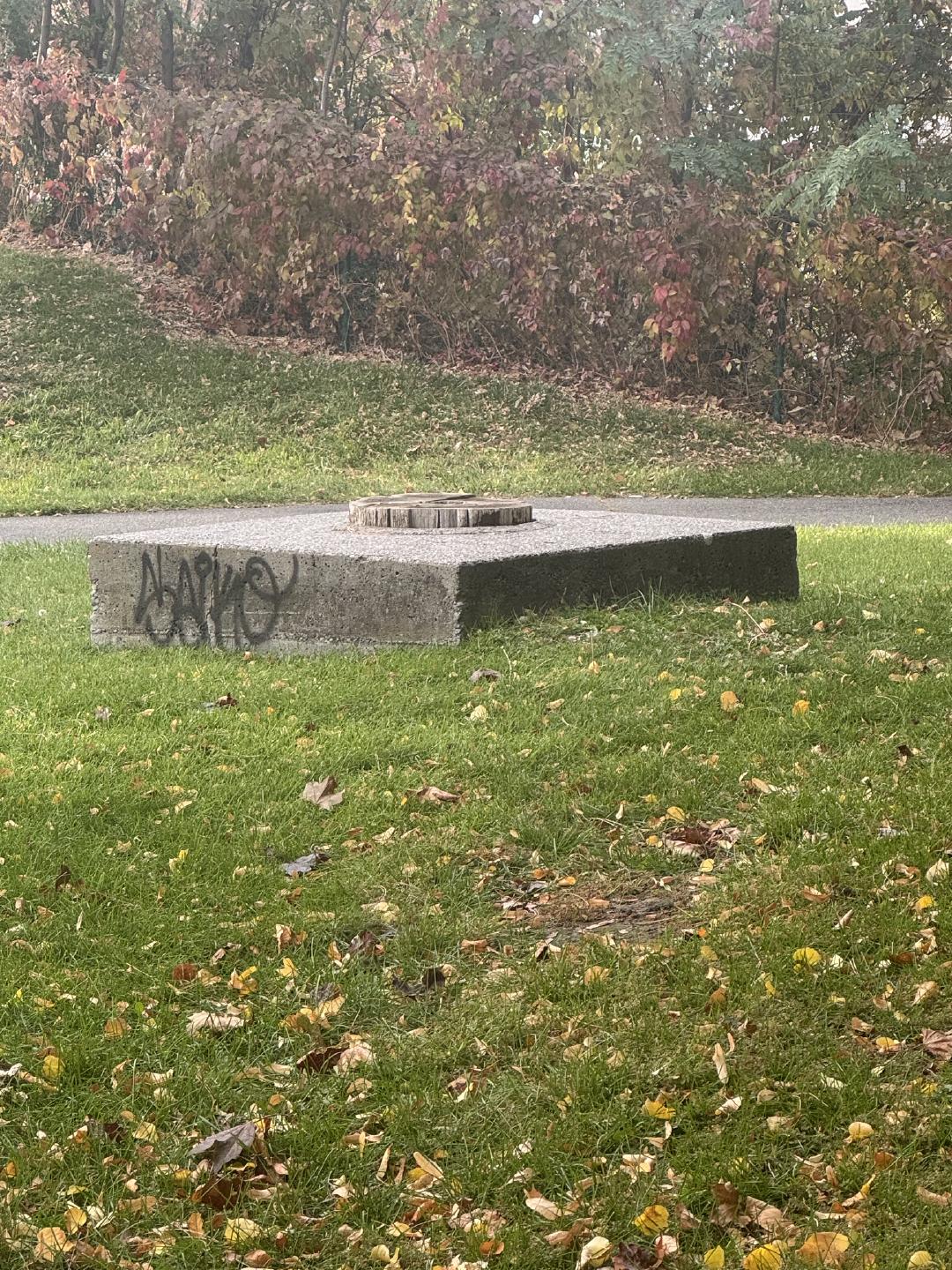
The concrete base and stump of the Leonard totem pole.
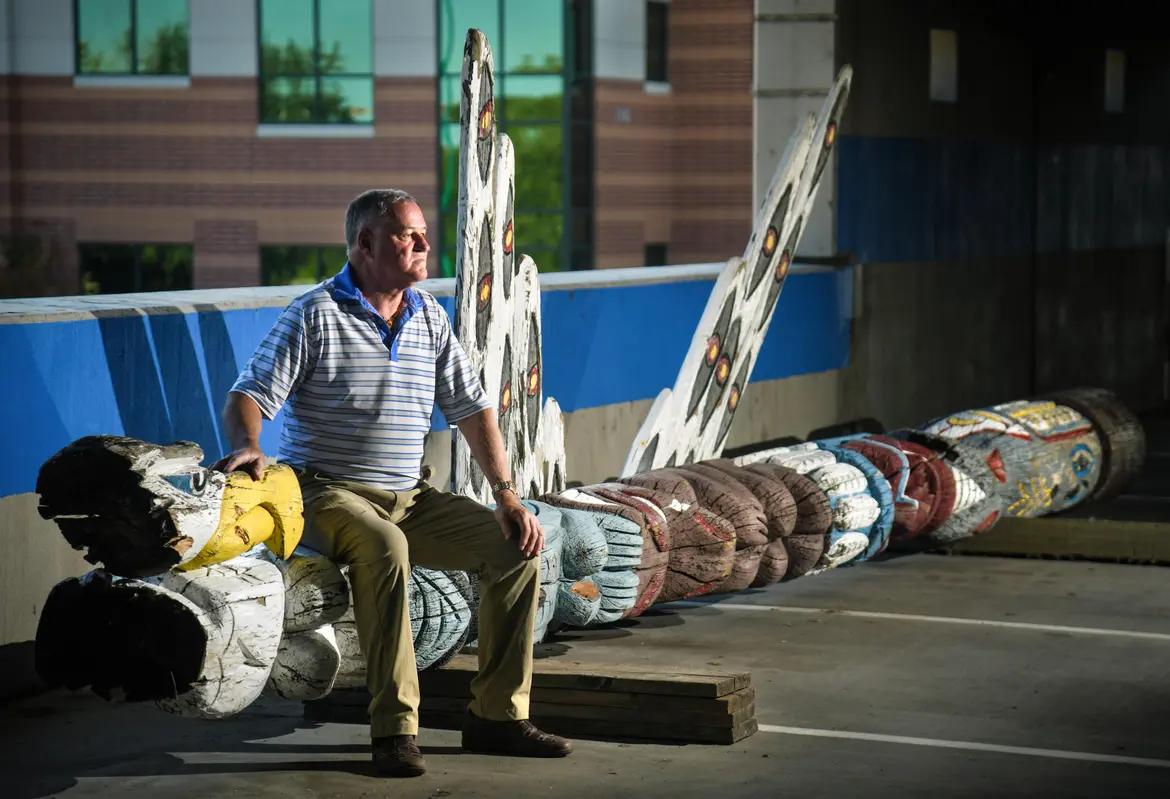
This 2019 photograph from the Spokesman-Review depicts the totem pole after its removal. The man seated on it is Kent Hull, one of the original organizers of its donation.
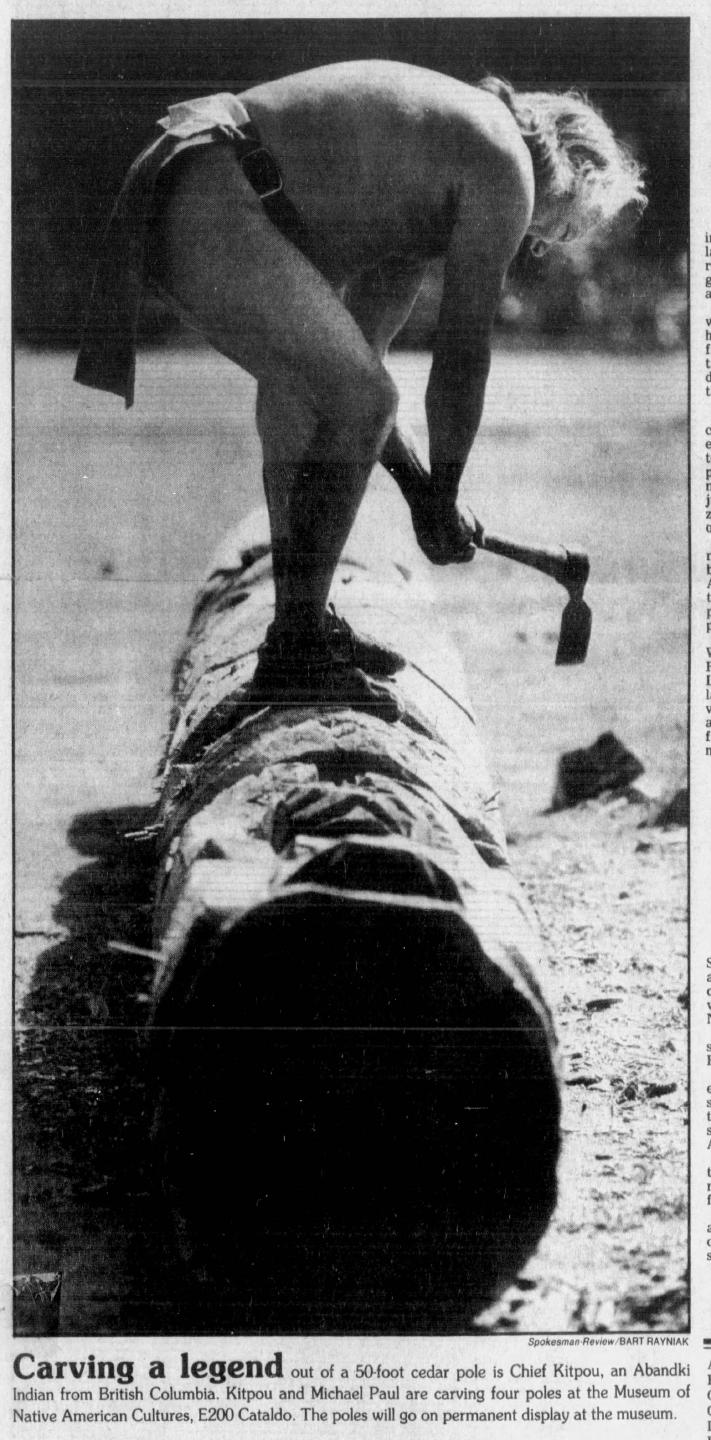
Kitpou in 1981, working on one of four additional totem poles that he and Michael Paul would present to MONAC.
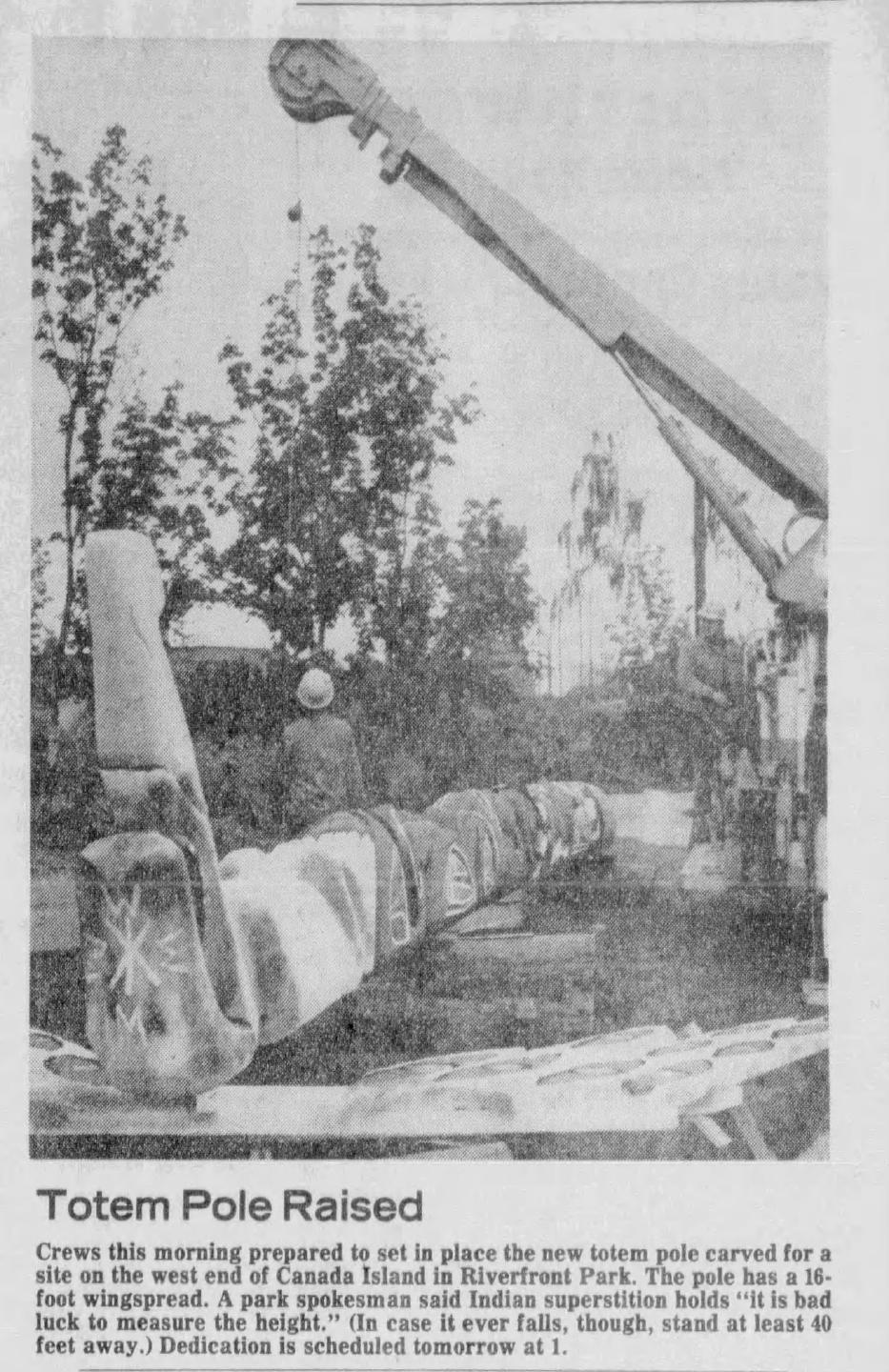
"Totem Pole Raised." (August 26, 1977). Spokesman-Review, p. 5.
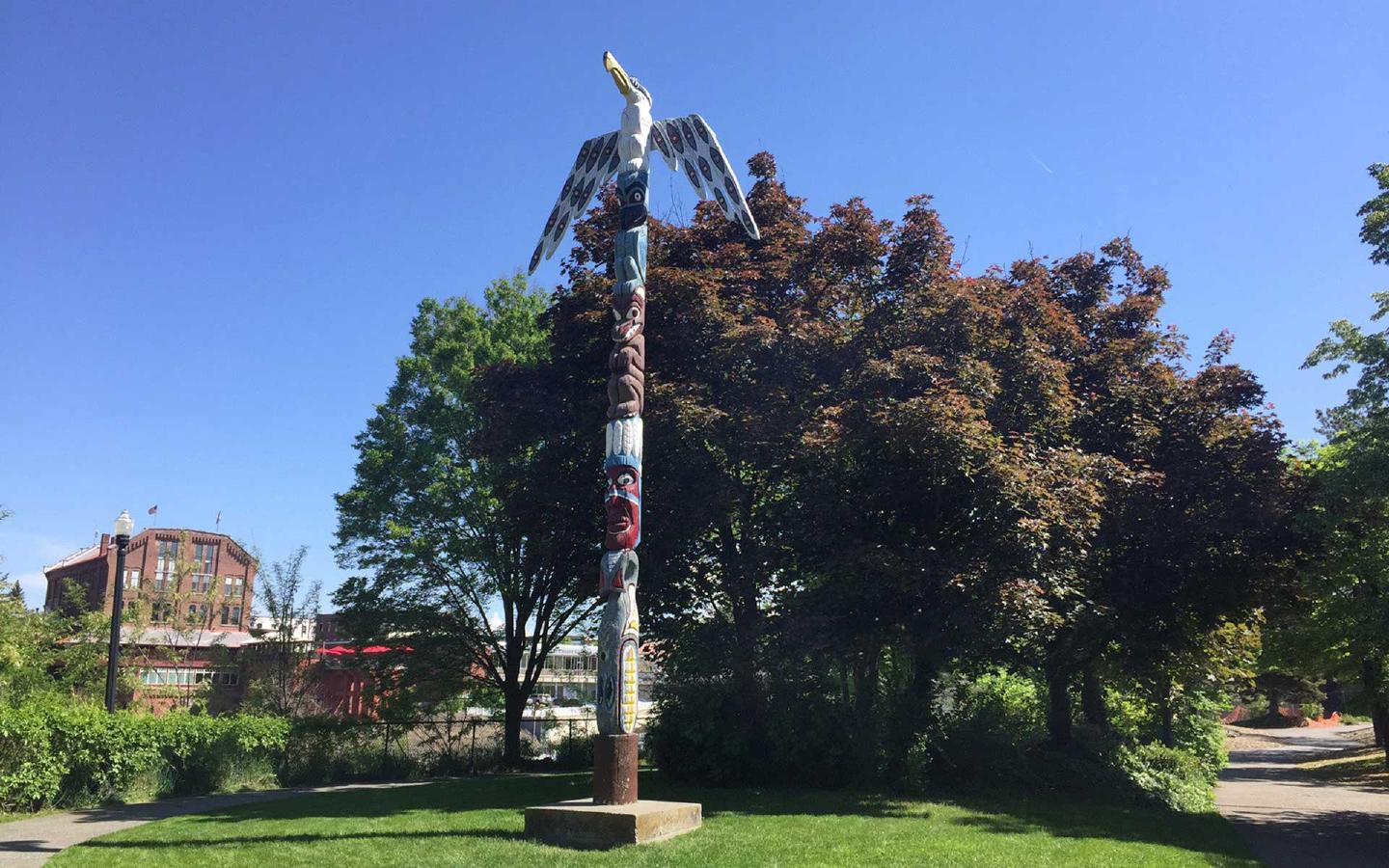
Undated photo of the Leonard totem pole.
Source: Originally published as part of the City of Spokane's 2019 press release about the removal. Retrieved August 30, 2026 from: https://my.spokanecity.org/news/stories/2019/03/20/second-totem-pole-will-return-to-inw-wildlife-council/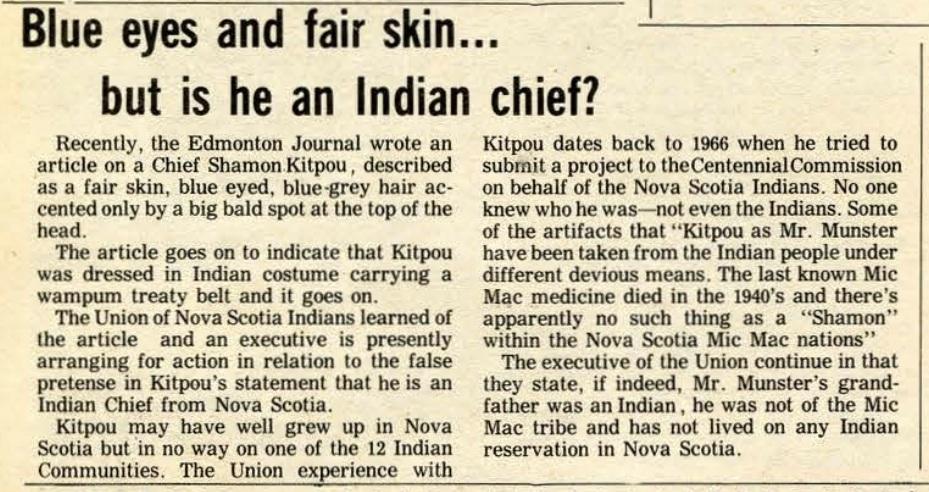
This article from the April 1972 Micmac News gives a Native perspective on Kitpou.
Source: The Micmac News (1965-1991) is fully digitized and available online at the Beaton Institute: https://beatoninstitute.com/micmac-news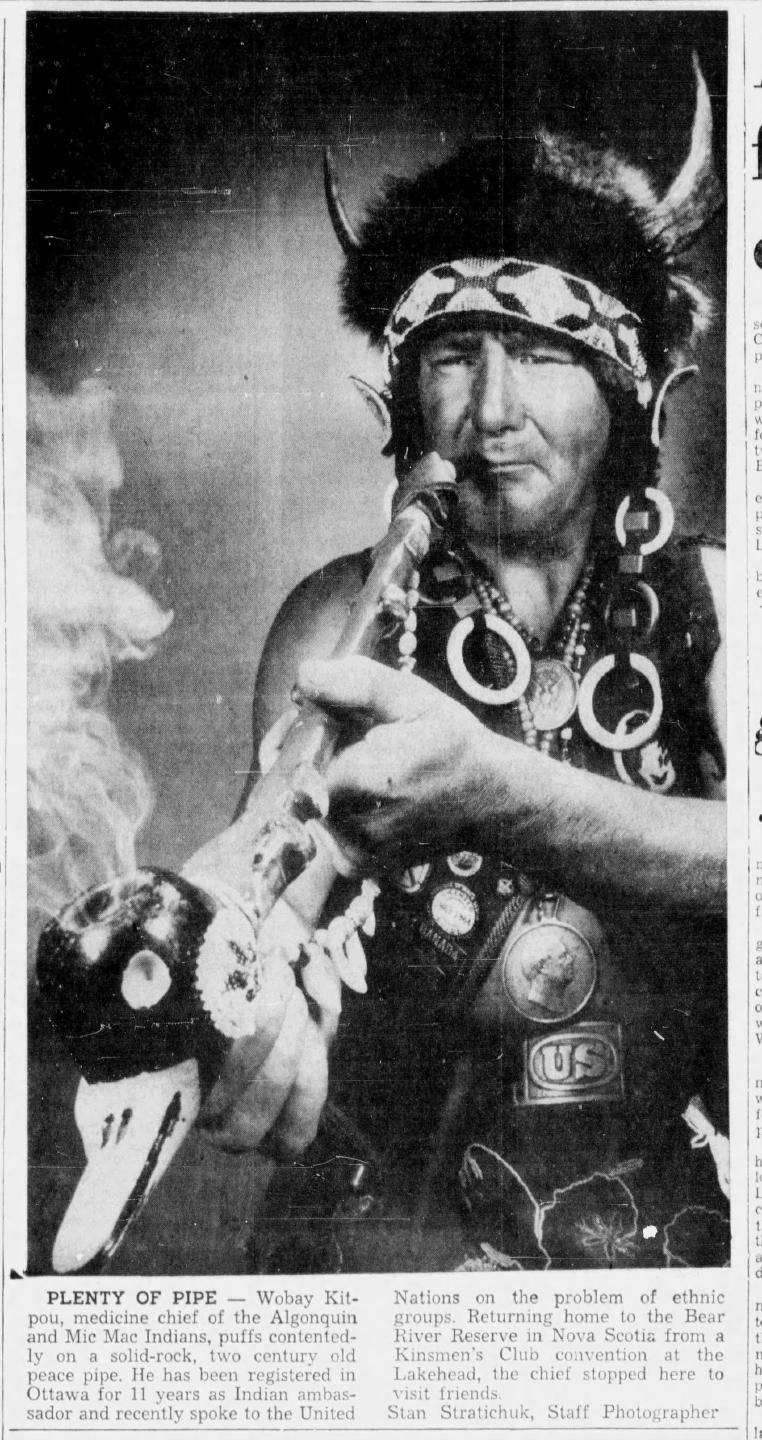
Kitpou is pictured here with the allegedly centuries-old pipe that he claimed was once smoked by Queen Victoria. The belt buckle with "US" is claimed to be from Custer's Last Stand.
Source: Originally published as "Plenty of Pipe," (September 8, 1966). The Sault Star, p. 17.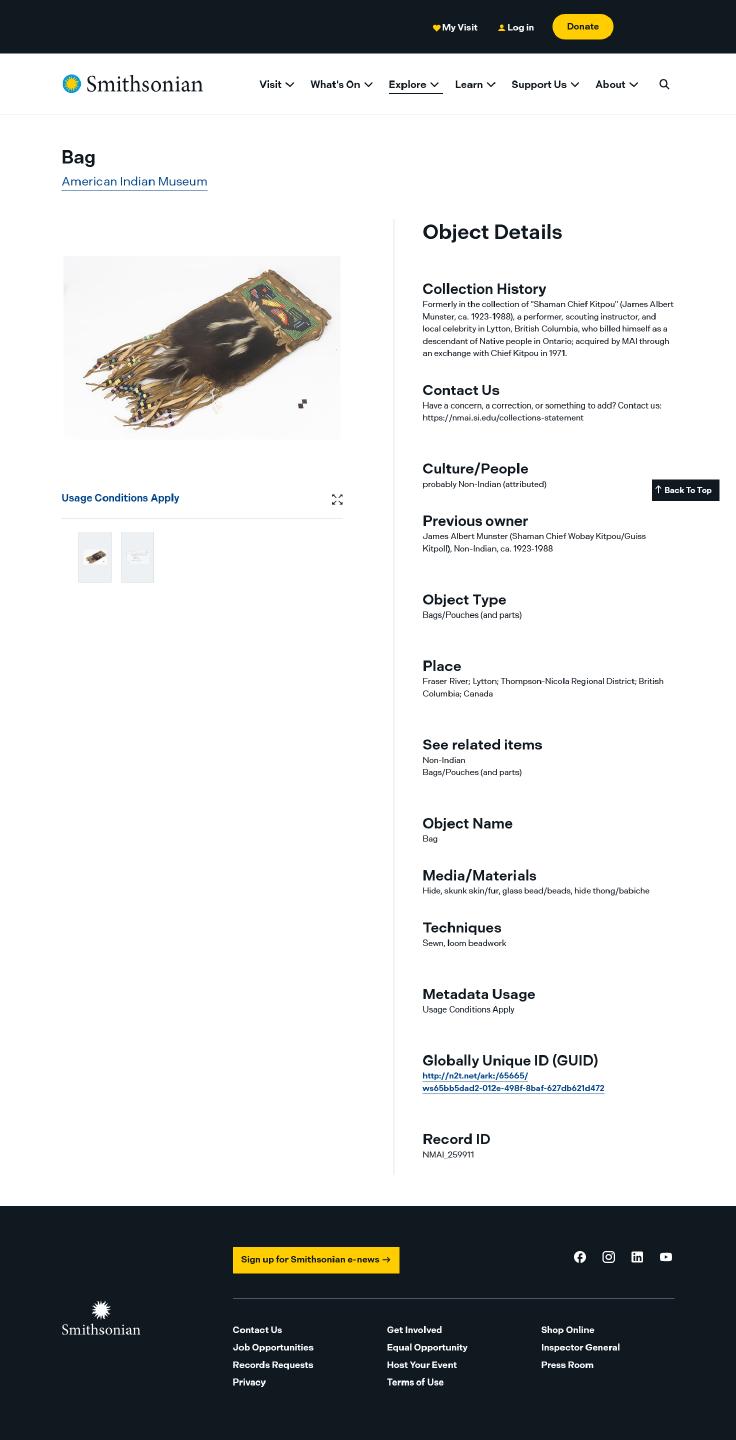
An item from Kitpou's collection as listed by the Smithsonian Museum of the American Indian in 2026.
Source: Accessed August 30, 2026 from https://www.si.edu/object/bag%3ANMAI_259911| File Details | Download |
|---|---|
This page from the June 1972 Micmac News describes a troubling experience with Kitpou.Source: The Micmac News (1965-1991) is fully digitized and available online at the Beaton Institute: https://beatoninstitute.com/micmac-news | Downloadpdf / 816 KB |