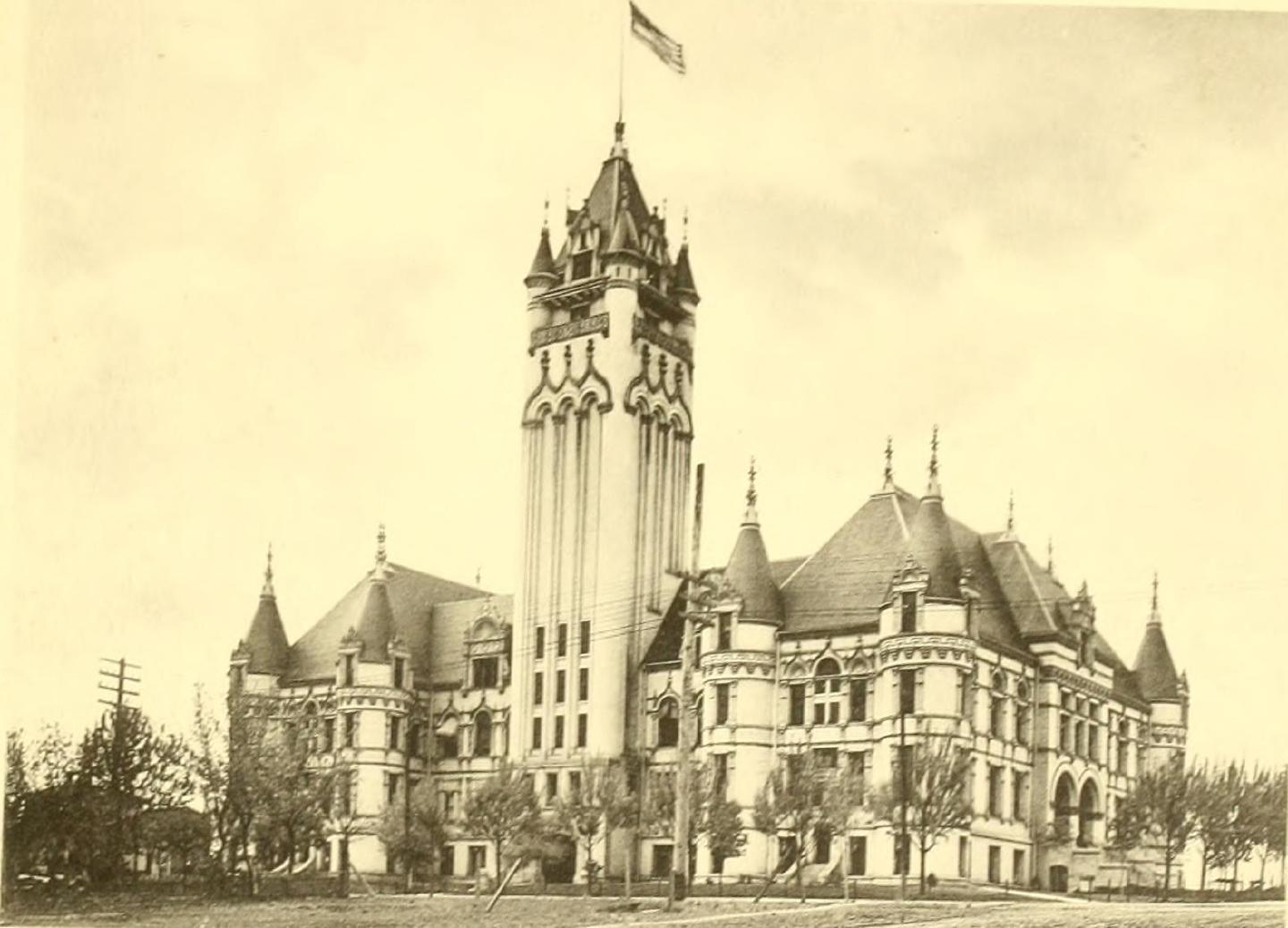
Spokane's "Mayor for a Day" (Who Never Was)
The little-known (and utterly fictional) tale of Spokane's "mayor for a day," Josiah Forsyth.
Text
In 2025, a mysterious item surfaced online in Spokane history circles: two pages of typewritten text, photocopied at a slight angle, containing the intriguing tale of "Spokane's Unknown Mayor."
According to this document, in 1883, the great men of Spokane Falls had a problem. Their fine town was to be visited by the territory's governor, Elisha P. Ferry, on a day when the mayor would be out of town. Fortunately for these concerned city fathers, "there was in Spokane Falls at this time, a Shakespearean troupe [...] Mr. Josiah Forsyth, well known among mining camp and western frontier towns for his "Hamlet" and "King Lear", was prevailed upon to act as mayor pro-tem for the Governor's visit, and to be the key-note speaker for the day's festivities."
The piece explains that Forsyth performed his mayoral duties with great aplomb. Sadly, it seems he celebrated his successful performance too enthusiastically and fell into the river while inebriated. His acting troupe moved on without him, and his body was discovered a few weeks later and interred in Greenwood Cemetery under his stage name, as his real one was unknown.
According to the author, "the story might have ended there, but for the construction of Spokane County's new courthouse in 1894." It seems the architect of the courthouse, one Mr. W. A. Ritchie, desired to emulate European cathedrals and castles by interring Spokane's deceased civic leaders beneath the courthouse. Meeting with little support for this proposal, he arranged to have Josiah Forsyth removed from Greenwood and relocated to the courthouse burial vault instead, honoring Forsyth's role as Spokane's "mayor for a day."
Searches of early Spokane newspapers reveal no trace of a man named Josiah Forsyth. While the territorial governor did briefly visit Spokane in 1883, the man holding that office at the time was William A. Newell, not Elisha P. Ferry. Newell visited Spokane in September 1883 during a rolling celebration of the Northern Pacific line's completion. James N. Glover was demonstrably in town on that occasion and served as chairman of the associated festivities.
It turned out that the secret to this strange tale wasn't hiding in a newspaper article from the 1880s, but in an article from a century later. On October 14, 1985, Spokesman-Review staff writer Jim Camden revealed the truth in an article titled, "Former county employee fabricates a 'Forsyth saga'." According to Camden, the tale "was dreamed up nearly two years ago by an employee in the County Assessor's office." This anonymous former deputy assessor originally had told his co-workers that "they've got old county officials down there" in the courthouse basement. When these co-workers were skeptical, the prankster "went home and typed up the story on an old manual typewriter, added a letter-press headline, and brought back the story of Josiah Forsyth. He says he later confessed to his co-workers that the story was a fake. But by then the miracles of modern photo-copying had taken over and the story was circulating through the courthouse, minus any disclaimer."
The story came to the attention of county elections superintendent Tom Wilbur, who in turn passed it along to Pat Griffin when she was developing the Spokane Trivia Game in 1985. As one of the juicier tidbits of Spokane trivia, the Forsyth tale was repeatedly brought up in public conversations about the game. When it was highlighted by KHQ's show, "PM Magazine," the original creator of the tale realized that his office prank had spread further than he could have imagined.
Camden reported that the man who invented Josiah Forsyth "wishes at this point to remain anonymous. He doesn't fear any reprisals, but says he's having too much fun watching the story go around to have his name revealed." The man was quoted as saying, "I'm kind of getting a bang out of it. This may be the only thing I've ever done that may outlive me."
Forty years later, someone came to the Spokane History Researchers Facebook page with a question. "This article was found while going through some files at work, at Spokane County, though we have no idea where it came from," wrote Carson Harris. "We have tried looking everywhere from news articles to Google Scholar and haven’t been able to find its source. [...] Has anyone heard of this story?" Just as the original prankster hoped, the Forsyth saga had survived to puzzle another generation.
The original tale concludes, "Today, somewhere beneath Spokane County's grand courthouse lies a former Shakespearean actor, who worked under the stage name Josiah Forsyth, his real name known but to God. He is now all but forgotten to history, but having served as mayor for one brief, shining moment, he can truly be called Spokane's 'unknown mayor.'" While Forsyth's bones never truly rested there, he will haunt the courthouse for many years to come... or for however long it takes for the last stray photocopy of his legend to be removed from the county's file cabinets.
Files
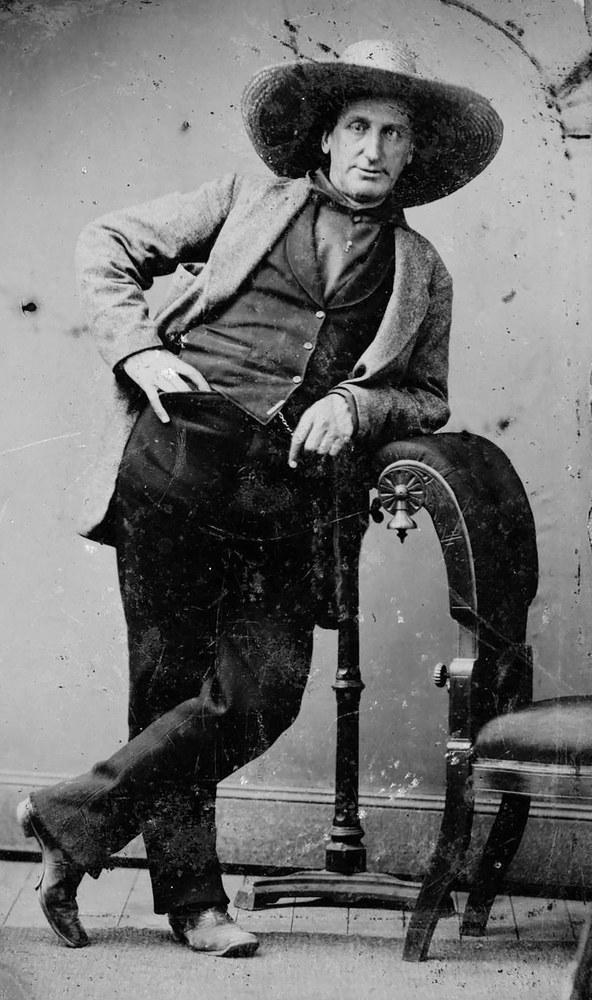
If Josiah Forsyth had any real-world equivalent, it was the actor John Sewell Folds, better known by his stage name of "Jack Langrishe."
Langrishe was well known for his Shakespearean roles and was said to have played in every town in the west during his long career. Like Forsyth, he was known for his 'Hamlet.' Like Forsyth, he performed in Spokane in 1883 to great acclaim. Unlike Forsyth, he did not drunkenly fall into the Spokane River and drown. Langrishe retired from acting in 1885 and settled in Coeur d'Alene. He was elected as an Idaho state senator in 1890. | Source: Originally from Dakota Images, retrieved September 13, 2026 from https://www.sdhspress.com/journal/south-dakota-history-52-4/dakota-images-jack-langrishe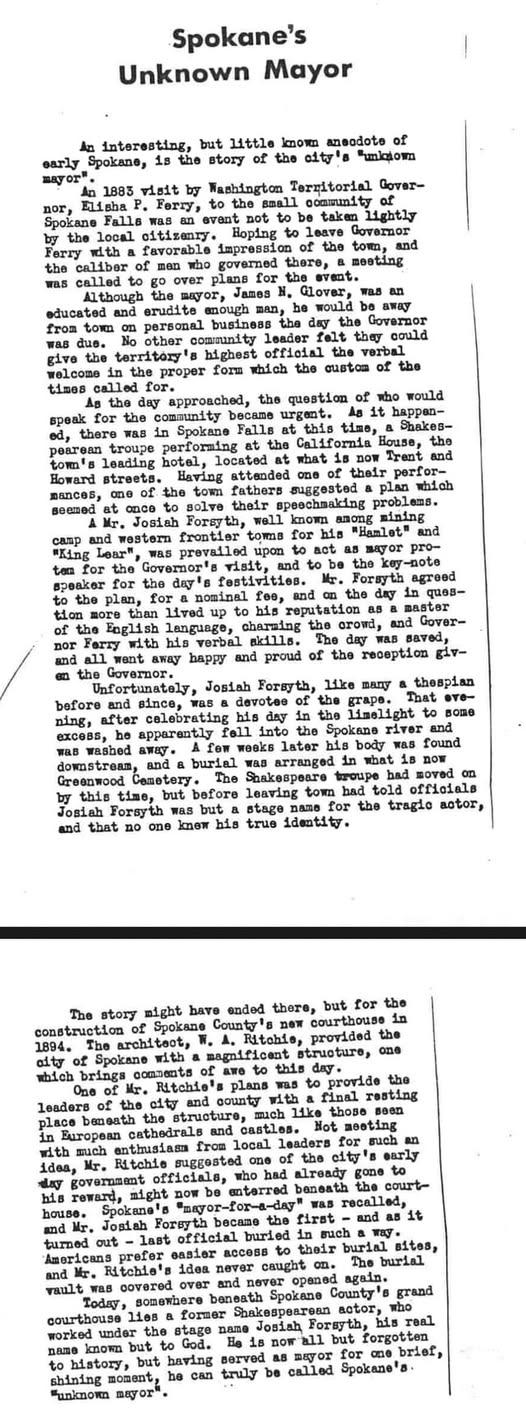
"Spokane's Unknown Mayor"
A digital copy of the original hoax, shared on the Spokane History Researchers page by Carson Harris in March 2025.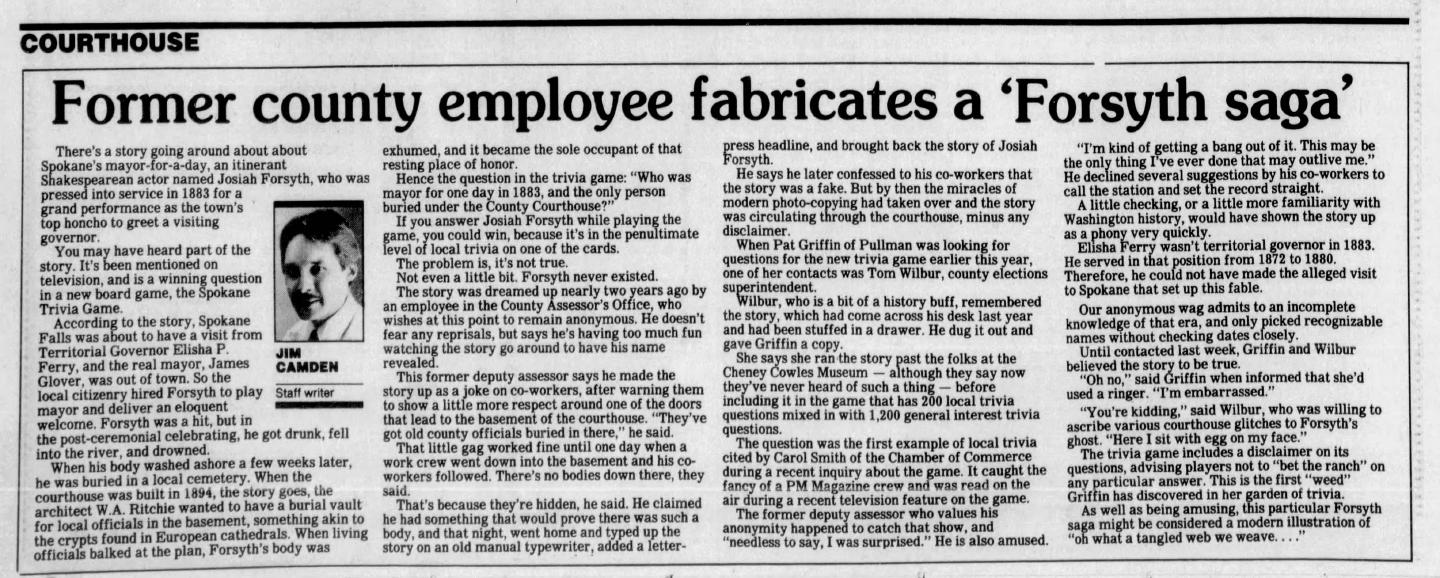
1985 Spokesman-Review article explaining the hoax's origin.
Camden, Jim. (October 14, 1985). Former county employee fabricates a "Forsyth Saga." Spokesman-Review, p. 6.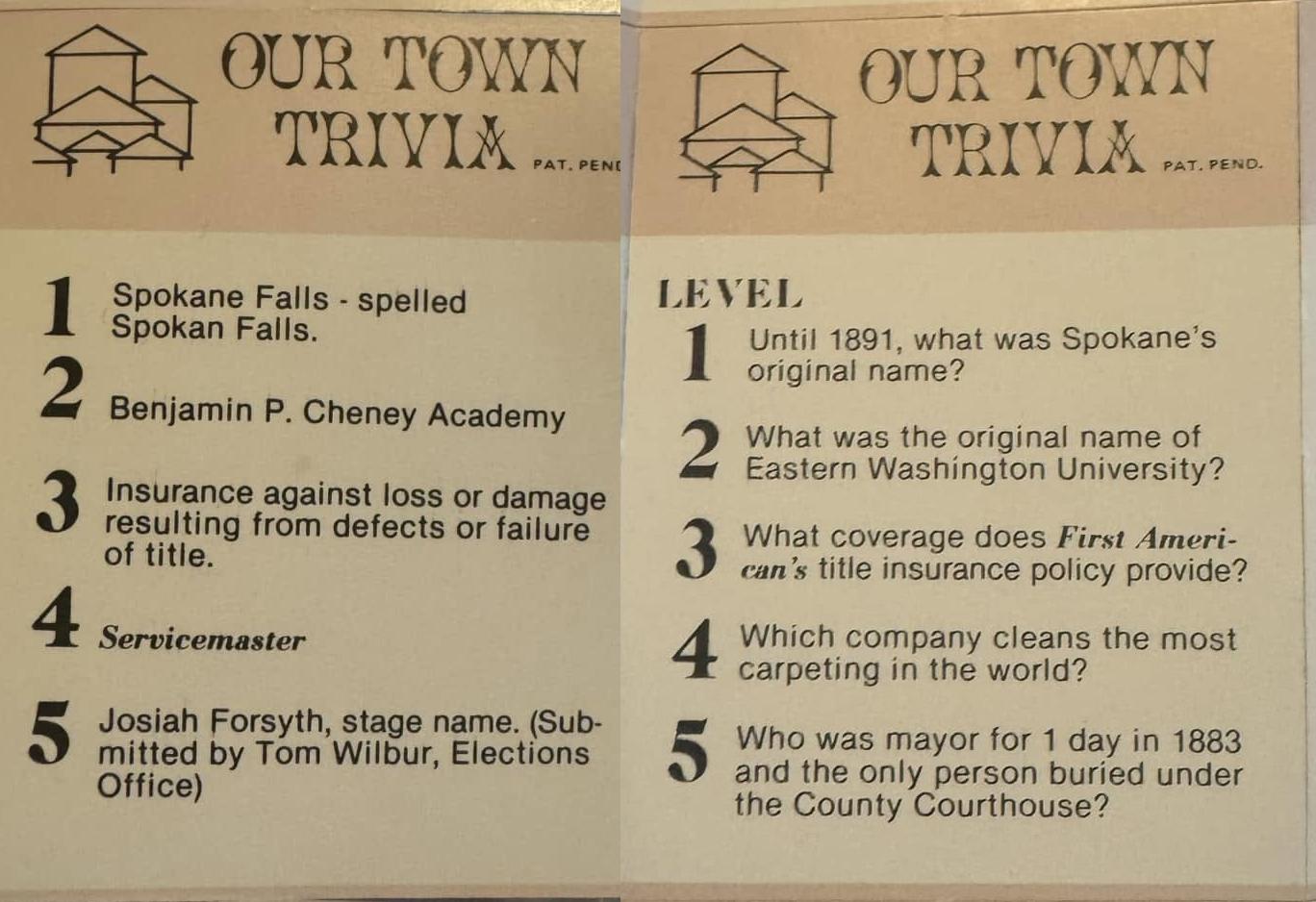
The "Our Town" trivia card where the hoax was repeated.
Source: Author's own photo.